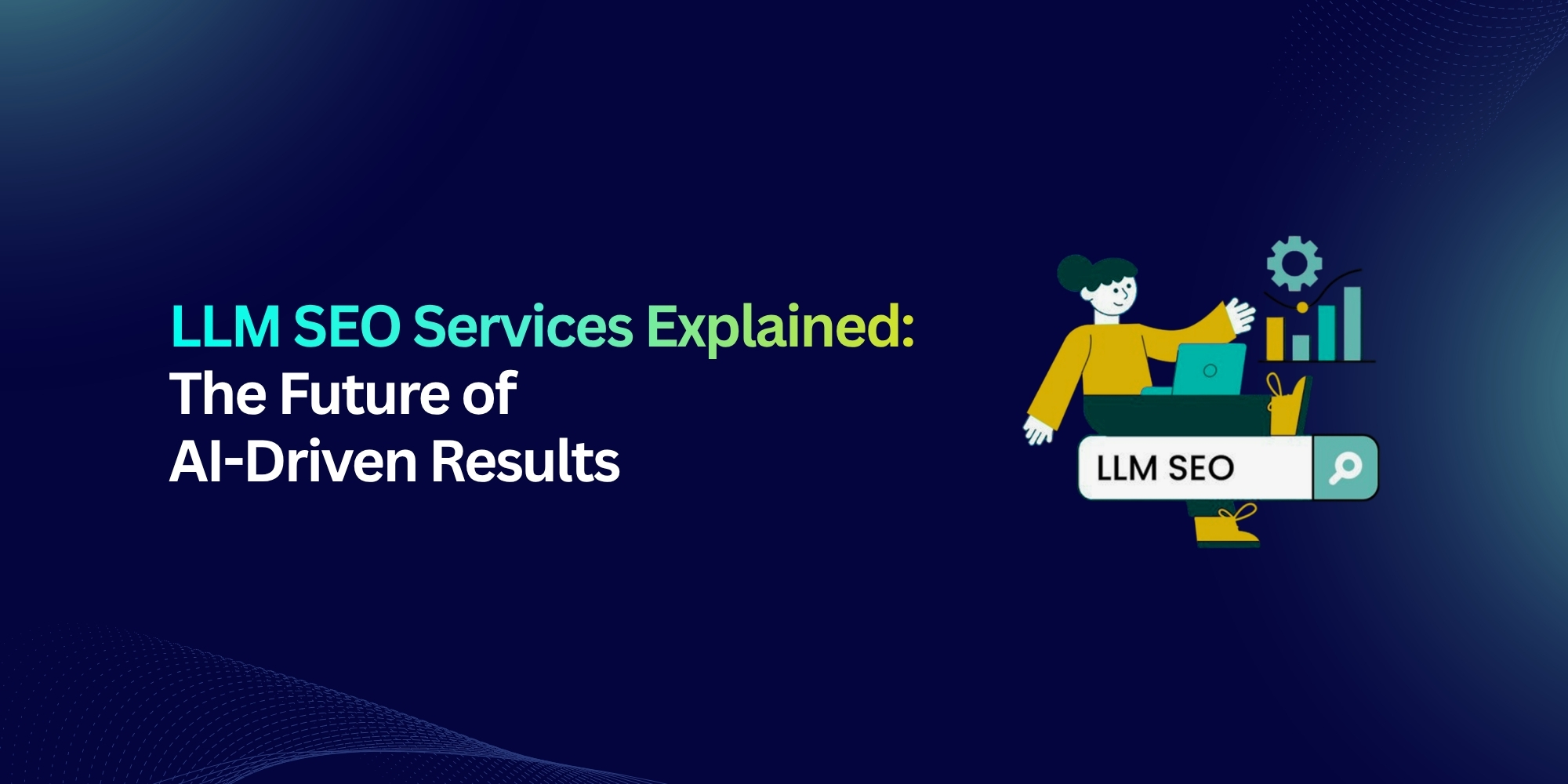
LLM SEO Services Explained: The Future of AI-Driven Results
LLM SEO services are reshaping how businesses get discovered online. As AI models like ChatGPT, Google Gemini, and Perplexity become primary research tools for millions of users, optimizing for large language models is no longer optional , it is the next frontier of organic visibility.
Key Takeaways
What are LLM SEO services?
LLM SEO services are specialized optimization offerings that help businesses get discovered, cited, and recommended by large language models , ensuring their content is not just indexed by search engines but actively used as a source when AI systems answer user queries.
How are LLM SEO services different from traditional SEO?
Traditional SEO focuses on ranking web pages for keywords in SERPs. LLM SEO focuses on making content comprehensible, trustworthy, and citation-worthy to AI systems that synthesize answers from multiple sources , with no single "top result" to compete for.
Are LLM SEO services suitable for small businesses?
Yes. In a 2025 survey of 800+ small business owners, 83% agreed that SEO still has value , and 50% said a combination of traditional Google visibility and LLM SEO visibility is the ideal approach going forward.
What industries benefit most from LLM SEO?
Industries where users ask research-heavy, decision-stage questions , including healthcare, legal, finance, e-commerce, and professional services , benefit most from a well-executed LLM SEO strategy, as these are precisely the queries AI models are being used to answer.
You ranked on page one. Your meta titles were sharp, your backlinks were strong, and your technical SEO was spotless. Then something changed , not gradually, but suddenly. Traffic plateaued. Impressions held steady. But clicks started dropping.
The reason wasn't a penalty. It wasn't a competitor outranking you. It was something more fundamental: a growing portion of your audience stopped clicking altogether. They asked an AI instead , and the AI answered using someone else's content.
This is the new reality of search. Google AI Overviews now appear above traditional results for millions of queries. ChatGPT handles hundreds of millions of requests daily. Perplexity, Claude, and Gemini are increasingly the first stop for research-driven questions. And in this environment, being ranked #1 is no longer enough if AI systems don't recognize your content as authoritative enough to cite.
That is what LLM SEO services are built to solve.
In this guide you will learn what LLM SEO services are and how they work, how LLM SEO differs from the traditional search optimization most businesses rely on, what a practical LLM SEO strategy looks like, whether LLM SEO services are accessible to small businesses, and which industries stand to gain the most from working with an LLM optimization agency.
What Are LLM SEO Services?
LLM SEO services are a category of search optimization focused specifically on large language models , the AI systems that power tools like ChatGPT, Google Gemini, Microsoft Copilot, Claude, and Perplexity. Where traditional SEO helps pages rank in search engine results pages, LLM SEO helps content get retrieved, understood, summarized, and cited by AI systems when they generate answers to user queries.
The distinction matters because AI models do not work the way search crawlers do. They don't rank ten blue links and present them to users. They synthesize information from sources they have determined to be accurate, authoritative, and clearly structured , and they deliver a single, consolidated answer. Getting included in that answer is the new ranking.
An LLM optimization agency delivers services across three core areas: content structure and clarity (making content easy for AI to parse and cite), entity and authority building (establishing brand recognition across the web so AI models trust the source), and technical optimization (structured data, schema markup, and page architecture that signal credibility to AI systems).
What LLM SEO covers
- Entity optimization , ensuring your brand, people, products, and services are clearly defined as distinct entities that AI models can identify and associate with specific topics
- Answer-first content structure , restructuring content so the most important answers appear early and clearly, matching how AI models retrieve and quote information
- Schema and structured data , implementing markup that helps AI systems understand the context, type, and relationships of your content
- Citation and brand mention building , earning mentions and references across authoritative third-party sources so AI models encounter your brand as a trusted source during training and retrieval
- AI visibility monitoring , tracking how often and how accurately your brand appears in AI-generated responses across major platforms
How Are LLM SEO Services Different from Traditional SEO?
The core difference between LLM SEO and traditional SEO is the audience being optimized for. Traditional SEO optimizes for search engine crawlers , algorithms that rank pages based on keywords, backlinks, technical signals, and user engagement metrics. LLM SEO optimizes for AI systems that read content the way a researcher would , looking for clarity, authority, factual accuracy, and topical depth.
Traditional SEO gets you found. LLM SEO gets you chosen as the answer.
This distinction has real consequences. A law firm ranking #1 for a competitive keyword in Google might receive zero citations from ChatGPT , because their content, while keyword-optimized, was not structured to answer conversational queries in the clear, authoritative way AI models prefer. The content was built for an algorithm that counts terms and measures backlinks, not for a system that reads for comprehension.
Side-by-side comparison
| Dimension | Traditional SEO | LLM SEO |
| Primary target | Search engine crawlers | Large language models |
| Success metric | Keyword rankings, organic traffic | AI citations, brand mentions in responses |
| Content focus | Keyword placement, on-page optimization | Answer-first structure, entity clarity |
| Link signals | Backlink quantity and authority | Brand mentions across authoritative sources |
| Technical signals | Page speed, Core Web Vitals, schema | Structured data, natural language patterns |
| Query type | Keyword-based queries | Conversational, intent-driven queries |
| Optimization outcome | Page ranks in SERPs | Content cited in AI-generated answers |
Google AI Overviews alone can reduce organic clicks to websites by up to 34.5% for queries where an AI answer appears , making LLM SEO strategy not a future consideration but an active, present-tense business need.
Building an LLM SEO Strategy
A well-executed LLM SEO strategy is not a replacement for traditional SEO , it is an extension of it. The most effective approach combines both, ensuring your content ranks in traditional search while also being recognized as authoritative enough for AI systems to cite. An LLM optimization agency typically builds this strategy across five pillars.
Pillar 1: Establish clear entity identity
AI models organize the world around entities , people, brands, products, places, and concepts. If your brand does not have a clear, consistent entity identity across the web (Google Business Profile, Wikipedia or Wikidata presence, consistent NAP data, About pages with structured information), AI models will not confidently reference you. The first step in any LLM SEO strategy is establishing unambiguous entity clarity.
Pillar 2: Restructure content for AI comprehension
LLM SEO requires content written to be understood and summarized, not just scanned for keywords. This means placing direct answers at the top of sections, using clean heading hierarchies that signal topic structure, writing in natural language that mirrors how questions are asked conversationally, and avoiding jargon-heavy passages that obscure meaning.
Pillar 3: Implement comprehensive structured data
Schema markup tells AI systems what your content is about, who created it, what type of content it represents, and how it relates to other entities. FAQ schema, HowTo schema, Article schema, and Organization schema are among the most valuable implementations for LLM SEO services.
Pillar 4: Build authoritative third-party citations
When AI models are trained and when they retrieve information, they weigh how frequently and consistently a brand is mentioned across trusted third-party sources. Earning mentions in industry publications, news outlets, directories, and authoritative blogs is a cornerstone of LLM SEO , analogous to link building in traditional SEO but optimized for AI recognition rather than PageRank.
Pillar 5: Monitor and measure AI visibility
A mature LLM SEO strategy includes systematic tracking of how your brand appears across AI platforms. This means regularly querying ChatGPT, Perplexity, Gemini, and Copilot with the questions your target audience asks , and auditing whether your brand appears, how accurately it is described, and where gaps exist.
Are LLM SEO Services Suitable for Small Businesses?
Yes , and the data supports early adoption. In a 2025 survey of over 800 small business owners, 50% said a combination of traditional Google visibility and LLM SEO visibility is their ideal approach, reflecting a clear awareness that AI search is not a trend to monitor but a channel to invest in now. Meanwhile, 83% confirmed that SEO overall , including LLM SEO services , continues to deliver value in an increasingly AI-driven search environment.
Small businesses are particularly well-positioned to benefit from LLM SEO services for two reasons. First, AI models favor specificity and local authority , a small business with deep expertise in a narrow niche or local market can become the go-to cited source for AI systems far more easily than a generalist competitor. Second, the cost of inaction compounds quickly: as AI search usage grows, businesses that establish LLM visibility early will accumulate citation equity that becomes increasingly difficult for latecomers to match.
For small businesses, a practical entry point into LLM SEO involves three priorities: ensuring entity clarity (consistent business information across all platforms), restructuring existing high-value pages with answer-first content, and identifying the five to ten questions their target customers are asking AI models , then creating content that directly and authoritatively answers each one.
What Industries Benefit Most from LLM SEO?
Any industry where users ask complex, research-driven questions before making a decision is primed for LLM SEO strategy investment. AI models are used most heavily for queries that require synthesis , comparing options, understanding processes, evaluating risks , which is exactly the research behavior that precedes high-value decisions.
| Industry | Why LLM SEO Matters | Example AI Query Type |
| Healthcare | Patients research symptoms, treatments, and providers via AI | "What are the early signs of Type 2 diabetes?" |
| Legal | People ask AI for general legal guidance before hiring counsel | "Do I need a lawyer for a minor car accident?" |
| Finance and tax | Tax rules, investment decisions, and compliance questions are AI-researched | "What is the penalty for filing taxes late?" |
| E-commerce | Product comparisons and buying decisions increasingly start with AI | "What's the best ergonomic chair under $500?" |
| Real estate | Buyers and renters ask AI about neighborhoods, processes, and pricing | "What credit score do I need to buy a house?" |
| Education | Course and program research is heavily AI-assisted | "Is an MBA worth it in 2026?" |
Professional services firms , accountants, consultants, marketing agencies, and healthcare providers , are among the highest-priority candidates for LLM SEO services because their target audience relies heavily on AI to evaluate expertise before making contact.
Common LLM SEO Mistakes
Avoiding these errors ensures your LLM SEO strategy builds visibility rather than going unnoticed by AI systems.
Mistake #1: Treating LLM SEO as separate from traditional SEO. The most effective approach integrates both. Abandoning keyword rankings in pursuit of AI citations , or ignoring AI optimization because traditional rankings feel stable , creates blind spots. A coordinated LLM SEO strategy reinforces both channels simultaneously.
Mistake #2: Writing for keywords instead of questions. AI models retrieve content that answers questions clearly and directly. Content that is structured around keyword density rather than genuine user questions is unlikely to be cited, regardless of how well it ranks in traditional search.
Mistake #3: Neglecting entity consistency across the web. If your brand name, description, location, and area of expertise are inconsistent across your website, Google Business Profile, social profiles, and third-party directories, AI models may not confidently identify or recommend you. Entity hygiene is foundational to LLM SEO services.
Mistake #4: Not monitoring AI responses. Many businesses have no idea how , or whether , they appear in AI-generated answers. Without monitoring, you cannot identify inaccuracies in how AI describes your brand, gaps in citation coverage, or opportunities to displace competitors in AI responses.
Mistake #5: Waiting for AI search to "stabilize" before investing. The businesses that establish authority with AI models earliest will be the hardest to displace later. Waiting for the LLM search landscape to mature before acting is equivalent to waiting for Google to "stabilize" before investing in SEO in 2005.
How Shankom Can Help
Shankom is an LLM optimization agency that helps businesses build lasting visibility across both traditional search and AI-powered platforms. From entity optimization and structured data implementation to answer-first content restructuring and AI citation monitoring, Shankom delivers end-to-end LLM SEO services tailored to your industry and audience. Whether you're a small business establishing your first LLM SEO strategy or a growing brand looking to protect organic visibility in an AI-first search environment, Shankom provides the expertise to ensure your content gets cited, not just ranked.
People Also Ask
What are LLM SEO services?
SEO services are optimization services that help brands become discoverable, trusted, and citable by large language models , ensuring their content appears in AI-generated responses across tools like ChatGPT, Gemini, Perplexity, and Microsoft Copilot.
How are LLM SEO services different from traditional SEO?
Traditional SEO optimizes for keyword rankings in SERPs. L-L-M optimizes for AI comprehension and citation , structuring content, building entity authority, and earning third-party mentions so AI systems recognize and reference your brand when answering user queries.
Are LLM SEO services suitable for small businesses?
Yes. Small businesses with clear niche expertise and local authority are well-positioned for L-L-M SEO success. Early adoption builds citation equity that becomes harder for competitors to displace over time, making now the ideal moment to invest.
What industries benefit most from LLM SEO?
Healthcare, legal, finance, e-commerce, real estate, and professional services benefit most , industries where users rely on AI to research complex questions before making high-stakes decisions. A tailored L-L-M SEO strategy ensures these businesses are the source AI models cite.
What does an LLM optimization agency do?
LLM optimization agency audits your brand's current AI visibility, optimizes content structure and schema for AI comprehension, builds third-party citation presence, establishes entity clarity across the web, and tracks how your brand appears in AI-generated responses over time.
Recent Blogs
Social Media Marketing for Businesses: Proven Strategies to Increase Engagement, Leads & Sales
Know More