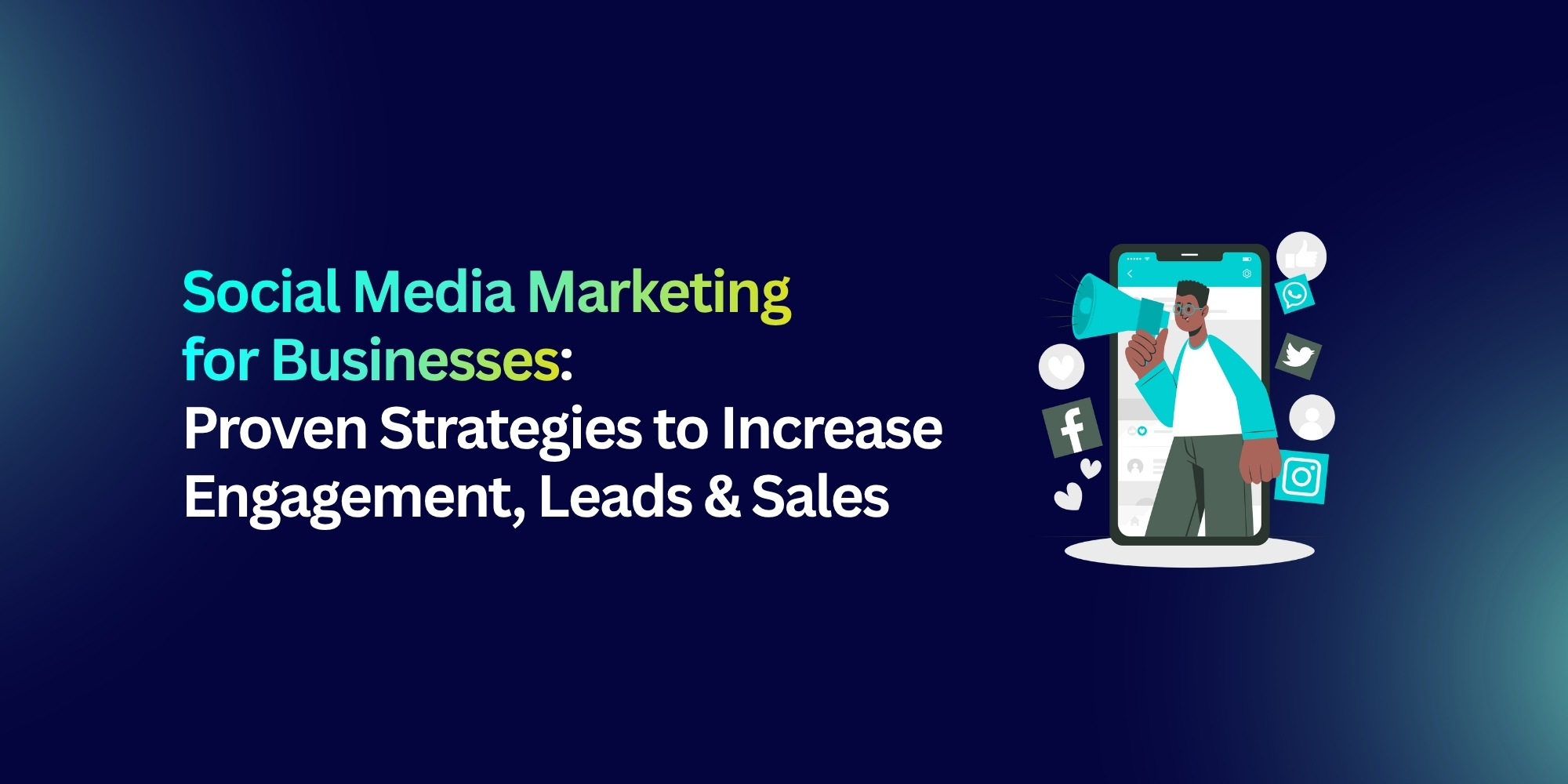
Social Media Marketing for Businesses: Proven Strategies to Increase Engagement, Leads & Sales
Social media marketing is no longer a supplementary channel for businesses, it is a primary driver of brand visibility, audience trust, lead generation, and direct revenue. In 2026, with over 5.24 billion active social media users worldwide, the question is not whether your business needs a social media strategy, it is whether yours is built to convert attention into measurable business outcomes.
Key Takeaways
What is social media marketing for businesses?
Social media marketing is the practice of using social platforms, Facebook, Instagram, LinkedIn, YouTube, TikTok, X, and others, to build brand awareness, engage target audiences, generate leads, and drive sales through a combination of organic content, community management, and paid social advertising.
Which social media platform drives the most leads for businesses?
It depends on the industry. LinkedIn generates the highest-quality B2B leads, 80% of B2B social media leads originate on LinkedIn. Facebook and Instagram lead for B2C lead generation and direct sales.
What is a good social media engagement rate?
Average engagement rates vary by platform and content type. Instagram averages 0.60% engagement per post. Facebook averages 0.15%. LinkedIn averages 0.35%.
How does social media marketing generate leads and sales?
Through four primary mechanisms: organic content that builds authority and drives inbound interest; paid social advertising that targets specific audience segments with conversion-focused messaging; social proof, reviews, testimonials, and user-generated content.
How much should a business spend on social media marketing?
Most businesses allocate 10–25% of their total marketing budget to social media. The right split between organic and paid depends on audience size, content quality, and conversion objectives, but businesses that combine both consistently outperform those relying on either approach alone.
Every business has social media accounts. Most post regularly. Some invest in paid promotion. Very few have a social media strategy that runs from content creation through to measurable revenue outcomes and that gap is where most of the platform's potential quietly disappears.
The challenge is not a shortage of social media advice. It is a surplus of tactical guidance disconnected from strategic outcomes. Post consistently. Use hashtags. Go live. Try Reels. Run a giveaway. In 2026, social media marketing has matured into one of the most measurable, targetable, and scalable channels in digital marketing, but only for businesses that treat it as a system rather than a content calendar.
Social commerce is accelerating this urgency. Global social commerce sales are projected to reach $1.2 trillion in 2025, growing at three times the rate of traditional e-commerce. Consumers increasingly discover, evaluate, and purchase products without ever leaving the social platform. Businesses that have not built social media into their sales infrastructure are not just missing engagement, they are missing transactions.
In this guide you will learn how to build a social media marketing strategy that generates measurable business results, which platforms belong in your mix and why, how to increase social media engagement.
Building a Social Media Marketing Strategy That Converts
A social media strategy that drives business results is built backwards, starting from the revenue objective and working back to the content, platform, and audience decisions that support it.
Step 1: Define specific business objectives
Every social media marketing decision should serve a defined business objective, not a vanity metric. The four objectives most directly tied to revenue are:
- Brand awareness, reaching new audiences who are not yet familiar with your business
- Lead generation, capturing contact details from users who have expressed interest
- Sales conversion, driving direct purchases, bookings, or sign-ups
- Customer retention, deepening relationships with existing customers to increase lifetime value and referral rates
Each objective requires a different content approach, platform weighting, and measurement framework. Businesses that mix all four without defining which is primary for each campaign consistently underperform against businesses that focus clearly.
Step 2: Know your audience with precision
Effective social media marketing is not about reaching as many people as possible, it is about reaching the right people with the right message. Audience definition goes beyond demographic basics:
- What problems are they actively trying to solve?
- Where in the decision journey are they, awareness, consideration, or decision?
- What content format do they consume on which platform?
- What objections do they have to purchasing, and what proof points resolve them?
The answers to these questions should drive every content and targeting decision, and they come from customer interviews, CRM data, social listening, and the engagement analytics your existing content is already generating.
Step 3: Select platforms based on audience presence, not trend
Platform selection should be driven by where your target audience actually spends time and in what decision-making context, not by which platform is currently generating the most marketing industry press. The practical platform guide for business:
| Platform | Primary Audience | Best For | Key Strength |
| 25–55, broad demographics | B2C lead gen, retargeting, local businesses | Largest ad targeting depth | |
| 18–44, visual-first | E-commerce, lifestyle, B2C brand building | Shopping features, visual storytelling | |
| Professionals, B2B decision-makers | B2B lead gen, thought leadership, recruiting | 80% of B2B social leads | |
| YouTube | All demographics | Long-form education, product demos, SEO | Highest average watch time |
| TikTok | 18–34 primarily | Organic reach, brand discovery, product virality | Highest organic reach potential |
| X (Twitter) | News followers, tech, finance | Real-time engagement, PR, industry conversation | Speed and topicality |
| 25–45, primarily female | Home, fashion, food, DIY, wedding | Purchase intent, 89% use for buying ideas |
Content Strategy: What Actually Drives Engagement
Social media engagement is the currency that precedes every lead and sale a social platform generates, but most business content programs fail at engagement because they prioritize what the business wants to say over what the audience wants to consume.
The content mix that works
The most effective business social media content follows an 80/20 principle: 80% value, education, entertainment, insight, behind-the-scenes authenticity, and 20% direct promotion. Audiences that are consistently provided genuine value before being asked to buy are 6 times more likely to convert when a promotional message does appear.
High-performing content types by objective:
- Video content, generates 1,200% more shares than text and image content combined; short-form video (Reels, TikTok, YouTube Shorts) is the highest-reach format across all major platforms in 2026
- User-generated content (UGC), customer photos, reviews, and testimonials shared as brand content convert at 4.5 times the rate of brand-produced content; 79% of consumers say UGC highly influences their purchase decisions
- Educational content, how-to guides, industry insights, and explainer content build authority and generate saves and shares that extend organic reach
- Behind-the-scenes content, humanizes the brand, builds trust, and consistently outperforms polished promotional content on engagement metrics
- Polls, questions, and interactive content, drive comment and response engagement that signals content value to platform algorithms and expands organic distribution
Consistency and publishing cadence
Algorithmic reach on every major social platform rewards consistent publishing, not volume. A business publishing three well-crafted, audience-relevant pieces of content per week consistently outperforms one publishing seven rushed posts. The optimal cadence varies by platform: LinkedIn performs best at 3–5 posts per week for business accounts; Instagram at 4–7; Facebook at 1–2 daily; TikTok at 1–3 daily for accounts building organic reach.
Paid Social Advertising: Generating Leads and Sales at Scale
Organic social media marketing builds authority and nurtures audiences over time. Paid social delivers speed, scale, and targeting precision that organic reach cannot match, making it the primary driver of measurable lead and sales volume for most business social media programs.
Facebook and Instagram ads
Meta's advertising platform remains the most sophisticated audience targeting system in social media, with over 2.11 billion daily active users across Facebook and Instagram and targeting capabilities that span demographics, interests, behaviors, life events, lookalike audiences, and custom audiences built from your CRM data.
The highest-converting paid social frameworks for lead generation:
- Lead generation ads, capture contact details within the platform without requiring a website visit; reduce friction and consistently outperform website click campaigns for top-of-funnel lead volume
- Retargeting campaigns, serve ads to users who have visited your website, watched your videos, or engaged with your content; retargeting audiences convert at 3 to 5 times the rate of cold audiences
- Lookalike audiences, reach new users who share behavioral and demographic characteristics with your highest-value customers; 1–3% lookalike audiences typically deliver the best balance of reach and precision
LinkedIn ads for B2B
LinkedIn advertising delivers the highest CPL of any major social platform, but for B2B businesses, it also delivers the highest lead quality. LinkedIn's targeting allows campaigns to reach users by job title, seniority, company size, industry, and professional skills, a precision unavailable anywhere else in digital advertising.
For B2B social media lead generation, LinkedIn's most effective formats are:
- Sponsored Content, native feed ads promoting thought leadership, case studies, or gated resources
- Lead Gen Forms, pre-filled forms that capture business contact details without leaving LinkedIn, reducing friction dramatically
- InMail campaigns, direct message ads delivered to targeted LinkedIn inboxes; average open rates of 50–70% versus email's 20–25%
TikTok and YouTube for brand discovery
TikTok's advertising platform has matured significantly, its algorithm-driven discovery model means that even paid content can achieve organic-like distribution when creative quality is high. For businesses targeting 18–34 demographics, TikTok paid social delivers some of the lowest CPMs available across major platforms. YouTube advertising, particularly non-skippable pre-roll and mid-roll, reaches high-intent audiences in a high-attention context and delivers strong brand recall metrics.
Social Proof and UGC: The Trust Layer That Closes Sales
No social media marketing strategy is complete without a systematic approach to social proof, the reviews, testimonials, case studies, and user-generated content that reduce purchase hesitation and accelerate conversions.
79% of consumers trust online reviews as much as personal recommendations. Businesses that actively generate and amplify social proof across their socials media channels reduce the trust deficit that prevents first-time purchases and increase the conversion rate of both organic social traffic and paid social campaigns.
Practical social proof integration:
- Request and share customer testimonials as native content, not just website copy
- Repost customer-generated content with permission and attribution
- Create case study content that documents specific customer outcomes with measurable results
- Respond publicly to reviews, both positive and negative, to demonstrate accountability and customer care
- Feature employee and team content that humanizes the brand and builds authenticity signals
Measuring Social Media Marketing ROI
The most common failure point in business socials media marketing is measuring reach and engagement rather than revenue outcomes. Likes, followers, and impressions are inputs, they tell you whether your content is being seen. The metrics that matter for business are the ones that connect social activity to pipeline and revenue.
| Business Objective | Primary Metric | Supporting Metrics |
| Brand awareness | Reach, impressions, share of voice | Follower growth, brand mention volume |
| Engagement | Engagement rate, saves, shares | Comments, video watch time, click-through rate |
| Lead generation | Cost per lead, lead volume | Form completions, landing page conversion rate |
| Sales | Revenue attributed, ROAS | Add-to-cart rate, checkout completion |
| Retention | Repeat engagement rate, referral traffic | Customer response rate, NPS from social |
A complete media ROI measurement system connects platform analytics (Meta Business Suite, LinkedIn Campaign Manager, TikTok Ads Manager) to website conversion tracking (Google Analytics 4 with UTM parameters on every social link) and CRM revenue attribution (connecting closed deals to originating social touchpoints).
Common Social Media Marketing Mistakes
Mistake #1: Publishing without a content strategy. Random posting, content without a defined objective, audience, or platform fit, generates activity without results. Every piece of content should serve a defined objective and be designed for the specific platform it is published on.
Mistake #2: Treating all platforms identically. Content that performs on LinkedIn rarely translates to TikTok, and vice versa. Each platform has its own format requirements, audience expectations, and algorithmic signals. Repurposing content across platforms without adapting it for each one consistently underperforms against platform-native content.
Mistake #3: Focusing on follower count over engagement quality. A 5,000-follower account with a 4% engagement rate is more valuable than a 50,000-follower account with 0.1% engagement, because the former's audience is genuinely interested, and the latter's is likely inflated by low-quality growth tactics. Socials media engagement quality determines lead and sales conversion potential, not raw audience size.
Mistake #4: Abandoning paid social media because of early CPL results. Paid social campaigns require a learning phase, typically 7 to 14 days, during which the platform's algorithm tests audiences and creative combinations to find optimal delivery. Pausing campaigns during this window prevents them from reaching the performance level the data will support.
Mistake #5: Not retargeting engaged audiences. The users who have watched your videos, engaged with your posts, or visited your website are your highest-conversion opportunities. Failing to build and target retargeting audiences from these groups leaves the most valuable segment of your social audience unaddressed.
Mistake #6: Measuring social media ROI in 30 days. Organic social media marketing builds authority and audience trust over months, not weeks. Evaluating organic content programs on a 30-day window systematically undervalues the compounding returns that consistent social media investment generates over 6 to 12 months.
How Shankom Can Help
Shankom builds and manages social media marketing strategies for businesses that want measurable growth, not just a more active social presence. From platform strategy and content planning to paid social campaign management, audience targeting, retargeting architecture, and cross-channel attribution reporting, Shankom connects every social media decision to the revenue outcomes it is designed to produce. Whether your goal is B2B lead generation through LinkedIn, D2C sales through Instagram and TikTok, or local customer acquisition through Facebook, Shankom provides the strategy and execution that turns social media engagement into leads, and leads into sales.
People Also Ask
What is social media marketing and why does it matter for businesses?
Social media marketing is the use of platforms to build brand awareness, engage target audiences, generate leads, and drive sales. With over 5.24 billion active media users globally, it is one of the most scalable and cost-efficient channels available to businesses, delivering both brand-building and direct revenue outcomes when executed strategically.
Which social media platform is best for business lead generation?
LinkedIn generates 80% of B2B media leads and is the definitive platform for professional services and B2B businesses. Facebook and Instagram lead for B2C lead generation through Meta's advanced audience targeting. The right platform depends on your audience: where they spend time and in what decision-making context.
How do you increase social media engagement for a business?
The highest-impact social media engagement strategies are: publishing short-form video content (which generates 1,200% more shares than static content), featuring user-generated content and customer testimonials, maintaining consistent publishing cadence optimized for each platform's algorithm, and actively engaging with comments and responses, which signals content quality to platform distribution systems.
How much does social media advertising cost?
Media advertising costs vary widely by platform, industry, audience, and objective. Facebook and Instagram CPMs average $6–$15 depending on targeting precision. LinkedIn CPCs average $5–$12 for B2B campaigns. TikTok offers some of the lowest CPMs for younger demographics. The most important cost metric is not CPM or CPC but cost per qualified lead or cost per acquisition, benchmarked against the revenue value of each converted customer.
Recent Blogs