
SEO Problems We Commonly Find on Law Firm Websites in Atlanta
Most law firm websites in Atlanta are built for appearances, not search performance. They load slowly on mobile, have thin practice area content that cannot rank against competitive pages, carry no E-E-A-T signals establishing attorney credibility, have incomplete Google Business Profiles, and are missing the neighborhood-specific content Google needs to validate local relevance. None of these problems is unusual, and none is permanent. The Atlanta law firm marketing programs generating consistent organic leads in 2026 are the ones that have addressed each of these failures systematically and maintained them with ongoing SEO activity.
Key Takeaways
- Why do most Atlanta law firm websites underperform in search? Because law firm websites are almost universally built by web designers prioritizing visual presentation over technical search performance. The result is websites that look credible but rank poorly because they lack the technical foundation, content depth, and E-E-A-T signals that Google requires for competitive legal rankings.
- What makes legal SEO different from other industries? Google classifies legal websites as YMYL content, Your Money or Your Life, meaning it applies its strictest E-E-A-T evaluation standards. Thin content, anonymous authorship, and weak credibility signals that might be tolerated on a general local business website are direct ranking liabilities on a legal website.
- How competitive is law firm SEO in Atlanta? Extremely. Keywords like "personal injury lawyer Atlanta" and "Atlanta criminal defense attorney" carry paid search cost-per-click values exceeding $50 to $100, reflecting the commercial value each new client represents. Organic rankings for these terms deliver the same high-intent traffic with no per-click cost and compounding returns over time.
- Is an SEO audit necessary before starting optimization? Yes. A comprehensive SEO audit for law firms identifies the specific gaps causing ranking underperformance and prioritizes fixes by impact. Without the audit, optimization efforts are applied to assumptions rather than data, and the highest-leverage improvements are frequently missed.
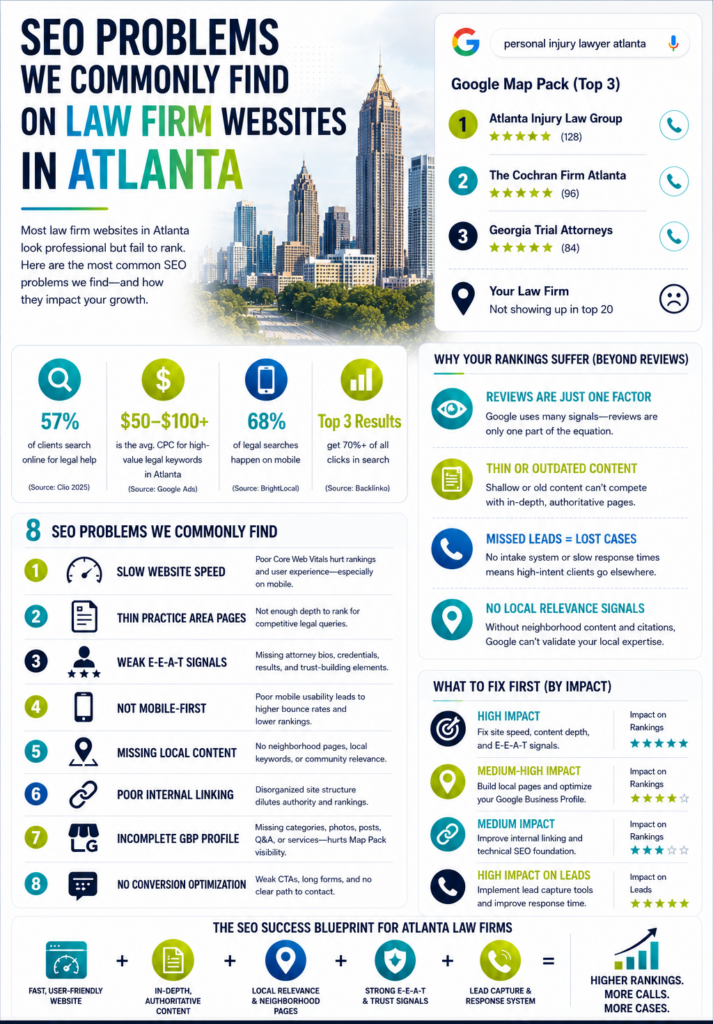
Every law firm in Atlanta has a website. Very few of those websites are generating consistent organic leads. When Clio's 2025 Legal Trends Report surveyed potential legal clients, 57% said they search online when looking for a lawyer, and of those, the overwhelming majority never go past the first page of results. In a city with over 30,000 licensed attorneys in Georgia and a legal market as competitive as any in the Southeast, the difference between a law firm that generates a steady flow of new client inquiries through organic search and one that relies entirely on referrals comes down to a small number of recurring, fixable problems that appear on virtually every law firm website we audit. This blog documents exactly what those problems are and what fixing them requires.
How is SEO in Atlanta different from other US states?
Atlanta is the largest legal market in the Southeast and one of the most competitive in the country. The city's continued population growth, its position as a regional headquarters for national corporations, and its status as a major logistics and transportation hub generate a continuous volume of personal injury, business litigation, employment, immigration, and criminal defense cases that sustains intense competition for search visibility across every practice area year-round.
Atlanta's neighborhood structure creates specific local search opportunities that most law firms underuse. A firm in Buckhead has a different target client profile than one in Midtown, Decatur, or Sandy Springs, and the search behavior of prospective clients in each area reflects those differences. Law firm SEO Atlanta programs that treat the entire metro area as one undifferentiated market miss the neighborhood-level precision that produces the highest conversion rates from organic traffic.
Atlanta's diversity also creates a multilingual search opportunity that most firms have not addressed. A significant portion of Atlanta's population searches for legal services in Spanish, Korean, Vietnamese, and other languages, and the competition for these queries is dramatically lower than for English-language equivalents.
Firms with Spanish-language service pages targeting queries like "abogado de lesiones personales Atlanta" are capturing a high-intent audience that most English-only competitors have left entirely uncontested.
The Eight SEO Problems We Most Commonly Find on Atlanta Law Firm Websites
Problem 1: A Website Built for Branding, Not Search Performance
The most consistent finding across every SEO audit for law firms in Atlanta is a website that was designed to impress existing clients and referral sources rather than to rank for the queries that generate new ones. Businesses investing in SEO Services in Atlanta understand that premium legal website templates, JavaScript-heavy design frameworks, embedded video backgrounds, and oversized hero images often contribute to the same outcome: a website that looks authoritative but loads too slowly on mobile for Google to rank it competitively.
Google uses Core Web Vitals as a ranking factor. The three metrics that matter most for law firm website optimization are:
- Largest Contentful Paint, which measures how quickly the main content loads, with 2.5 seconds or faster passing the threshold.
- Cumulative Layout Shift, which measures visual stability during page load, with 0.1 or lower as the passing threshold.
- Interaction to Next Paint, which measures responsiveness to user inputs, with 200 milliseconds or lower as the passing threshold.
The majority of Atlanta law firm websites built on premium legal templates fail at least two of these three metrics on mobile. Fixing Core Web Vitals typically involves image compression and WebP conversion, deferral of render-blocking JavaScript, implementation of browser caching, and, in some cases, migration to a faster hosting environment.
Problem 2: Thin Practice Area Pages With Insufficient Content Depth
The second most common finding is practice area pages that describe services in 300 to 500 words when the top-ranking competing pages for the same queries average 1,400 to 2,000 words with structured sections covering legal process, client rights, case timelines, Georgia-specific statutes and procedural rules, and detailed FAQ sections.
Personal injury lawyer SEO in Atlanta is particularly competitive, making high-quality SEO content writing services essential for achieving strong search rankings. A page targeting "personal injury lawyer Atlanta" that covers the topic in just 400 words cannot compete with a law firm's page that explains Georgia's modified comparative negligence rule, Atlanta-specific accident statistics, the Georgia statute of limitations for personal injury claims, what clients should do in the first 24 hours after an accident in Atlanta, and a FAQ section answering the most common questions from Atlanta injury victims. In highly competitive legal markets, content depth is not optional. It is the primary differentiator between pages that rank and those that do not.
Every practice area page on a competitive Atlanta law firm website should cover:
- A clear explanation of the legal matter and who it applies to
- The specific legal process in Georgia, referencing relevant Georgia codes and statutes
- What the client's rights are and what they should do immediately
- How the firm approaches cases in this practice area, with specific process details
- Case outcome examples where permitted under Georgia State Bar advertising rules
- A FAQ section with 6 to 10 questions addressing the specific concerns Atlanta clients express
- A clear, low-friction call to action with a tap-to-call button for mobile visitors
Problem 3: An Incomplete or Unmanaged Google Business Profile
For law firms, local SEO services play a crucial role in improving Google Business Profile performance, which directly influences Map Pack visibility, the first thing most prospective clients see before they ever reach organic search results. However, the majority of Atlanta law firm profiles are claimed but not actively maintained, often missing critical completeness elements and showing little to no recent activity that signals an active, trustworthy practice to Google.
A fully optimised Google Business Profile for lawyers in Atlanta includes:
| Profile Element | What It Should Include |
| Primary category | "Law Firm" or specific practice category such as "Personal Injury Attorney" |
| Secondary categories | All relevant practice areas the firm handles |
| Services listed | Every practice area with individual keyword-rich service descriptions |
| Business description | Keyword-natural description referencing Atlanta, practice areas, and years of experience |
| Photos | Office interior, attorneys, team photos, updated at least monthly |
| Google Posts | Weekly posts covering legal tips, case outcomes, or client education content |
| Q&A management | Active answers to questions prospective clients ask about the legal process and fees |
| Review responses | Response to every review within 48 hours |
The firm name, address, and phone number on the Google Business Profile must be an exact character-for-character match to what appears in the website footer and across every legal directory. Any inconsistency in this data reduces Google's confidence in the listing and directly suppresses Map Pack rankings.
Problem 4: Missing or Weak E-E-A-T Signals
Google's E-E-A-T framework applies with maximum scrutiny to legal websites. A legal SEO services audit that does not evaluate E-E-A-T signals is an incomplete audit, because this is the dimension that most distinguishes Atlanta law firm websites that rank from those that do not.
The specific E-E-A-T gaps most commonly found in Atlanta:
- No named attorney bio pages with Georgia Bar numbers, law school credentials, years of experience, and practice area focus
- Legal content with no author byline attributing articles to a named, credentialed attorney
- No external directory presence on Avvo, Martindale-Hubbell, Super Lawyers, Justia, or FindLaw
- No case results or client outcomes published where permitted under Georgia State Bar Rule 7.1 advertising guidelines
- No professional affiliations displayed, such as Georgia Trial Lawyers Association, Atlanta Bar Association, or State Bar of Georgia membership
- No peer endorsements or third-party recognition signals are visible on the website or external profiles
Each of these gaps makes it harder for Google to verify the professional credibility of the firm behind the content, and in the YMYL category, unverifiable credibility translates directly into suppressed rankings.
Problem 5: No Practice Area Specific Location Pages
Google validates local ranking eligibility by checking whether the website reinforces the relevance signals claimed in the Google Business Profile. A firm with a single "Service Areas" page listing ten Atlanta neighborhoods does not carry the same local authority signal as a firm with dedicated pages for each major area it serves.
For an Atlanta law firm, building dedicated location pages for the highest-case-volume neighborhoods and suburbs is one of the highest-leverage content investments available:
- Midtown Atlanta: business litigation, employment law, real estate disputes
- Buckhead: high-asset divorce, estate planning, corporate law
- Decatur: family law, DUI defense, criminal matters
- Sandy Springs: personal injury, premises liability, corporate matters
- College Park: traffic violations, criminal defense, immigration
- Marietta: personal injury, workers' compensation, family law
Each location page should include the area name in the title tag, H1, and URL, reference local courts such as Fulton County Superior Court or DeKalb County State Court relevant to that area, describe how Georgia law applies to the cases most common in that community, and carry LocalBusiness schema with geo-coordinates.
Problem 6: No Review Generation Strategy
Most Atlanta law firms with strong reputations have surprisingly thin review profiles. The firms we consistently see at the top of Atlanta's Map Pack for competitive legal queries have 50 to 100 or more Google reviews, with consistent new reviews arriving monthly. The firms below them in the Map Pack typically have 15 to 25 reviews, and the most recent one is dated several months ago.
The challenge for law firms is that the moment of maximum client satisfaction, immediately following a successful case outcome, is also a legally and ethically sensitive moment that most attorneys are uncomfortable leveraging for a review request. The solution is a structured, compliant review request process:
- Send a brief, personal email from the lead attorney within 24 hours of a positive case resolution, thanking the client and including a direct Google review link
- Reference the firm's commitment to helping other clients in similar situations find trustworthy representation, framing the review as a contribution rather than a promotion
- Follow up once by SMS if no review is received within five days
- Respond to every review, positive and negative, within 48 hours with a professional, personalized response
Problem 7: Ignoring Local Citation Consistency
NAP consistency, the exact match of Name, Address, and Phone Number across every directory and citation, is a foundational law firm Google rankings signal that most Atlanta firms have never audited. Legal directories are particularly prone to stale data because firms change addresses, phone numbers, and attorney rosters more frequently than most local businesses, and directories rarely update automatically.
The legal directories that carry the highest authority for attorney SEO services and that require consistent NAP data are:
- Avvo
- Justia
- FindLaw
- Martindale-Hubbell
- Super Lawyers
- Lawyers.com
- Georgia State Bar member directory
- Atlanta Bar Association member directory
- Better Business Bureau Atlanta
A citation audit using BrightLocal or Semrush's Listing Management identifies every inconsistency and enables bulk corrections across directories without manual individual updates.
Problem 8: No Ongoing SEO Activity After the Initial Website Build
The Atlanta law firms generating consistent organic leads are not firms that invested in a website build and assumed the work was done. They maintain an ongoing law firm SEO Atlanta program that continuously builds relevance signals, expands content authority, and sustains the activity levels that signal an active, trustworthy practice to Google.
An effective ongoing legal SEO cadence for an Atlanta law firm:
- Weekly Google Posts covering Georgia legal news, recent case outcomes permitted under State Bar rules, or client FAQ answers
- Monthly content refreshes on high-traffic practice area pages, updating Georgia statute references, case law citations, and Atlanta-specific statistics
- Quarterly citation audits identifying and correcting new NAP inconsistencies
- Active pursuit of local backlinks from Atlanta-area sources: Atlanta Business Chronicle features, community organization directories, Atlanta Bar Association event coverage, and local news outlets
- Ongoing review generation after every positive case resolution
What must your Firm do Differently
The law firms consistently visible in Atlanta's Map Pack and organic results share a pattern that reflects execution consistency rather than firm size:
- A technically sound, fast-loading website with deep practice area content, proper schema markup, and passing Core Web Vitals scores on mobile
- A fully completed and actively managed Google Business Profile with consistent new review velocity
- Named attorney bio pages with Georgia Bar credentials, education, and professional affiliations
- Dedicated neighborhood location pages referencing local Atlanta courts and community context
- Active legal directory presence with consistent NAP data across Avvo, Justia, FindLaw, and Martindale
- An ongoing content and link-building program expanding local authority month over month
Shankom solutions provides attorney SEO services for Atlanta law firms that need organic search visibility to generate a consistent flow of new client inquiries. From a comprehensive SEO audit for law firms identifying every technical and content gap, to law firm website optimization, Google Business Profile management, neighborhood location page development, E-E-A-T signal building, review generation systems, and ongoing legal SEO services that compound in value over time, Shankom builds the complete law firm SEO Atlanta program that moves law firms from invisible to consistently visible for the searches that convert into signed retainers. Whether your firm has never invested in SEO or has an existing program that is not delivering results, Shankom provides the strategy and execution that make Atlanta law firm marketing through organic search a predictable, measurable lead generation system.
FAQs
Why is my Atlanta law firm website not ranking on Google?
The most common causes are thin practice area pages with insufficient content depth, failing Core Web Vitals scores on mobile, an incomplete or unmanaged Google Business Profile, missing E-E-A-T signals such as named attorney credentials and professional affiliations, and inconsistent NAP data across legal directories. A comprehensive SEO audit identifies which of these is causing the most significant ranking suppression and prioritizes fixes by impact.
What is E-E-A-T and why does it matter for law firm SEO?
E-E-A-T stands for Experience, Expertise, Authoritativeness, and Trustworthiness. Google applies this framework with maximum scrutiny to legal websites because they fall under the YMYL category, where inaccurate or untrustworthy information can cause real-world harm. Law firms with named attorney bio pages carrying Georgia Bar credentials, author bylines on all content, active legal directory profiles, and case result examples rank significantly better than firms publishing anonymous content with no verifiable credibility signals.
How many Google reviews does an Atlanta law firm need to rank in the Map Pack?
The firms consistently appearing in Atlanta's Map Pack for competitive legal queries typically have 50 or more Google reviews with consistent new review velocity. Review recency matters as much as total count. A firm with 40 reviews and three new ones this month regularly outranks a firm with 80 reviews and none in the past quarter. A structured review request process following positive case outcomes is the most effective and ethically compliant approach.
Why do location pages matter for Atlanta law firm SEO?
Atlanta's geographic spread and neighborhood diversity mean that a single citywide location page produces Map Pack visibility only near the registered office address. Dedicated pages for Buckhead, Midtown, Decatur, Sandy Springs, and other high-case-volume areas, each referencing local courts such as Fulton County Superior Court or DeKalb County State Court, capture neighborhood-level searches that generic city pages never rank for and significantly expand the firm's organic lead generation footprint.
How long does SEO take to generate leads for an Atlanta law firm?
Most Atlanta law firms with a complete technical foundation and active optimization program see measurable ranking improvements within 90 to 120 days. Consistent organic lead volume from competitive queries like "personal injury lawyer Atlanta" typically develops over 6 to 12 months as content depth, E-E-A-T signals, and local authority compound. Neighborhood-specific and long-tail practice area queries often produce results faster, within 60 to 90 days of relevant pages being properly indexed.