What Local SEO Looks Like for Real Estate Agencies in New York City
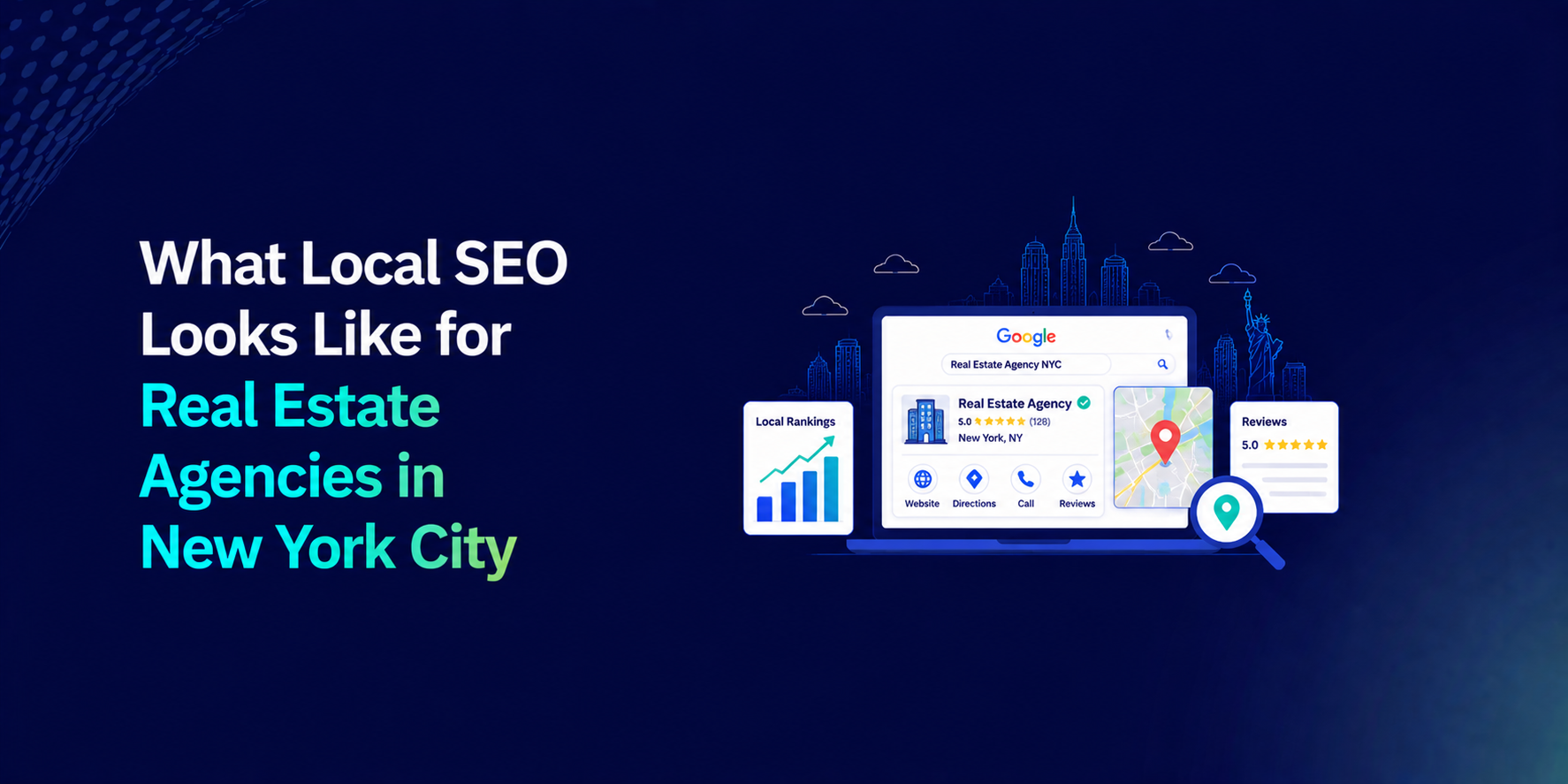
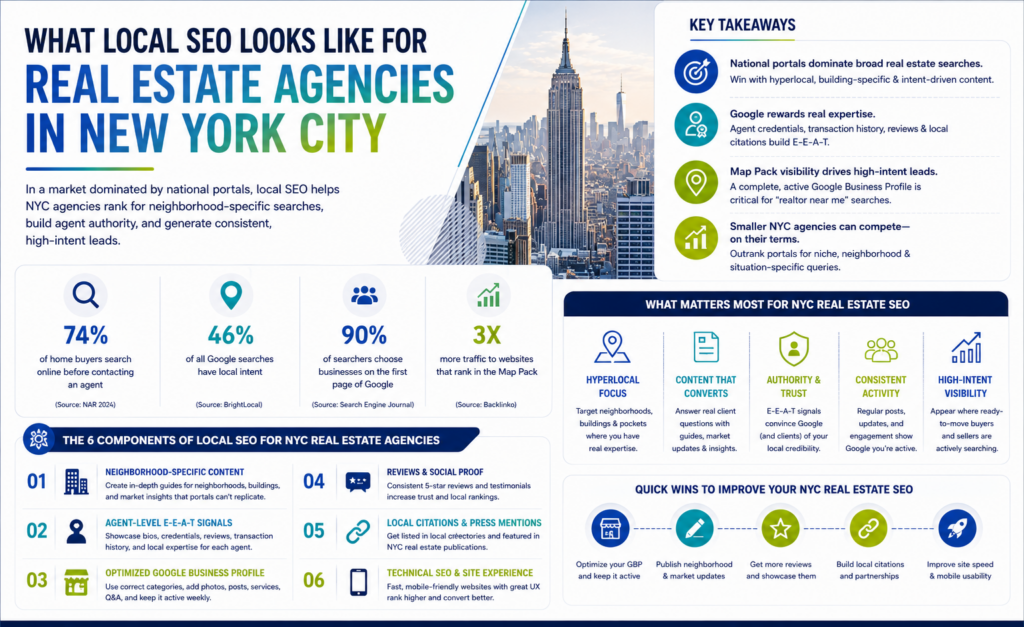
Local SEO for real estate agencies in New York City requires a fundamentally different approach from most local service businesses. National property portals occupy the majority of broad search real estate, making neighborhood-level content, practitioner-level authority, and hyperlocal Google Business Profile signals the primary competitive battleground. The agencies generating consistent NYC real estate lead generation through organic search are the ones ranking for neighborhood and building-specific queries that national portals do not serve well, building agent-level E-E-A-T signals that establish genuine local expertise, and maintaining the active search presence signals that separate a trusted local agency from an anonymous listing aggregator.
Key Takeaways
- Why is NYC real estate SEO different from other local industries? Because national property portals dominate broad real estate search terms, pushing independent agencies out of the top positions for generic queries. The competitive opportunity for local SEO for real estate agents in NYC lies in neighborhood-specific, building-specific, and client-situation-specific queries that large real estate portals often serve poorly. By investing in local SEO services, agencies can improve their visibility for these highly targeted searches, attract qualified local buyers and sellers, and generate more relevant leads.
- What does Google prioritize for real estate agency local rankings? Proximity, relevance, and prominence for Map Pack results. For organic rankings, Google prioritizes E-E-A-T signals demonstrating genuine neighborhood expertise: agent credentials, transaction history in specific areas, neighborhood guide content, and external citations from local real estate publications.
- Can smaller NYC agencies compete with national portals in search? Yes, but not on their terms. A boutique agency cannot outrank Zillow for "NYC apartments for sale." It can outrank Zillow for "pre-war co-op specialists Upper West Side" or "best buildings for families in Park Slope Brooklyn." Specificity is the competitive advantage that independent agencies have, and portals do not.
- How important is the Google Business Profile for NYC real estate agencies? Critically important for Map Pack visibility, which is where a significant portion of "realtor near me" and neighborhood-specific agent searches convert to contact. Most NYC real estate agency profiles are incomplete, uncategorized correctly, or entirely unmanaged.
New York City has more licensed real estate agents per square mile than any other market in the United States. With over 45,000 active real estate licensees competing across the five boroughs, and national portals like Zillow, StreetEasy, and Realtor.com dominating the top of search results for most property-related queries, the challenge for independent real estate agencies and boutique brokerages is not just ranking. It is appearing at all in a market where the first page is split between national aggregators and a small group of highly optimized local firms. The agencies winning NYC realtor online visibility in 2026 are not winning it with bigger budgets. They are winning it with a more precise, more localized, and more technically complete real estate SEO NYC strategy than their competitors.
The NYC Real Estate Search Landscape
Before building an SEO strategy for real estate agencies in New York, it is necessary to understand exactly what the search landscape looks like, because it is structurally different from most local industries.
For broad transactional queries like "NYC apartments for rent," "condos for sale Manhattan," or "Brooklyn real estate," the first page is dominated by StreetEasy, Zillow, Realtor.com, Compass, and Corcoran. These are platforms with domain authorities above 70, millions of indexed listing pages, and SEO budgets that no independent agency can match on their own terms.
For neighborhood-specific and intent-specific queries, the landscape changes dramatically. Searches like "Park Slope Brooklyn co-op buyer's agent," "Astoria Queens real estate agent," "Upper East Side luxury condo specialist," or "first-time buyer agent Washington Heights" are queries that national portals answer poorly because they require genuine local expertise to serve well. These are the queries where independent agencies and boutique brokerages compete on equal terms with anyone, because the ranking factor is not domain authority. It demonstrates neighborhood expertise, content specificity, and local trust signals.
Real estate website optimization for NYC agencies starts with this understanding: local search optimisation begins with a hyperlocal keyword strategy, while the content strategy focuses on neighborhood expertise rather than listing aggregation.
The Six Components of Local SEO for NYC Real Estate Agencies
#1 Neighborhood-Specific Content That Portals Cannot Match
The single highest-leverage content investment for local SEO for real estate agents in NYC is neighborhood guide content so specific, so locally informed, and so practically useful that a national portal's algorithmically generated neighborhood summary cannot compete with it.
A genuine neighborhood guide for Jackson Heights, Queens written by an agent who has closed 40 transactions there contains information that Zillow's data team in San Francisco cannot produce: the specific co-op boards known for strict application processes and the ones known for speed, the blocks where street-level retail affects residential desirability, the parking situation block by block, the elementary school zoning lines and their impact on property values, the typical closing timeline at the local title companies, and the specific building types where buyers consistently encounter inspection surprises.
This is the content that a family relocating from Ohio to Jackson Heights will search for and find genuinely useful. It is also the content that Google, evaluating expertise and experience signals, will rank above a portal's generic neighborhood overview because it demonstrably comes from someone with real transaction experience in that specific area.
A competitive neighborhood content strategy for a NYC real estate agency covers:
- Every neighborhood in the agency's primary service area has a dedicated guide page
- Building-specific pages for the highest-search-volume co-op and condo buildings in each neighborhood, covering board requirements, maintenance fee ranges, sublet policies, and transaction history
- Buyer's and seller's guide content specific to NYC's unique transaction environment, covering co-op board approval processes, REBNY customs, mansion tax thresholds, and NYC transfer taxes
- Market update content published quarterly with real transaction data from the agency's own sales history
#2 Google Business Profile Optimization for Realtors
The Google Business Profile for realtors is the primary asset for Map Pack visibility, and the majority of NYC real estate agency profiles are either missing critical completeness elements, have never been actively managed beyond the initial claim, or are negatively impacted by issues such as duplicate location pages, which can dilute local search performance.
A fully optimised profile for a NYC real estate agency includes:
| Profile Element | What It Should Include |
| Primary category | "Real Estate Agency" with secondary categories for buyer and seller specializations |
| Services listed | Buyer representation, seller representation, rental assistance, investment property, co-op sales, condo sales, commercial real estate, if applicable |
| Business description | Keyword-natural description referencing NYC, specific boroughs served, and years of neighborhood experience |
| Photos | Office, team, sold property examples, neighborhood event participation, updated monthly |
| Google Posts | Weekly posts covering market updates, recently sold properties, neighborhood news, and buyer or seller tips |
| Q&A management | Active answers to questions prospective clients ask about the NYC buying and selling processes |
| Review responses | Respond to every client review within 48 hours |
The NAP data on the Google Business Profile must match exactly what appears on the website and across every real estate directory. Inconsistencies between the agency name, address, and phone number on Zillow, StreetEasy, RealDirect, and other platforms reduce the local authority signal the profile generates.
#3 Agent-Level E-E-A-T Signals
NYC real estate lead generation through organic search depends heavily on E-E-A-T signals that establish individual agent expertise at the neighborhood level. Google treats real estate as a category where demonstrated transactional experience is a credibility signal, and the agencies ranking most consistently for neighborhood-specific queries are the ones with agent profiles that make this experience verifiable.
Each agent page should include:
- Full name and professional headshot
- New York State real estate license number
- Specific neighborhoods of expertise with transaction counts, where available
- Years of active experience in NYC real estate
- Languages spoken, which matters significantly in NYC's multilingual market
- Client testimonials attributed to specific transaction types
- Links to external profiles on Compass, Corcoran, StreetEasy agent pages, or REBNY member directory
Author bylines on all neighborhood content and market update articles, linking to the relevant agent profile, create the authorship signal that Google uses to verify that neighborhood guide content is produced by someone with genuine local expertise rather than a content agency with no transactional history in the area, while also strengthening topical authority.
#4 Technical Website Foundation
Real estate website optimization for NYC agencies requires the same technical foundations as any competitive local business, with additional considerations specific to the real estate category.
The core technical requirements:
- Passing Core Web Vitals on mobile, where a significant percentage of NYC real estate searches happen during commutes and lunch breaks
- IDX integration that does not create thin or duplicate listing pages that dilute the domain's content quality signal
- LocalBusiness and RealEstateAgent schema on all relevant pages
- Neighborhood page URLs are structured with the neighborhood name and borough, for example,/brooklyn/park-slope/, for a clean geographic signal
- XML sitemap excluding low-value IDX listing archive pages that should be blocked from indexing to protect crawl budget for the neighborhood guide and service pages that carry ranking value
The IDX integration issue deserves specific attention. Most NYC real estate websites integrate an IDX feed that generates thousands of individual property listing pages. If these pages are indexed without canonical or noindex controls, they consume the majority of the site's crawl budget and dilute the domain-wide content quality signal with thin, automatically generated pages. The listing pages that carry genuine SEO value are the neighborhood-level and building-level aggregation pages, not individual property listings.
#5 Citation Consistency Across Real Estate Directories
New York City real estate marketing operates in a directory-dense environment. A NYC real estate agency has a credibility presence on more platforms than most local businesses, and maintaining NAP consistency across all of them is a more complex ongoing task than it is in most industries.
The real estate-specific directories and platforms that carry the most weight for local search rankings for real estate in NYC:
- StreetEasy agent and agency profiles
- Zillow Premier Agent profiles
- Realtor.com agent directory
- REBNY member directory
- Compass, Corcoran, Brown Harris Stevens, or whichever brokerage the agency is affiliated with
- Yelp business listing
- Google Business Profile
- LinkedIn company page
- RealDirect and HomeLight
Each platform should carry the same business name, address, phone number, and website URL. Discrepancies across these platforms reduce the local authority signal and the E-E-A-T credibility assessment Google builds from external citations.
#6 Review Generation and Management
Client reviews on Google, Zillow, and StreetEasy are both a ranking signal and the primary trust factor for prospective buyers and sellers evaluating agencies they have never worked with. NYC real estate transactions take months to complete, which means the review generation window requires deliberate timing.
The highest-response moment for a Google review request from a real estate client is within 48 hours of closing, when the satisfaction of completing the transaction is at its peak. A personal email from the lead agent, referencing specific moments from the transaction process and including a direct review link, consistently outperforms automated generic review requests.
For realtor SEO services that include review strategy, the platform priority is Google first for Map Pack ranking impact, then Zillow and StreetEasy for the research-phase trust signal they provide to buyers actively evaluating agents before making contact.
The Keyword Strategy That Works in NYC Real Estate
Competing against national portals on generic terms is a losing strategy for independent agencies. The keyword strategy that produces genuine NYC real estate lead generation through organic search targets three query types that portals serve poorly:
Hyperlocal neighborhood queries: "buyer's agent Park Slope Brooklyn," "co-op specialist Riverdale Bronx," "Astoria Queens real estate agent Spanish speaking"
Transaction-type specific queries: "NYC co-op board rejection help," "estate sale apartment Upper West Side," "1031 exchange NYC investment property"
Buyer and seller situation queries: "first-time buyer agent Brooklyn no fee," "selling inherited property NYC process," "relocating to NYC from out of state real estate agent"
These queries have lower search volume than generic terms, but significantly higher conversion intent. A searcher looking for a "co-op specialist Upper West Side" has already decided to buy a co-op on the Upper West Side and is now selecting their agent. That is a conversion-ready lead that broad, generic content cannot capture.
AI SEO: Showing Up in ChatGPT, Google AI Overviews, Gemini, Perplexity, and Copilot
In 2026, an increasing share of buyers and sellers start their research not just with Google, but with AI assistants: “What’s it like to buy a co‑op on the Upper West Side?” “Which real estate agents specialise in condos in Long Island City?”, or “Best neighborhoods for families in Brooklyn with good schools.”
If your agency's content isn’t accessible, understandable, and trustworthy to these AI systems, you’ll be invisible in that part of the discovery journey.
A practical AI SEO layer for NYC real estate agencies focuses on:
- Conversational, answer-focused content: Neighborhood guides and building pages should include concise, natural‑language answers to common questions (co‑op vs condo pros and cons, typical down payments, board packages, closing timelines) formatted with headings and FAQs so AI models can easily extract and summarise them.
- Clear entities for agency and agents: Make sure agent and agency details—names, roles, locations, service areas—are consistent across your website, Google Business Profile, and major directories. AI systems cross‑check this data to decide whether you are a real, stable entity worth recommending.
- Structured data for people and places: Implement schema that clearly ties agents to neighborhoods and content pieces. This helps AI understand who the experts are on each topic and where they operate.
- Proof of expertise across the web: Appear in local media, niche blogs, or community sites where your agents offer commentary or insight. AI systems look beyond your site to confirm that others recognise your expertise.
- Up‑to‑date content and reviews: AI often values recency and consistency. Keep guides updated, market commentary current, and reviews flowing, so when assistants scan for “relevant and active” experts, your agency fits that description.
Done well, this ensures that when someone asks an AI assistant for help with specific NYC real estate questions, your content and agents stand a real chance of being included in the answer.
What Top-Ranking NYC Real Estate Agencies Are Doing Differently
The real estate agencies consistently visible in NYC's local search results for neighborhood and agent-specific queries share a content and technical pattern built on specificity rather than volume:
- Neighborhood guide content is so locally specific that national portals cannot replicate it
- Agent profiles with verifiable neighborhood transaction experience and New York State license numbers
- A fully optimised and actively managed Google Business Profile with consistent new review velocity
- Technical IDX integration that protects crawl budget and domain quality signals
- Consistent NAP data across every real estate directory and citation platform
- A quarterly market update content program generating fresh, expertise-demonstrating content that compounds authority over time
How Shankom Can Help
Shankom provides realtor SEO services for NYC real estate agencies that need genuine online visibility to generate consistent buyer and seller leads without relying solely on portals and ads. From technical audits and IDX configuration to neighborhood and building guide content, agent E-E-A-T development, Google Business Profile management, citation consistency, and AI SEO strategy, Shankom builds the complete NYC real estate SEO program focused on the precise queries where independent agencies can win.
In one recent engagement, a boutique Manhattan and Brooklyn agency was almost invisible outside branded searches, despite excellent reviews and strong word-of-mouth. Portals controlled nearly all of their target queries. Over 9 months, Shankom:
- Rebuilt their neighborhood and building content for a dozen core areas, each tied to named agents with real transaction histories
- Cleaned up IDX indexing so search engines focused on guides and agent pages instead of thousands of duplicate listings
- Fully optimised their Google Business Profile and implemented a review and Google Posts cadence
- Added AI‑friendly FAQ sections and structured data so assistant-style tools could understand and surface their expertise
The outcome: page‑one visibility for dozens of hyperlocal terms (e.g., “[neighborhood] buyer’s agent” and “[building] co-op specialist”), a substantial increase in organic enquiries from buyers and sellers who had never interacted with the agency before, and early signs of inclusion when clients tested AI assistants with NYC-specific real estate questions.
Whether you are an independent brokerage or a team within a larger brand, Shankom helps align your content, technical foundations, Google presence, and AI visibility so that your agents show up where modern NYC buyers and sellers actually start their journey.
FAQs
How do real estate agencies compete with Zillow and StreetEasy in NYC search?
By targeting hyperlocal and intent-specific queries that national portals cannot serve with genuine expertise. A boutique agency cannot outrank Zillow for "NYC apartments for sale" but can outrank it for "pre-war co-op specialist Upper West Side" or "first-time buyer agent Park Slope Brooklyn." Neighborhood guide content written from real transaction experience, agent profiles with verifiable NYC credentials, and hyperlocal keyword targeting produce organic rankings in the spaces national portals leave uncontested.
What is the most important Google Business Profile fix for a NYC real estate agency?
Ensuring the primary category is set to "Real Estate Agency" rather than a generic business category, completing the full service listing with every transaction type the agency handles, and implementing a consistent weekly Google Posts program covering market updates, recently closed transactions, and neighborhood content.
Why do real estate websites need to manage IDX pages for SEO?
Because IDX feeds generate thousands of thin, automatically populated listing pages that consume crawl budget and dilute domain-wide content quality signals if left uncontrolled. Individual listing pages provide minimal SEO value because their content is duplicated across every portal carrying the same listing. Blocking individual listing pages from indexing while allowing neighborhood-level and building-level aggregation pages to be indexed protects the crawl budget and domain quality assessment for the pages that carry genuine ranking value.
What E-E-A-T signals matter most for NYC real estate agents?
Verifiable transaction history in specific neighborhoods, New York State real estate license numbers on agent profile pages, REBNY membership and other professional affiliation badges, client testimonials attributed to specific transaction types and neighborhoods, author bylines on all neighborhood content linking to credentialed agent profiles, and external citations on StreetEasy, Zillow, and the REBNY member directory.
How long does local SEO take to generate leads for a NYC real estate agency?
Neighborhood guide content and Google Business Profile improvements typically produce initial ranking visibility within 60 to 90 days for long-tail neighborhood and agent-specific queries. Competitive neighborhood-level rankings for higher-volume queries typically develop over 6 to 12 months as content depth, agent E-E-A-T signals, and local citation authority compound.