
Why Most Contractors in New York Have Duplicate Location Pages
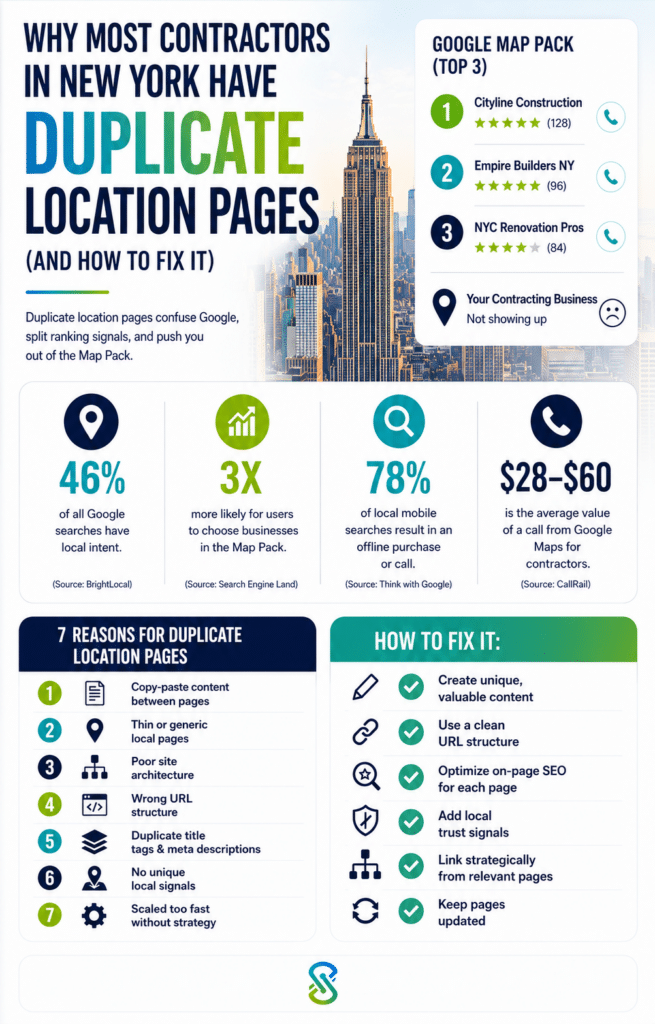
Most New York contractors build duplicate location pages because they want to rank in every borough and suburb simultaneously and believe that more pages equal more visibility. What Google actually sees is thin, templated content that provides no unique value to searchers in different locations. The result is suppressed rankings across all pages rather than strong rankings in any of them. The fix is not fewer location pages. It is genuinely differentiated pages that provide real, location-specific value. Done correctly, multi-location SEO for New York contractors produces ranking visibility across the full service area without the duplicate content penalty that templated pages create.
Key Takeaways
- What are duplicate location pages? Location pages where the only meaningful difference between pages is the city or borough name, with identical service descriptions, identical body copy, and no unique content that a searcher in that specific location would find more useful than a searcher anywhere else.
- Why do duplicate location pages hurt rankings? Because Google's Helpful Content system evaluates whether a page provides genuine value to a real searcher. A page about "contractor services in Queens" that contains the same content as a page about "contractor services in Brooklyn" with only the borough name changed provides no unique value to a Queens resident and is assessed accordingly.
- How widespread is this problem among New York contractors? Extremely widespread. The competitive pressure to rank across New York's five boroughs and surrounding suburbs pushes most local SEO for contractors programs toward templated page production as the path of least resistance. While local SEO audit services can help identify these issues early, many contractors overlook them in favor of quick fixes. The technical execution is fast and inexpensive, and the damage is often not visible until a content quality update penalizes the entire domain.
- What is the alternative? Genuinely differentiated location pages with unique content specific to each area, referencing local permitting requirements, neighborhood construction characteristics, local building codes, and the specific project types most common in each community.
New York is the most geographically dense contractor market in the United States. A single general contractor, electrician, or renovation company can legitimately serve Manhattan, Brooklyn, Queens, the Bronx, Staten Island, and a dozen suburban ZIP codes across Westchester, Nassau, and Suffolk counties simultaneously. That reality creates an SEO temptation that most contractor website SEO programs fall into without realizing the damage it causes: building dozens of near-identical location pages that swap city names but share the same content, the same service descriptions, and the same everything else. Google has a name for this. It is called duplicate content, and it is one of the most consistent and preventable reasons local search rankings stall for New York contractors despite years of effort and investment.
How New York's Geography Creates the Duplicate Page Trap
No other city in the United States presents the same combination of geographic complexity and search market opportunity that New York does. The five boroughs alone represent five distinct communities with distinct demographics, distinct housing stock, distinct building code enforcement priorities, and distinct contractor needs. Add Westchester County, Long Island's Nassau and Suffolk counties, and northern New Jersey for contractors operating across the tri-state area, and the list of locations a contractor might legitimately want to rank for reaches 30 or more. Managing this level of geographic targeting also requires careful technical SEO considerations, including the proper handling of URL parameters, to ensure search engines crawl and index the right pages without creating duplicate content issues.
The math looks compelling on the surface. If one location page can rank for contractor queries in one borough, thirty location pages should rank in thirty locations. This logic drives most duplicate location page problems in contractor SEO New York programs. A web agency or in-house marketer builds a template for a location page, drops in each borough or suburb name, publishes thirty pages, and submits the sitemap. The pages go live. Rankings do not improve. In many cases, they decline. A comprehensive SEO audit often reveals that these pages offer little unique value, making it difficult for search engines to rank them competitively.
What the logic misses is that Google does not reward page quantity. It rewards page quality. A contractor who builds thirty pages of identical content has not signaled relevance across thirty locations. They have signaled to Google that their website contains thirty pages of low-value, thin content that exists to manipulate search rankings rather than to serve searchers. That signal is a ranking liability at the domain level, not just the page level.
What Google Actually Does With Duplicate Location Pages
Understanding why duplicate content SEO is harmful requires understanding what Google does when it encounters multiple pages on the same domain covering the same topic with substantially similar content. A Digital Marketing Agency in New York can help businesses identify and resolve duplicate content issues, ensuring every page delivers unique value that improves search visibility and enhances the overall user experience.
Google's response to duplicate location pages operates through three mechanisms:
- Canonicalization. When Google determines that multiple pages contain substantially similar content, it selects one as the canonical version and reduces the ranking consideration given to the others. For a contractor with 30 templated borough pages, Google may select one as canonical and treat the remaining 29 as near-duplicates, effectively removing them from meaningful ranking competition.
- Crawl budget dilution. Google allocates a crawl budget to every site based on its authority and technical health. A site with 30 thin location pages consumes crawl budget on pages that provide no value, leaving the pages that actually deserve ranking consideration crawled less frequently and indexed more slowly.
- Domain-wide quality signal reduction. Google's Helpful Content system evaluates content quality at the domain level. A domain with a large proportion of thin, templated pages receives a lower overall quality assessment that suppresses rankings across all pages, including the service pages and homepage, which had nothing to do with the duplicate location page problem.
The practical outcome is consistent: contractors who built large numbers of templated location pages see flat or declining rankings across their entire site, not just on the duplicate pages themselves.
How to Identify Whether Your Location Pages Are Duplicates
Before fixing the problem, it needs to be confirmed and quantified. A location page SEO audit for a New York contractor involves four specific checks:
- Content similarity analysis. Copy the body text from two location pages and paste it into a text comparison tool. If the similarity percentage is above 85% with only proper nouns changed, the pages are functionally duplicates in Google's assessment.
- Unique word count per page. Subtract the content that appears identically across all location pages (navigation, footer, boilerplate service descriptions) from the total word count. If the unique content on each page is fewer than 200 words, the page does not meet the content differentiation threshold that protects against duplicate classification.
- Google Search Console impressions by location and page. Pull impressions and clicks for each location page URL in Search Console. Genuinely differentiated pages ranking for location-specific queries produce distinct impression profiles. Templated pages all show near-zero impressions because Google has reduced their ranking consideration.
- Screaming Frog duplicate content report. Screaming Frog's site crawler identifies pages with high content similarity scores across a domain and flags them as duplicate or near-duplicate, making it straightforward to see the full scale of the problem across a large location page inventory.
The Right Way to Build Location Pages for New York Contractors
The solution to duplicate location pages is not to delete them all and start over. It is to differentiate them with genuine, location-specific content that a real searcher in each area would find uniquely valuable. This process is more time-intensive than template production, but it is the only approach that produces durable local search rankings across multiple locations.
For a New York contractor, the differentiating content that makes each location page genuinely unique:
| Content Element | What Makes It Location-Specific |
| Building permit references | NYC DOB permit requirements vary by borough; Nassau and Westchester have separate permit offices |
| Housing stock context | Pre-war brownstones in Brooklyn, post-war co-ops in Queens, single-family homes in Staten Island, and luxury condos in Manhattan require different contractor approaches |
| Local building codes | NYC Building Code applies citywide, but enforcement priorities and common violations vary by borough and community board district |
| Neighborhood project examples | Real completed projects in each area referenced by neighborhood rather than generic project descriptions |
| Local material sourcing | Suppliers, lumber yards, and trade vendors specific to each borough or suburb |
| Community-specific context | Common renovation challenges in that specific area's housing stock, historical designation considerations in landmarked neighborhoods |
| Local trade references | Licensed contractors in New York must reference their NYC Home Improvement Contractor license; suburb-specific contractor registration requirements in Nassau, Westchester, and Suffolk differ |
A location page for Astoria, Queens, built around the neighborhood's predominantly brick multi-family housing stock, local DOB permit requirements for that community board district, common gut renovation projects in pre-war walkups, and real project examples from that specific neighborhood provides genuine value that a Queens resident will not find on a generic "contractor services Queens" page. Google can measure that difference.
What a Differentiated Location Page Architecture Looks Like
A properly differentiated multi-location SEO architecture for a New York contractor does not require a unique page for every ZIP code in the five boroughs. It requires a hierarchical structure that concentrates unique content at each geographic level.
Tier 1: Borough pages. One page per borough with substantial, borough-specific content. The Brooklyn page covers Brooklyn's housing stock characteristics, prevalent renovation types, Brooklyn Community Board district permit considerations, and neighborhood-level service coverage. This page earns rankings for broad borough-level queries.
Tier 2: Neighborhood pages. For the highest-search-volume neighborhoods within each borough, dedicated pages with neighborhood-specific content. A Williamsburg page differs from a Park Slope page in housing stock, project types, permit history, and client profile. These pages earn rankings for neighborhood-level queries with higher conversion intent than borough-level ones.
Tier 3: Suburb pages. For the Westchester, Nassau, and Suffolk service area, one page per major municipality with specific permit office references, housing stock context, and local project examples. Great Neck differs from White Plains, which differs from Huntington in ways that a local resident will recognize and that Google can validate through content specificity.
This three-tier architecture produces 15 to 25 high-quality location pages rather than 50 to 80 templated ones, covers a larger effective geographic footprint, and carries none of the duplicate content risk that templated production creates.
Google Business Profile and Multi-Location Signals
The Google Business Profile optimization component of a multi-location contractor strategy in New York operates under a different set of rules than location page development, and conflating the two creates compliance problems.
Google's rules for service area businesses are clear: a contractor should have one Google Business Profile per physical location or per legitimate separate business entity. Creating multiple Google Business Profiles for the same business at different addresses to gain Map Pack visibility across boroughs is a violation of Google's guidelines and can result in profile suspension.
The correct approach for Google Business Profile optimization in a multi-location context:
- One primary profile at the main business address with a service area configured to cover every borough and suburb the contractor actually serves
- Service area ZIP codes are entered individually for every area served, not just the areas surrounding the physical address
- Every service is listed with keyword-rich descriptions that reference the specific types of projects handled in each area
- Weekly Google Posts covering recently completed projects in specific neighborhoods, referencing the borough or suburb by name to reinforce service area relevance signals
The combination of a single, correctly configured profile with well-differentiated location pages on the website produces the local authority signal that ranks contractors across New York's full geographic complexity without the profile suspension risk that multiple-profile strategies create.
Fixing Existing Duplicate Pages Without Losing Whatever Rankings Exist
For contractors who have already built large inventories of templated location pages, the recovery process requires careful execution to avoid losing the small amount of ranking value that even thin pages may have accumulated.
Do not delete pages before differentiating them. Deleting location pages removes any backlink value they have accumulated and creates 404 errors that damage user experience and crawl signals. Instead, differentiate each page in place, replacing templated content with unique location-specific content while keeping the URL structure unchanged.
Prioritize by existing traffic and ranking value. Pull Search Console data for every location page URL and rank them by current organic impressions. Differentiate the pages with the deepest existing impression counts first, since these pages are closest to ranking and will respond fastest to content improvements.
Set a content minimum per page. Each differentiated location page should have a minimum of 600 words of unique content that could not appear unchanged on any other location page. Pages that cannot reach this threshold with genuine content should be consolidated with a related page and 301 redirected rather than left live as thin content.
Update internal linking after differentiation. As each location page is differentiated and strengthened, update internal links from the homepage, service pages, and other location pages to point to the newly improved version, concentrating link equity on the pages that now deserve it.
AI SEO: Showing Up in ChatGPT, Google AI Overviews, Gemini, Perplexity, and Copilot
Homeowners are no longer only typing “general contractor near me” into Google. Increasingly, they ask AI assistants questions like “Who is the best bathroom remodeler in Brooklyn?” or “Which contractor can renovate a brownstone in Park Slope?” If your business is not visible to those assistants, you are missing a growing layer of demand.
To improve visibility in AI environments like ChatGPT, Google AI Overviews, Gemini, Perplexity, and Microsoft Copilot, New York contractors need AI SEO layered on top of traditional local SEO:
- Entity clarity: Make sure your business is easy for AI to understand as an entity, clear and consistent business name, address, phone number, services, and service areas across your website, Google Business Profile, and major directories. AI systems look for this consistency before they recommend a provider.
- Location‑specific, answer‑friendly content: Build borough and neighborhood pages with succinct answer blocks to questions people actually ask (“Do I need a permit to finish a basement in Queens?”, “How long does a kitchen remodel take in Manhattan co‑ops?”). Use headings and FAQ sections so AI models can easily extract location-accurate answers.
- Structured data for services and locations: Implement LocalBusiness, ProfessionalService, Service, and FAQPage schema that connects your services to specific locations. Structured data helps AI link your entity to the work you do and where you do it.
- Reputation and proof off-site: Maintain strong, recent reviews on Google and relevant directories, and secure mentions in local publications or trade sites. AI models increasingly cross-check that you are a real, trusted contractor, not just a logo on a site.
- Stable crawl and index coverage: Keep sitemaps updated, ensure pages are indexable, and maintain a clean internal linking structure. Many AI systems rely on major search indices; if your location pages are hard for search engines to discover or understand, they will also be hard for AI to use.
When your multi‑location content is genuinely unique and your signals are clean and consistent across the web, you’re far more likely to be the contractor AI assistants name or cite when homeowners ask for recommendations.
How Shankom Can Help
Shankom solutions provides contractor SEO services for New York businesses that need to rank across boroughs and suburbs without falling into the duplicate content trap. We audit location page inventories for duplication issues, redesign your location architecture for genuine differentiation, and align technical foundations and Google Business Profile signals so your multi‑location SEO actually lifts visibility instead of suppressing it.
In one recent engagement, a New York renovation contractor had more than 40 nearly identical “city + contractor” pages covering Brooklyn, Queens, the Bronx, Staten Island, and multiple Long Island towns. Rankings had plateaued, and some core service pages were beginning to slide after recent quality updates. Over five months, Shankom:
- Consolidated and re‑architected their location strategy down to a focused set of borough, key neighborhood, and major suburb pages
- Rewrote each page with location‑specific project examples, housing stock details, permit considerations, and clear, answer‑oriented content
- Cleaned up internal linking and schema, and aligned the Google Business Profile service area and posts to match the new content
The result: page‑one rankings for several “contractor + borough” and neighborhood queries that had never ranked before, a noticeable increase in qualified leads from Queens and Brooklyn, where visibility was previously weak, and improved stability in organic traffic through subsequent core updates. AI search checks also began surfacing the contractor’s brand more often when users asked assistant-style tools for New York renovation recommendations.
Whether your contractor website has five location pages or fifty, Shankom identifies what is suppressing your rankings, differentiates what can be saved, and builds the location content architecture that makes your business genuinely visible across New York’s market, in both traditional search and AI-driven discovery.
FAQs
What are duplicate location pages, and why do they hurt contractor SEO?
Duplicate location pages are location-specific pages where the content is substantially identical across multiple pages, with only the city or borough name changed. They hurt contractor SEO because Google's Helpful Content system assesses whether pages provide genuine value to real searchers. Pages that provide no unique value specific to their claimed location are assessed as thin content, which suppresses their rankings individually and reduces domain-wide quality signals that affect all other pages.
How many location pages should a New York contractor have?
The right number is determined by the geographic area served and the ability to produce genuinely differentiated content for each page, not by how many locations the contractor wants to rank for. A three-tier architecture covering borough pages, key neighborhood pages, and suburb pages typically produces 15 to 25 well-differentiated pages that outperform 50 to 80 templated pages across the same territory.
Can a contractor have multiple Google Business Profiles across New York boroughs?
Only if each profile corresponds to a separate physical business location or a genuinely separate business entity. Creating multiple profiles for the same business at different addresses to gain Map Pack visibility across boroughs violates Google's guidelines and risks profile suspension. A single correctly configured profile with full service area coverage across all boroughs and suburbs is the compliant approach.
What content makes a location page genuinely unique for a New York contractor?
References to borough or neighborhood-specific permit requirements through the NYC Department of Buildings, the local housing stock characteristics and renovation types most common in that area, real completed project examples from that specific neighborhood, local material suppliers or trade references, and any historical designation or landmark district considerations relevant to that community. Content that could not appear unchanged on a page for any other New York location meets the differentiation threshold.
How do you fix duplicate location pages without losing existing rankings?
By differentiating pages in place rather than deleting them, preserving URL structure and any accumulated backlink or ranking value while replacing templated content with unique location-specific content. Pages with insufficient unique content potential should be consolidated with related pages and 301 redirected. The process should be prioritized by current Search Console impression data, differentiating the pages closest to ranking first.