Why Ecommerce Stores in Los Angeles Lose Rankings After Website Redesigns
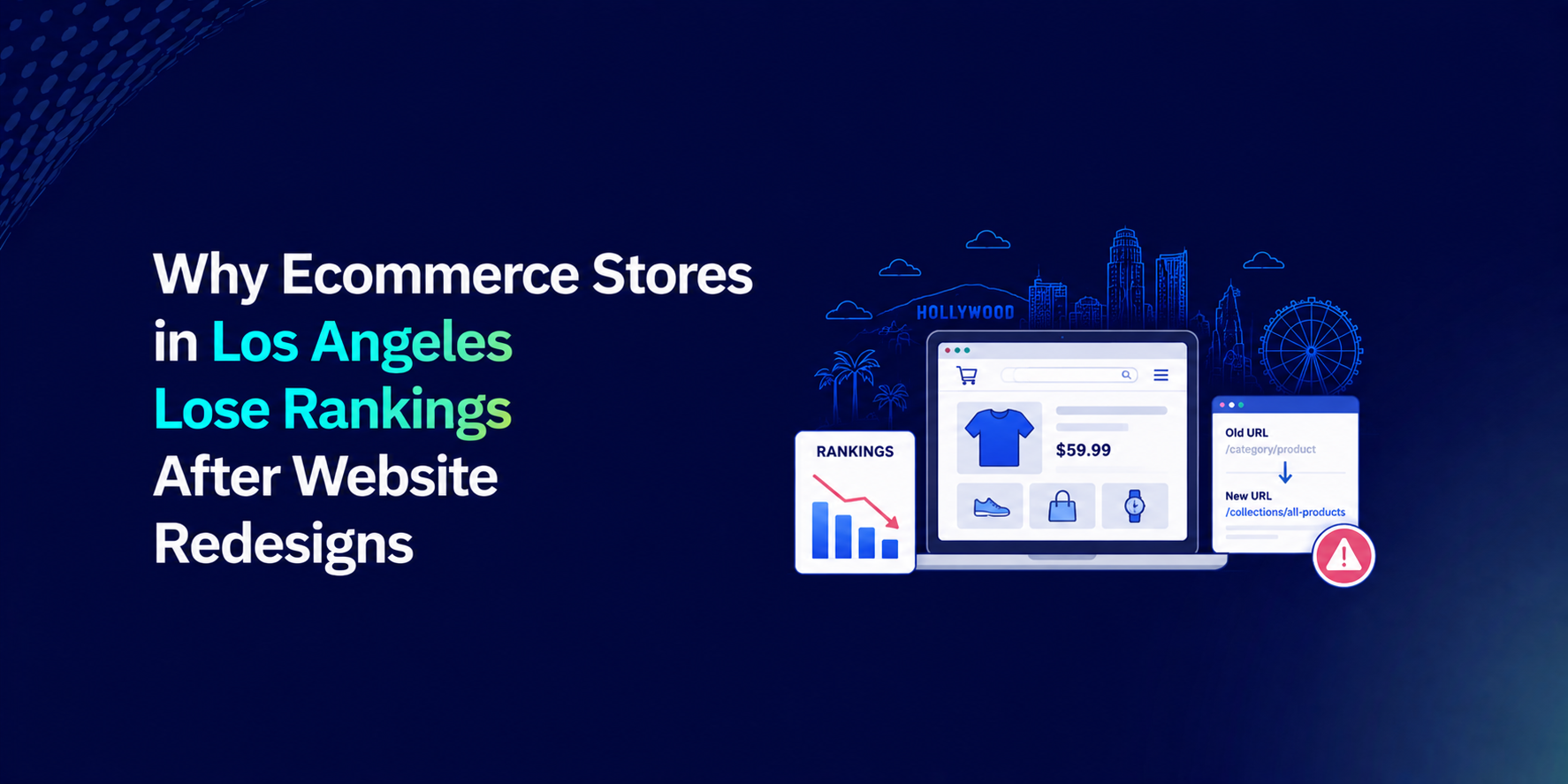
Most ecommerce stores in Los Angeles lose rankings after redesigns because the migration is managed as a design and development project rather than an SEO project. URL structures change without redirect mapping, canonical tags are misconfigured, internal link equity is broken, page speed regressions are introduced, and structured data from the old site is not rebuilt on the new one. Each of these failures compounds the others. The result is a Google ranking drop ecommerce situation that takes months to recover from and could have been prevented entirely with a structured pre-launch SEO checklist and post-launch monitoring protocol.
Key Takeaways
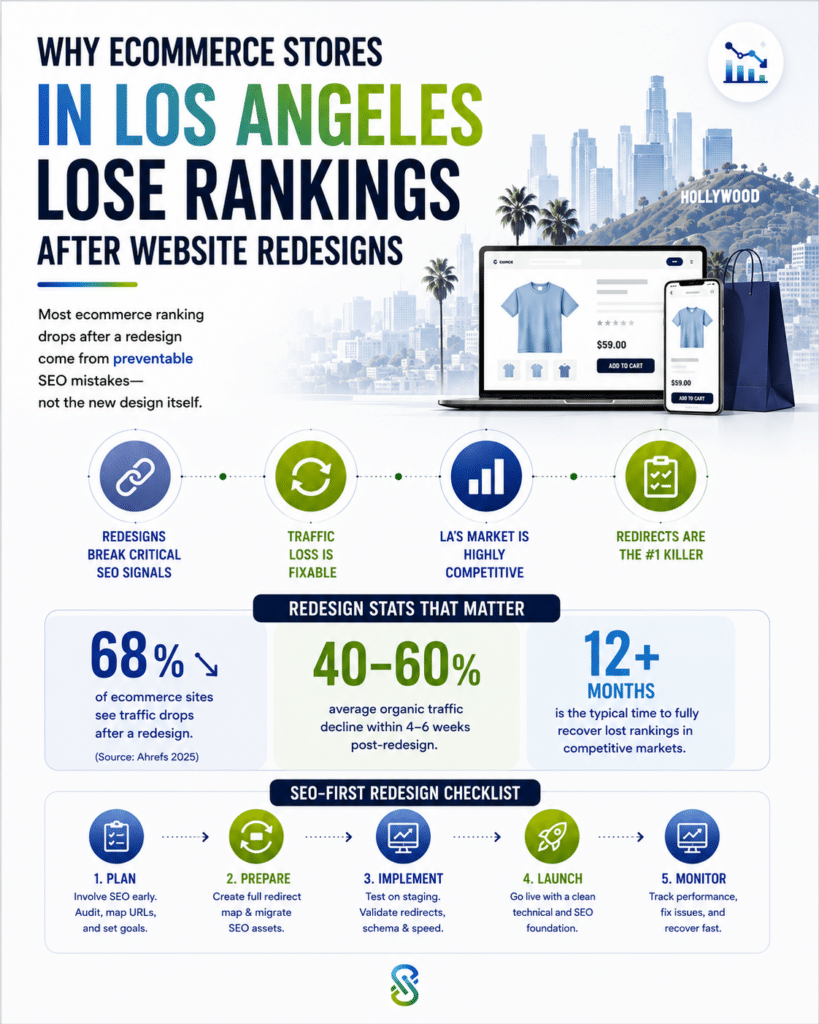
- Why do redesigns cause ranking drops? Because Google's understanding of a website is built on signals accumulated over time: URL structures, internal link patterns, structured data, crawl patterns, and page authority distributions. A redesign that changes any of these signals without a structured migration plan breaks the connection between the existing ranking authority and the new pages carrying the same content.
- Is the traffic loss permanent? Not if the causes are identified and fixed correctly. Organic traffic recovery SEO after a redesign follows a predictable pattern when the specific failures are addressed systematically. The timeline depends on how many signals were broken and how quickly the fixes are implemented after the drop is detected.
- Why is LA's ecommerce market particularly vulnerable? Because Los Angeles has one of the most competitive ecommerce landscapes in the country, with high concentrations of fashion, beauty, wellness, home goods, and lifestyle brands all competing for the same organic real estate. A traffic drop that a less competitive market might absorb without permanently losing ground can result in competitors capturing rankings that take 12 or more months to recover.
- What is the most common single cause of post-redesign ranking loss? Broken redirect mapping when URL structures change. When old URLs return 404 errors rather than 301 redirecting to the correct new URLs, every backlink, internal link, and ranking signal accumulated on those pages is lost overnight.
A website redesign feels like progress. New branding, faster navigation, a cleaner checkout flow, mobile-first layouts that finally reflect how customers actually shop. For most Los Angeles ecommerce businesses, the redesign is months in the making and represents a significant investment. Then it launches, and within four to six weeks, organic traffic is down 40 to 60%. Rankings that took two years to build have disappeared.
Calls to the web agency produce reassurances that everything will stabilize. It does not stabilize. A 2025 Ahrefs analysis of ecommerce sites post-redesign found that 68% experience measurable organic traffic drops following a major website change, and for most, the cause is not the new design itself. It is a sequence of preventable SEO mistakes during redesign, such as overlooked website speed issues, that were never identified because no one with SEO expertise was involved in the migration process.
The Los Angeles E-commerce Context
Los Angeles has a higher concentration of direct-to-consumer ecommerce brands per capita than any other US city outside of New York. The city's fashion districts, beauty industry clusters, wellness brands, home goods manufacturers, and lifestyle product companies have all shifted significant revenue to ecommerce, and for most of them, organic search is the primary acquisition channel.
This concentration makes the competitive consequences of a ranking drop more severe in LA than in most markets. When a Los Angeles fashion brand drops from position 2 to position 14 for "women's linen clothing" after a redesign, the traffic loss is immediate, and the competitors who absorb that traffic are often other LA-based brands with equivalent product quality and stronger post-migration SEO.
Recovering the lost ground requires not just fixing the migration errors, but rebuilding ranking authority in a market where competitors have continued building while the recovery was underway. Businesses investing in SEO Services in Los Angeles understand that successful e-commerce SEO migrations begin long before a website goes live. E-commerce SEO Los Angeles programs that survive redesigns intact are the ones that treated the migration as an SEO project from the planning stage, not the ones that brought in an SEO professional after the traffic had already dropped.
The Eight Most Common SEO Mistakes During Ecommerce Redesigns
#1 Changing URL Structures Without Complete Redirect Mapping
This is the most common and most destructive single failure in e-commerce website migration SEO. When a Shopify store migrates from one URL structure to another, or when a custom platform redesign changes the path structure of product, category, or blog pages, every old URL that returns a 404 error rather than a 301 redirect loses its accumulated ranking authority permanently.
The scale of this problem on most e-commerce sites is significant. A store with 500 product pages, 80 category pages, and 120 blog posts has 700 URLs that each need a correctly mapped 301 redirect if their path changes. Most redesign projects produce a redirect map for the top 20 or 30 pages and leave the rest to return 404s.
The correct process:
- Export a complete URL inventory from the old site using Screaming Frog before the redesign launches
- Map every old URL to its correct new equivalent individually
- Implement all 301 redirects before the new site goes live, not after
- Verify every redirect is returning a 301 status code, not a 302 temporary redirect, which does not pass ranking authority
- Test the complete redirect map after launch using Screaming Frog against the live site
#2 Removing or Misconfiguring Canonical Tags
Canonical tags tell Google which version of a page is the authoritative one when multiple versions exist. On ecommerce sites, canonical tags manage the duplicate content generated by product variants, filtered category pages, and paginated collections. When a redesign removes canonical tags, misconfigures them to point to incorrect URLs, or implements self-referencing canonicals on pages that should point elsewhere, Google's understanding of which pages to rank becomes confused.
Shopify SEO optimization is particularly vulnerable to canonical tag errors during theme migrations because Shopify's default canonical behavior interacts with theme-level code in ways that produce incorrect canonicals without generating obvious error messages. Every canonical tag on the new site should be explicitly verified rather than assumed to be carried over correctly from the old theme.
#3 Losing Structured Data From the Old Site
Product schema, breadcrumb schema, review schema, and FAQ schema take significant time to implement correctly and contribute directly to rich snippet eligibility, which affects click-through rates and visibility in Google Shopping surfaces. Most redesigns treat structured data as a development afterthought and either fail to rebuild it on the new site or rebuild it incorrectly.
The specific structured data that an e-commerce SEO audit should verify is present and correctly implemented on the redesigned site:
| Schema Type | Where It Should Appear | What It Enables |
| Product schema | Every product page | Price, availability, and rating in search results |
| BreadcrumbList schema | Product and category pages | Breadcrumb display in search results |
| AggregateRating schema | Product pages with reviews | Star rating display in search results |
| FAQPage schema | Product and category pages with FAQ sections | FAQ expandable results in search |
| Organization schema | Homepage | Brand knowledge panel signals |
| SiteLinksSearchBox schema | Homepage | Search box in Google's site links |
#4 Speed Regressions
A common pattern in ecommerce redesigns is that the new site looks faster because the design feels cleaner and the navigation is smoother, but the actual Core Web Vitals performance on mobile is worse than the old site. New hero image carousels, third-party app integrations, custom font loading, and JavaScript-heavy interactive elements all add to the load time that the visual design does not reveal.
Google uses Core Web Vitals as a ranking factor for ecommerce pages competing in close proximity with similar products and content quality. A redesigned site with a Largest Contentful Paint regression from 2.1 seconds to 4.3 seconds on mobile does not just affect user experience. It affects every page's ranking eligibility relative to competitors who maintained their performance scores.
Technical SEO for ecommerce websites requires a technical SEO audit and a Core Web Vitals comparison between the old site and the new site before launch, not after the drop appears in Search Console. Tools like PageSpeed Insights, WebPageTest, and Google's CrUX data make this comparison straightforward.
#5 Removing High-Performing Content Pages
E-commerce redesigns frequently involve content consolidation. Blog posts are removed, thin category pages are eliminated, and old product pages for discontinued items are deleted. Some of this consolidation is appropriate. Much of it destroys the ranking authority that the removed pages had accumulated.
The correct process for content removal in a redesign:
- Check Google Search Console for organic impressions and clicks on every page slated for removal
- Check Ahrefs or Semrush for backlinks pointing to every page slated for removal
- Any page with meaningful organic impressions or external backlinks should either be kept, consolidated with a 301 redirect to a relevant remaining page, or replaced with a redirect to the closest topically relevant live page
- Pages with zero impressions, zero clicks, and no backlinks are the only safe candidates for removal without redirect
A Los Angeles fashion brand that removed 40 discontinued product pages during a redesign without checking their backlink profiles subsequently discovered that 12 of those pages carried backlinks from press coverage and influencer mentions that were now returning 404 errors. The combined link equity those pages had accumulated took over a year to rebuild.
#6 Internal Link Structure Disruption
Every internal link on an ecommerce site is a signal to Google about which pages are most important and how topics and categories relate to each other. A redesign that changes navigation architecture, removes breadcrumb trails, eliminates blog-to-product internal links, or restructures category hierarchies disrupts the internal link equity distribution that Google had been using to assess page importance.
For Shopify SEO optimization specifically, redesigns that switch themes often break the programmatic internal linking that Shopify's default theme structures generate automatically, particularly the collection-to-product and blog-to-collection internal link patterns that contribute to category page authority.
An internal link audit using Screaming Frog before and after launch identifies every link that existed on the old site and does not exist on the new one, making the restoration of high-value internal links a manageable post-launch process rather than an invisible ongoing leak.
#7 Not Preserving Pagination and Filter Page Handling
Recovering the lost ground requires not just fixing the migration errors, but rebuilding ranking authority in a market where competitors have continued building while the recovery was underway. Businesses investing in SEO Services in Los Angeles understand that successful e-commerce SEO migrations begin long before a website goes live. E-commerce SEO Los Angeles programs that survive redesigns intact are the ones that treated the migration as an SEO project from the planning stage, not the ones that brought in an SEO professional after the traffic had already dropped.
Website design development projects often introduce SEO issues related to pagination and filter pages, making them among the most difficult problems to diagnose after launch. Unlike technical errors that appear immediately in Search Console, these issues typically cause gradual crawl budget dilution and duplicate content accumulation, which can suppress category page rankings over several weeks rather than triggering an obvious or immediate decline.
The correct handling for most ecommerce sites:
- Paginated pages beyond page 2 blocked from indexing with a noindex tag or excluded from the sitemap
- Filtered URL variants canonicalized to the unfiltered category page
- Faceted navigation parameters handled via Google Search Console's URL parameter tool or via robots.txt where appropriate
#8 Not Monitoring Search Console During and After Launch
The most recoverable redesign mistakes are the ones detected in the first two weeks after launch. A traffic drop after a website redesign that is caught on day three, when a spike in 404 errors appears in Search Console, is a different situation from one caught six weeks later, when rankings have already dropped, and competitors have absorbed the traffic.
A post-launch monitoring protocol for e-commerce website migration SEO:
- Daily Search Console checks for the first two weeks, covering crawl errors, index coverage drops, and manual action notifications
- Weekly organic traffic comparison between the new site and the same period on the old site using Google Analytics 4
- Weekly ranking position comparison for the top 50 organic keywords using Semrush or Ahrefs
- Core Web Vitals monitoring using Google's CrUX dashboard to detect performance regressions as real-user data accumulates
AI SEO: Protecting Ecommerce Visibility in AI Overviews and Answer Engines
Redesign mistakes don’t just affect traditional rankings; they also impact how AI systems see your store. Shoppers increasingly ask tools like ChatGPT, Google AI Overviews, Gemini, Perplexity, and Copilot to compare products, validate claims, or find the “best” option before clicking through. If your product and category pages are hard for these systems to read or trust, your competitors will be recommended instead.
Key AI SEO priorities for ecommerce in 2026:
- Make product data machine-readable: Ensure every key product has a complete, consistent Product schema (with Offer and AggregateRating where applicable), clear specs, sizing, materials, and FAQs that AI systems can parse and compare directly.
- Increase “information gain” on key pages: Add genuinely useful comparison details, care instructions, fit guidance, and use‑case content so your pages contribute more unique information than competing listings, something AI ranking logic increasingly rewards.
- Preserve clean canonical and URL structures: AI experiences are fed by the same search indices as traditional Google results. If your redesign breaks canonicals, creates duplicates, or degrades crawlability, you reduce both organic and AI Overview visibility.
- Reputation and external proof: Maintain strong, recent reviews and consistent brand information across marketplaces, review platforms, and social channels; AI systems cross‑reference these signals when deciding which brands to recommend for product‑comparison queries.
Treating the redesign as both an SEO migration and an AI SEO update, ensuring that product data, policies, and content are structured for machines as well as humans, reduces the risk of disappearing from both organic results and AI‑mediated shopping journeys.
The Recovery Process: What to Do When the Drop Has Already Happened
For Los Angeles ecommerce stores that are already experiencing a Google ranking drop following a completed redesign, the recovery process follows a specific sequence.
Step 1: Run a comprehensive ecommerce SEO audit. Screaming Frog crawl of the new site identifying 404 errors, redirect chains, missing canonical tags, and missing structured data. Search Console coverage report identifying pages removed from the index. Ahrefs backlink report identifying links pointing to 404 URLs.
Step 2: Implement redirect mapping for all 404 errors. Every URL returning a 404 that has either backlinks or prior organic impressions should receive a 301 redirect to the most relevant live page.
Step 3: Rebuild structured data. Product, breadcrumb, review, and FAQ schema should be verified and corrected across all key pages using Google's Rich Results Test.
Step 4: Remediate Core Web Vitals failures. Image compression, JavaScript deferral, and caching implementation for every page category failing the 2.5-second LCP threshold.
Step 5: Restore internal link structure. Rebuild navigation links, breadcrumb trails, and blog-to-product internal links that were broken in the migration.
Step 6: Monitor recovery. Weekly ranking and traffic comparisons against pre-redesign baselines, with Search Console index coverage reviewed daily until the recovery trend is confirmed.
The organic traffic recovery SEO timeline for a well-executed post-redesign recovery is typically 8 to 14 weeks for the majority of lost rankings to return, with full recovery by week 16 to 20 for sites where the migration errors are comprehensively addressed.
What LA Ecommerce Stores With Successful Redesigns Did Differently
The Los Angeles ecommerce businesses that completed major redesigns without significant ranking drops shared a consistent approach:
- SEO involvement from the planning stage, before URL structure decisions were made
- A complete Screaming Frog URL inventory and backlink report of the old site before any development began
- A fully mapped 301 redirect file was completed and tested before launch day
- A pre-launch staging environment audit covering canonical tags, structured data, and Core Web Vitals
- A post-launch monitoring protocol with daily Search Console checks for the first two weeks
- A structured data rebuild checklist reviewed by an SEO specialist before go-live
None of these steps is technically complex. All of them require treating the redesign as an SEO migration project rather than a design project with SEO considered after the fact.
How Shankom Can Help
Shankom provides e-commerce SEO services for Los Angeles brands that are planning a redesign, have already experienced a ranking drop, or want to harden their technical foundation before the next platform change. From full ecommerce SEO audits and migration planning to redirect mapping, structured data implementation, Core Web Vitals remediation, and AI SEO optimisation, Shankom builds the technical and content framework that protects and grows the organic visibility LA brands have spent years building.
In one recent engagement, a Los Angeles apparel brand migrated from a custom platform to Shopify with a new theme. Within a month, organic traffic was down 52%, and several top non‑brand keywords had dropped from page one to page three. Shankom:
- Rebuilt a full redirect map for hundreds of legacy URLs and implemented clean 301s
- Fixed broken and misconfigured canonicals created by the new theme
- Reapplied and expanded the Product and review schema across the catalogue
- Optimised Core Web Vitals on key category and product templates
- Added AI‑friendly FAQs and structured data to top‑selling products
Within 12 weeks, the store had regained roughly 80% of pre‑migration organic traffic, with several high‑intent keywords surpassing their prior ranking positions, and the brand began appearing more frequently in AI‑driven product comparison answers for its niche.
Whether you’re about to redesign or are already dealing with a post‑launch traffic cliff, Shankom provides the strategy and implementation to stabilise rankings, recover lost visibility, and position your LA ecommerce store for both traditional search and AI‑mediated shopping.
FAQs
Why does my ecommerce store lose rankings after a redesign?
Because website redesigns change the URL structures, internal link patterns, structured data, canonical tags, and page performance signals that Google uses to assess page authority and relevance. When these signals change without a structured migration plan, Google loses the connection between accumulated ranking authority and the new pages, producing ranking drops that can take months to recover without targeted intervention.
How do I recover organic traffic after a website redesign?
Start with a comprehensive ecommerce SEO audit identifying every 404 error, broken redirect, missing canonical tag, and missing structured data element on the new site. Implement 301 redirects for every URL returning a 404 that had prior organic traffic or backlinks. Rebuild product, breadcrumb, and review schema. Remediate Core Web Vitals failures on key pages.
How long does it take to recover rankings after a redesign?
With a comprehensive fix implemented quickly after the drop is detected, most ecommerce sites recover 70 to 80% of lost rankings within 8 to 14 weeks. Full recovery to pre-redesign baselines typically takes 16 to 20 weeks. Sites where the migration errors are left unaddressed for more than 60 days before intervention face longer recovery timelines because competitors continue building authority while the recovery is delayed.
What is the most important SEO check before a redesign goes live?
Complete redirect mapping for every URL that will change in the new site. This single check prevents the most common and most destructive post-redesign ranking failure. Every old URL should be mapped to its correct new equivalent, every redirect should be verified as a 301 rather than a 302, and the complete redirect map should be tested against the staging environment before the new site launches.
Does Shopify cause specific SEO problems during redesigns?
Yes. Shopify theme migrations can break canonical tag configurations, disrupt programmatic internal linking that default themes generate automatically, alter URL structures for collection and product pages, and change how pagination and filtered views are handled. A Shopify redesign should be treated as a full technical SEO migration project with pre-launch auditing of canonical tags, redirect mapping for any URL structure changes, and structured data verification across all product and collection page types.