AI Content vs. Human-Written Content: All the Essentials You Need to Know
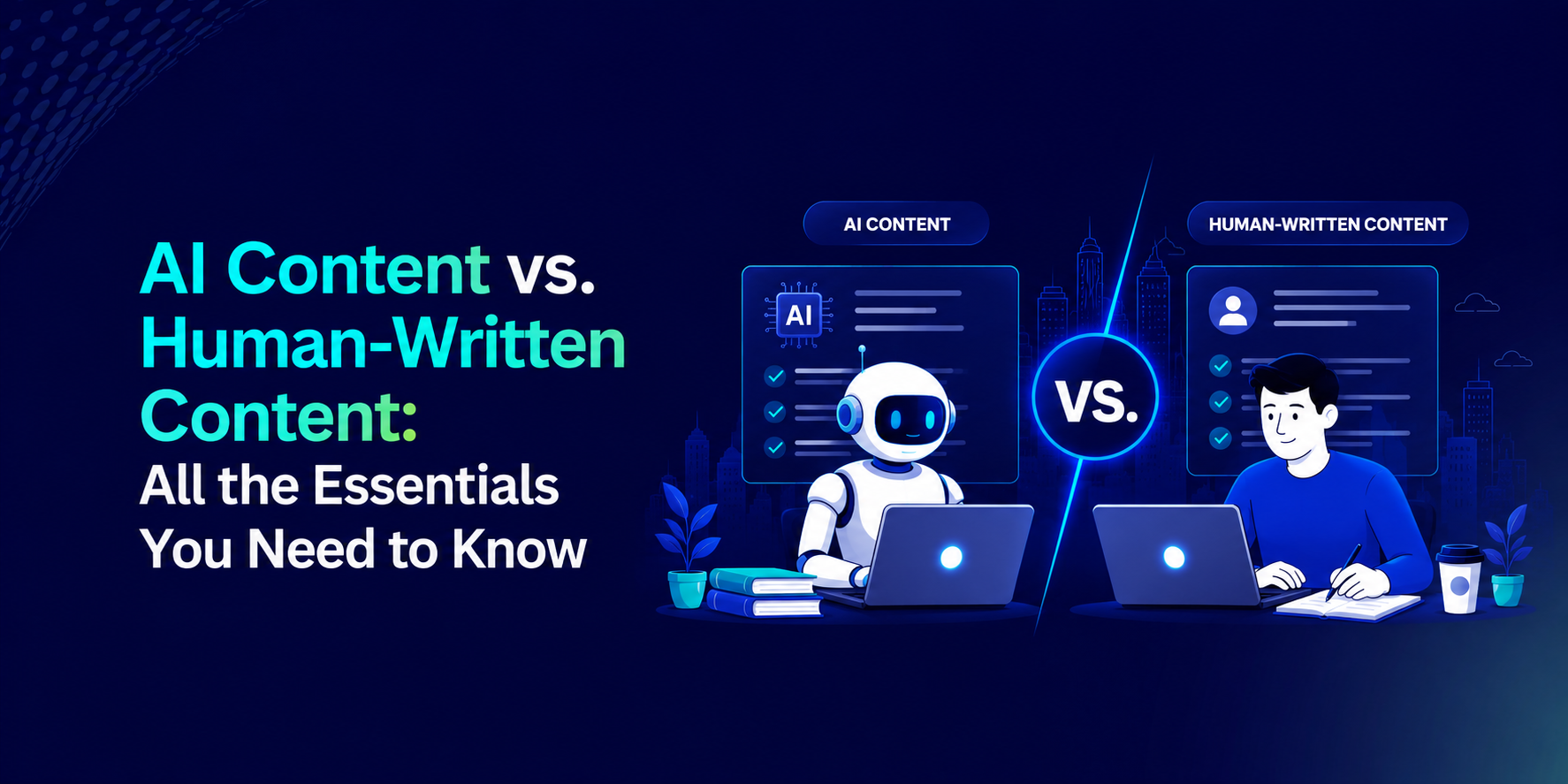
The debate between AI content and human-written content is the defining content strategy question of 2026, not because one has clearly won, but because most businesses are still making the choice based on cost and speed rather than the performance data that now exists to inform it properly.
Key Takeaways
- What is the difference between AI content and human-written content? AI content is produced by large language models that generate text by predicting statistically likely word sequences from training data. Human-written content is produced by people with genuine subject expertise, firsthand experience, and contextual judgment.
- Which performs better for SEO, AI or human-written content? Over a meaningful time horizon, human-written content consistently outperforms. Industry research tracking content trajectories over five months found human-written content generates 5.44 times more organic traffic than AI-generated equivalents.
- Is AI content ever the right choice? Yes, for specific, well-defined applications. AI excels at content briefs, metadata generation, first-draft scaffolding for non-YMYL content, keyword clustering, and content repurposing.
- What is the best content approach for most businesses? A hybrid content strategy- AI for efficiency tasks, human expertise for authority and experience signals- delivers the strongest documented results. Human-edited AI content ranks 34% higher on average than unedited AI output and costs significantly less than fully manual production. The hybrid model captures the savings without the liabilities.
- How does Google evaluate AI content vs. human content? Google does not explicitly penalize AI content; it rewards content that demonstrates Experience, Expertise, Authoritativeness, and Trustworthiness (E-E-A-T). AI content structurally lacks the firsthand experience and verifiable expertise signals that Google's quality evaluation weights most heavily.
Content production has never been faster, cheaper, or more abundant, and organic rankings have never been harder to earn and sustain. The relationship between those two facts is not coincidental. The flood of AI-generated content across every topic category has raised Google's quality bar significantly, made genuine expertise signals more valuable, and created a landscape where the businesses investing in real human knowledge are pulling away from those chasing volume.
And yet the choice is rarely as simple as "use AI" or "use humans."
The businesses generating the strongest content ROI in 2026 are neither the ones that adopted AI wholesale nor the ones that refused to engage with it at all. They are the ones who understood the distinction between what AI content tools genuinely do well and where they introduce liabilities that erode every efficiency gain they deliver.
That distinction is what this guide is designed to make clear.
In this guide, you will learn exactly how AI content and human-written content differ in production, quality, SEO performance, and business impact, which content types belong to each approach, what the data shows about their comparative performance over time, how to build a hybrid content strategy that maximizes the return of both, and the most common mistakes businesses make when choosing between them.
How AI Content and Human-Written Content Are Produced
Understanding the production process of each approach clarifies why they perform differently, and why the difference matters more in some content categories than others.
How AI content is produced
AI content is generated by large language models trained on vast data sets of text from the internet, books, and other sources. When given a prompt, a topic, a keyword, or a content brief, the model predicts the most statistically likely sequence of words to follow, drawing on patterns in its training data.
The output reflects what has been written about a topic, not what the model knows or has experienced about it. AI content is, by construction, a sophisticated synthesis of existing sources, which means it is competent at covering well-documented ground and unreliable at anything requiring original perspective, current accuracy, firsthand experience, or nuanced professional judgment.
Production is fast, scalable, and inexpensive. A 1,500-word draft that takes a skilled writer three to four hours can be generated by an AI tool in seconds. The cost differential at scale is significant. The quality differential, at the level that determines SEO performance and conversion rates, is equally significant.
How human-written content is produced
Human-written content is produced by people who bring knowledge, experience, judgment, and perspective that exist outside any training dataset. A physician writing about a treatment option brings clinical experience. An attorney writing about a legal process brings jurisdictional knowledge. A marketer writing a case study brings direct access to campaign data and client context.
This firsthand dimension is what Google's E-E-A-T framework, specifically its "Experience" component, is designed to reward and is a key factor in E-E-A-T content quality. It is also what audiences respond to: content that reflects genuine expertise reads differently from content that reflects pattern-matched synthesis, and readers increasingly recognize the difference.
Production is slower, more expensive, and harder to scale. These are real constraints, and they are the legitimate business case for introducing AI tools into the production process. The question is always where in the process, and for which content types.
Head-to-Head Comparison: AI Content vs. Human-Written Content
| Dimension | AI Content | Human-Written Content |
| Production speed | Minutes | Hours to days |
| Cost per piece | Very low | High |
| Keyword optimization | Consistent | Variable, depends on writer |
| Firsthand experience | None | High, when author is a practitioner |
| E-E-A-T compliance | Structurally limited | Strong, with credentialed authors |
| YMYL suitability | Low, expert review required | High, with appropriate credentials |
| Topical authority building | Weak over time | Strong, compounds with backlinks |
| Brand voice authenticity | Generic | Distinctive, reflects real perspective |
| Emerging topic coverage | Limited, relies on training data | Strong, draws from current knowledge |
| 5-month traffic performance | 1x baseline | 5.44x AI equivalent |
| Conversion rate (product copy) | Below human | Baseline, 30% higher than AI |
| Backlink acquisition | Low | High, original content earns citations |
| Compliance suitability | Risky without review | Strong, with expert authorship |
Where AI Content Delivers Real Value
Content brief and research generation
AI content tools generate comprehensive content briefs, covering target keywords, competitive landscape, required headings, and recommended sources, faster and more thoroughly than most manual research processes. For content teams producing briefs at volume, this represents a 70–80% time reduction on a high-frequency, formulaic task. The quality is maintained; the production cost collapses.
Metadata and on-page SEO elements
Title tags, meta descriptions, alt text, and schema markup generated at scale are one of the strongest AI content applications available. The output is consistent, optimized, and produced in a fraction of the time manual production requires, delivering measurable SEO value without the quality risks that apply to substantive content generation.
First-draft scaffolding for non-YMYL content
For content categories where expert review is not mandated, operational blog content, company updates, product feature explanations, AI-generated first drafts that receive substantive human editing represent a genuine cost reduction. The key qualifier is substantive editing: AI first drafts that are lightly proofread and published without real expertise layered in do not qualify as a cost-saving measure. They qualify as a liability.
Content repurposing at scale
Transforming a long-form blog post into a LinkedIn article, video script, email newsletter, and social media series is labor-intensive work that AI handles efficiently and accurately. For businesses with established content libraries, AI-powered repurposing extends the shelf life and reach of existing high-quality assets without the risks of generating net-new AI content for publication.
Programmatic SEO at scale for low-competition content
For e-commerce businesses managing thousands of product pages or publishers covering large topic territories at low competition levels, AI content optimisation can drive meaningful organic visibility across long-tail queries when paired with accurate specifications, natural keyword integration, and schema markup. The risk: thin content penalties from Google's Helpful Content system require active quality monitoring and human editorial oversight to manage.
Where Human-Written Content Is Non-Negotiable
YMYL content, healthcare, legal, financial services
Any content covering health decisions, legal guidance, financial advice, or safety information must reflect genuine, credentialed expertise, and must be reviewed and approved by a qualified professional before publication. AI content in these categories is not a cost-saving measure; it is a liability that combines ranking risk with professional liability and patient or client safety exposure.
88% of patients research health information online before making care decisions. Legal and financial consumers making high-stakes decisions are sophisticated evaluators of source credibility. The content that earns their trust and drives their conversions is categorically human, written by practitioners who can be identified, credentialed, and held accountable.
Thought leadership and authority-building content
The content that builds the brand authority responsible for long-cycle B2B conversions- original research, practitioner perspective, specific case study data, industry analysis- is inherently human. It reflects knowledge that does not exist in any training dataset, perspective that is distinctively attributable to a specific expert or organization, and the kind of original insight that earns citations from industry publications.
AI content can describe thought leadership topics. It cannot produce thought leadership, because thought leadership is, by definition, original thinking rather than synthesized reflection of existing sources.
Local and community-facing content
Home services, real estate, legal, and healthcare businesses competing in local search require content that reflects genuine local knowledge, neighborhood specifics, community context, and local market nuance that AI tools cannot credibly manufacture. In the Human Writer vs. AI Tools debate, local expertise remains one of the biggest differentiators because authentic, location-specific insights build credibility that generic AI-generated content cannot replicate. With 92% of consumers reading online reviews before choosing a local service provider, the authentic local brand voice that earns those reviews is the same voice that needs to drive every piece of locally targeted content.
Long-cycle B2B and SaaS content
SaaS and B2B buying cycles run 3 to 6 months from initial research to purchase decision. The content that earns and retains a prospective buyer's attention across that cycle requires genuine technical depth, product expertise, and practitioner credibility that AI content structurally cannot deliver. Thin AI content that ranks for top-of-funnel queries fails to convert the traffic it generates, making its organic visibility commercially worthless.
The 5-Month Performance Trajectory: What the Data Shows
The most important data point in the AI content vs. human content debate is not a snapshot; it is a trajectory. When performance is measured at 30 days, AI and human content often look comparable. When the measurement window extends to five months, the gap becomes unmistakable.
Month 1–2: AI content's early advantage
AI-generated content is structurally optimized by default, with consistent keyword use, logical heading hierarchy, and appropriate length. These characteristics help AI pages index quickly and rank early on lower-competition keywords. In the first four to eight weeks, AI content frequently matches or outperforms newly published human content on initial impressions and ranking positions.
This early performance is real but misleading. It reflects Google's initial keyword relevance assessment, not its deeper evaluation of quality, expertise, and user satisfaction, which requires engagement data to surface.
Month 3-4: The divergence
As pages accumulate engagement data- time on page, scroll depth, bounce rate, return visits- the performance gap opens. Human content that delivers genuine depth, original perspective, and accurate sourcing earns engagement signals that AI content typically cannot match. Google's quality algorithms weight these signals increasingly as pages age. In competitive keyword categories, this inflection typically occurs between weeks 8 and 14.
Month 5: The 5.44x gap
By the five-month mark, human-written content generates 5.44 times more organic traffic than AI-generated equivalents across comparable keyword targets. The compounding effect of backlink acquisition, which human content earns at significantly higher rates due to genuine originality and citation-worthiness, accelerates the divergence further. AI content that ranked at month one frequently plateaus or declines by month five; human content that ranked more slowly continues climbing.
Building a Hybrid Content Strategy
The evidence consistently points toward the same conclusion: neither pure AI content nor pure human-written content is the optimal approach for most businesses. The highest-performing content programs combine AI efficiency with human expertise in a defined workflow.
| Content Task | AI Role | Human Role |
| Keyword research and clustering | Leads | Reviews and prioritizes |
| Content brief generation | Leads | Approves and adjusts |
| First draft (non-YMYL) | Optional accelerator | Reviews and substantially edits |
| YMYL and authority content | Cannot lead | Leads, expert authorship required |
| E-E-A-T signals and author bio | Cannot contribute | Required |
| Metadata and schema | Leads | Verifies accuracy |
| Compliance review | Cannot contribute | Required for regulated industries |
| Local and community content | Cannot contribute | Required |
| Content repurposing | Leads | Reviews output |
| Performance monitoring | Leads | Interprets and acts |
Human-edited AI content ranks 34% higher on average than unedited AI output, capturing AI's efficiency advantage while protecting the quality level that earns durable rankings. Hybrid content programs see 2.3 times faster ranking improvements than manual-only approaches. The ROI case for a well-designed hybrid model is stronger than the case for either pure approach at most content volumes.
Common Mistakes Businesses Make When Choosing Between AI and Human Content
Mistake #1: Making the decision based on cost-per-word rather than revenue-per-piece. Cost-per-word is a production metric. Revenue-per-piece over a 12-month horizon is the business metric. On this measure, high-quality human or hybrid content almost always outperforms cheaper AI content within a 6-month window, because the traffic and conversion differential compounds while the production cost advantage is fixed.
Mistake #2: Applying AI content uniformly across all content types. The ROI of AI content varies dramatically by content type. Metadata generation and content brief production deliver strong, low-risk returns. YMYL content generation without expert review delivers negative returns when liability and remediation costs are included. A content strategy that does not differentiate by type will produce mixed results that make neither approach look as effective as it actually is when properly applied.
Mistake #3: Measuring AI content performance at 30 days. The 30-day window is the period during which AI content most closely resembles human content performance. The 5-month window is where the 5.44x divergence becomes visible. Short evaluation windows lead to continued investment in a strategy whose trajectory is already determined by the data; businesses just haven't waited long enough to see it.
Mistake #4: Publishing AI content without author attribution. Anonymous content, or content with generic placeholder bylines, is one of the clearest E-E-A-T red flags in Google's quality evaluation. Scaling AI content by removing author attribution defeats the purpose: it eliminates the human credibility signal that is the primary mechanism by which content earns sustained rankings.
Mistake #5: Not auditing existing AI content before scaling production. Businesses that published significant AI content volumes in 2023 and 2024 may already have quality signals in their content library that are suppressing domain-wide rankings through Google's sitewide Helpful Content assessment. Expanding AI content production without first auditing and remediating existing quality problems accelerates the damage rather than building on a stable foundation.
How Shankom Can Help
Shankom solutions builds hybrid content strategies that apply AI tools precisely where they deliver genuine efficiency gains and invest human expertise exactly where the data shows it builds durable organic value. From content audits that identify which existing pages in your library are creating quality signal risk, to full content programs that pair AI-assisted research and structure with credentialed human authorship, Shankom designs content operations that compound in value rather than requiring remediation.
Whether you are evaluating an AI content investment for the first time, recalibrating a program that has underdelivered, or building a content strategy from scratch in a competitive or compliance-sensitive industry, Shankom provides the framework and execution that turns content investment into measurable, sustained organic growth.