Why AI-Driven PPC Still Needs a Human Strategist in 2026
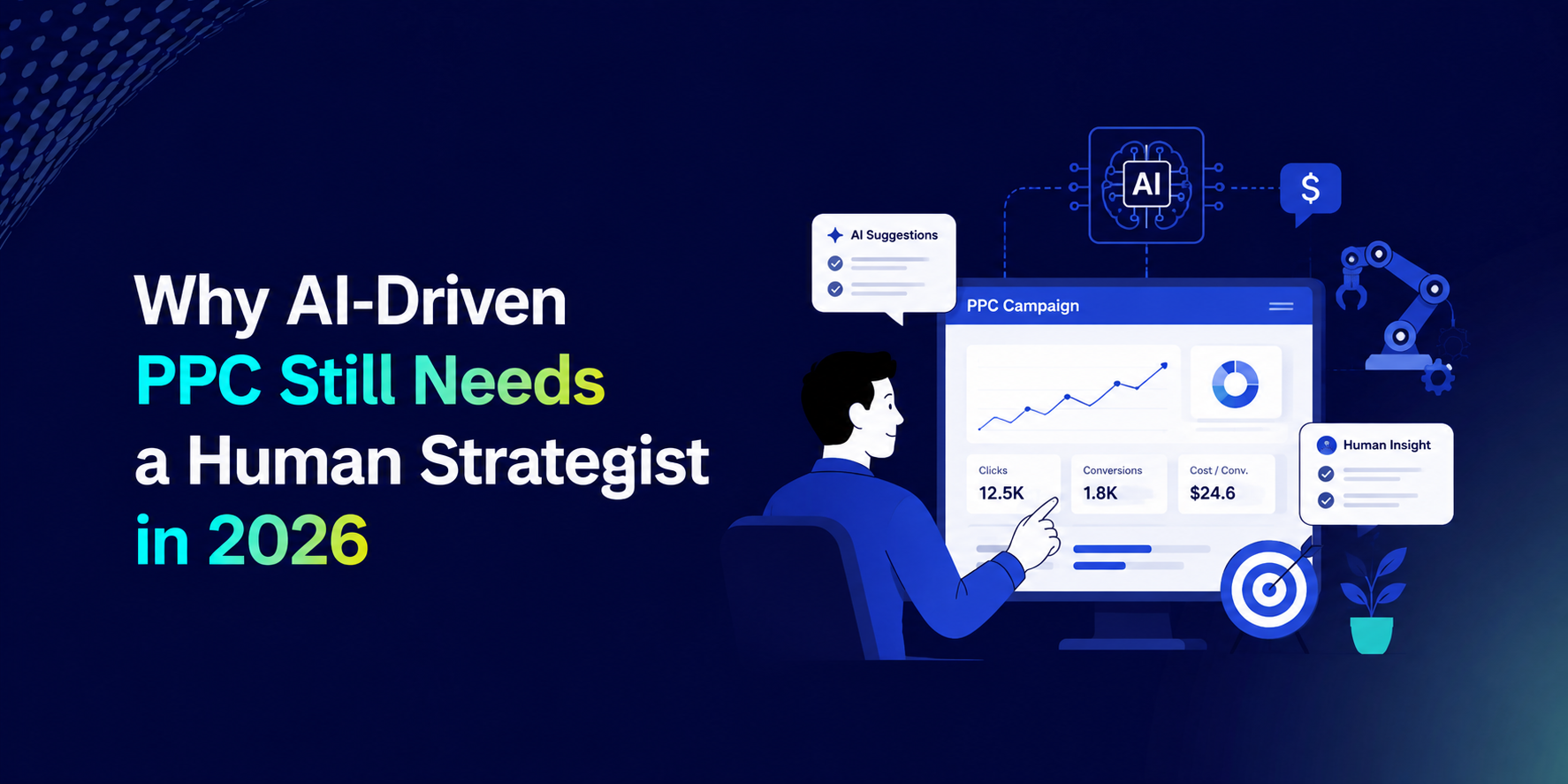
AI-driven PPC has transformed what is achievable in paid advertising, but every business that has handed full campaign control to an algorithm has eventually encountered the same lesson: AI optimizes brilliantly for the signals it can measure and makes consequential mistakes on everything it cannot.
Key Takeaways
- Why does AI-driven PPC still need human oversight in 2026? Google's Smart Bidding and Performance Max systems optimize for conversion signals, but they cannot apply business context, strategic judgment, compliance awareness, or creative direction.
- What does a human PPC strategist contribute that AI cannot? Pattern recognition tells you what happened. Strategic thinking tells you what to do about it. A human strategist provides business context for budget decisions and creative direction for messaging that resonates emotionally.
- Which industries are most at risk from AI PPC without human oversight? Legal services and financial services, where automated ad copy can trigger compliance violations, carry the highest risk. Healthcare follows closely, given regulated messaging requirements and patient acquisition stakes. Real estate, home services, and e-commerce all face meaningful wasted spend and conversion quality risks without active human campaign management.
- What is the right balance between AI and human PPC management? AI should own bid optimization, audience signal processing, and performance reporting, tasks that benefit from real-time data processing at a scale no human team can match. Human strategists should own campaign strategy, budget priority decisions, creative direction, compliance review, and the interpretation of performance data in business context.
The pitch for fully automated AI PPC management can be impressive. Google's algorithms process over 70 million auction signals per impression- device, location, time, search history, audience behavior, competitive landscape- and adjust bids in milliseconds. No human bid manager, however skilled, can operate at that speed or with that data density. The efficiency gains are real, the conversion volume improvements are documented, and the operational cost reduction is significant.
So why do the best-performing PPC accounts in 2026 still have a human strategist at the center of them?
Because the gap between what AI optimizes and what businesses actually need is filled entirely by human judgment, and in competitive, high-CPL industries, that gap is expensive to leave empty.
In this guide, you will learn exactly where AI PPC tools deliver genuine value and where they fall short, why pattern recognition is not the same as strategic thinking, which audience nuances AI consistently misses, how creative direction requires human judgment that no algorithm can replicate, why budget priority decisions need business context that sits outside any campaign dashboard, and how this plays out across six key industries.
Pattern Recognition vs. Strategic Thinking
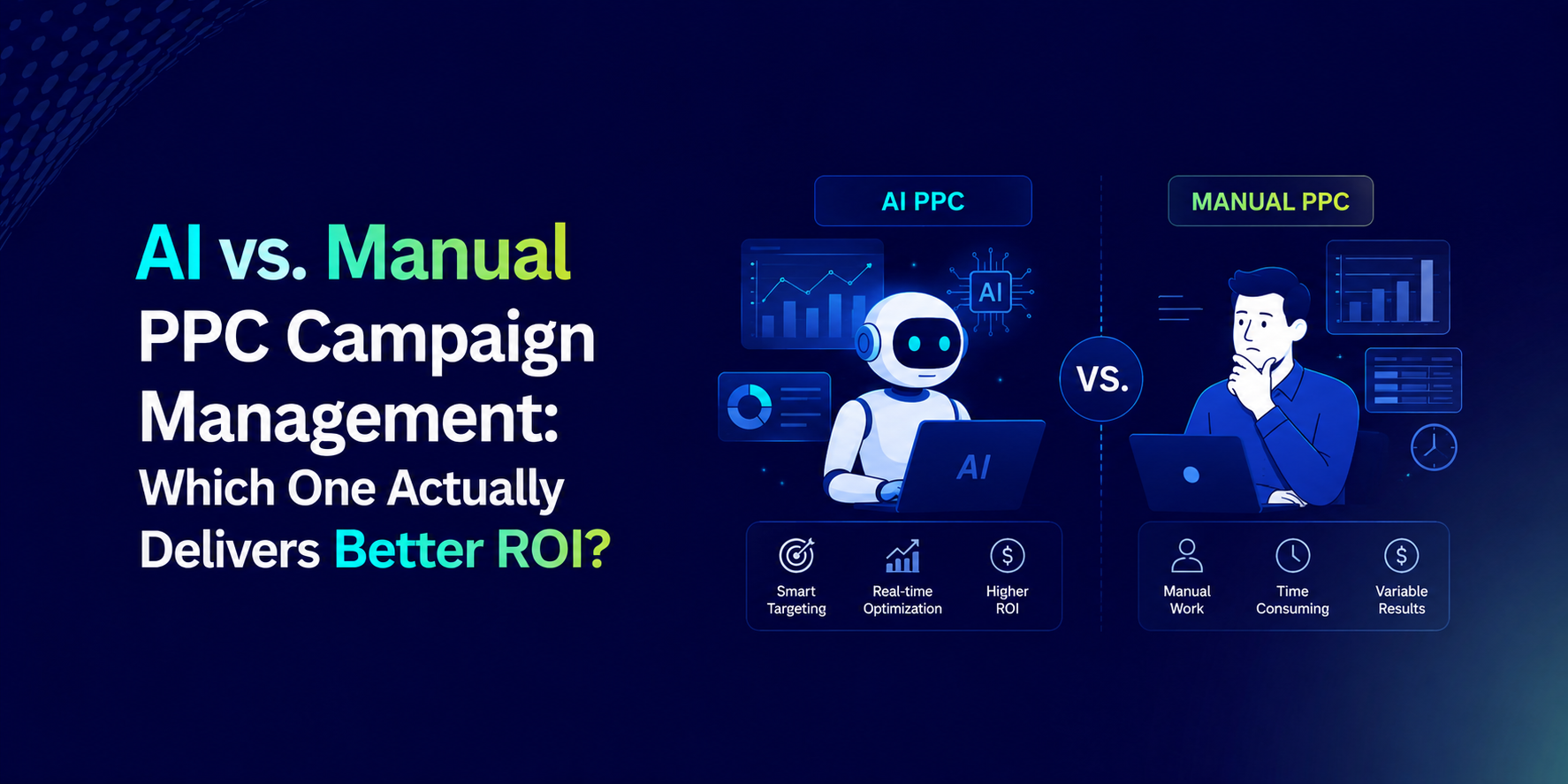
The most important distinction in the AI-driven PPC debate is the difference between pattern recognition and strategic thinking, because AI does the former exceptionally well and cannot do the latter at all.
Pattern recognition is identifying what has happened in historical and real-time data: which keywords convert at lower CPAs, which audiences click at higher rates, which times of day produce better ROAS, which bid levels win valuable impressions. Google's Smart Bidding algorithms are extraordinarily effective pattern recognizers; they process more signals, more quickly, than any human team can manually analyze.
Strategic thinking is deciding what to do with those patterns in the context of a specific business, at a specific moment, with specific constraints and objectives that live outside the campaign dashboard. Strategic thinking asks:
- Why is our CPL rising? Is it a campaign problem, a market shift, a seasonal pattern, or a product pricing issue?
- Should we pause this high-performing campaign while the landing page is being rebuilt, or accept lower conversion quality temporarily?
- Is the conversion volume our AI bidding system is optimizing for actually reflecting the leads our sales team can close?
- Does this ad copy comply with our industry's regulatory requirements, or did the algorithm assemble a headline combination that crosses a legal line?
- Should this month's budget be weighted toward new customer acquisition or toward retargeting our existing pipeline, and does the algorithm know which is more valuable right now?
None of these questions have answers in campaign data. They require a strategist who understands the business, the market, the competitive context, and the objectives that don't fit neatly into a conversion event.
The Four Things AI PPC Cannot Do
1. Apply business context to budget decisions
AI PPC systems optimize within the parameters they are given: budget caps, target CPAs, ROAS targets. They do not know that your highest-margin product line is about to launch and deserves a disproportionate budget allocation. They do not know that your largest competitor just exited a key market, creating a window to increase impression share aggressively. They do not know that your sales team is at capacity and additional lead volume this month will go unworked. Budget priority decisions require business intelligence that sits entirely outside the campaign management platform, and only a human strategist can bridge that gap.
2. Understand audience nuance beyond demographic signals
Google's audience targeting is sophisticated: in-market segments, affinity audiences, Customer Match, similar audiences, detailed demographics. But demographic signals are a proxy for human motivation, not a direct measure of it. The 45-year-old homeowner searching for "foundation repair" may be a panicked first-time buyer looking for reassurance, a property investor evaluating renovation costs, or a homeowner researching before calling a neighbor's recommendation. The same demographic signal signals three completely different audience needs, and three completely different ad messages that would resonate with each.
A human strategist recognizes these distinctions from sales team feedback, customer interview data, CRM patterns, and market knowledge. AI PPC tools see the demographic; the strategist sees the person behind it.
3. Direct creative that connects emotionally
Ad creative is where AI PPC tools have made the most visible advances. Responsive Search Ads test headline and description combinations automatically, Performance Max generates creative variants across channels, and Google's asset testing identifies what performs best statistically. While these capabilities can strengthen a Google Ads strategy, they primarily optimize for click-through rate, a measure of which combination earns the click, not which combination earns trust, builds brand equity, or connects with a prospective customer at an emotional level that drives long-term loyalty.
4. Enforce compliance before an ad runs
For regulated industries, the compliance risk of AI PPC creative automation is not theoretical; it is an active, recurring problem. Responsive Search Ads and Performance Max campaigns generate headline combinations automatically from the assets you provide. The specific combination the algorithm serves to a user on a given impression may create implied guarantees, use prohibited terminology, or make comparative claims that violate professional standards or platform policy, none of which the algorithm is designed to detect.
A human strategist reviews every active headline and description combination before campaigns go live, applies industry-specific compliance knowledge to creative decisions, pins required disclosures, and monitors ad serving patterns for combinations that require immediate pausing. This is not a task that can be automated away in legal, healthcare, or financial services; it is a professional obligation with real liability attached.
Industry Analysis: Where Human PPC Strategy Is Non-Negotiable
Legal Services
CPL benchmark: $131.63, the highest of any major industry
Legal services PPC operates at the highest cost-per-lead of any major advertising vertical, reflecting both the value of a qualified legal client and the intensity of competition for every impression. At $131.63 per lead, the cost of an imprecise campaign is measured quickly and painfully. AI PPC tools will optimize toward conversion volume, but in legal services, conversion quality is everything. A campaign generating 40 low-qualification leads at $131 each is not a $5,240 investment in the pipeline. It is a $5,240 waste.
Human strategists apply knowledge of the firm's practice areas, case types, and client profiles that no algorithm can access. They also enforce the compliance requirements that AI creative automation consistently struggles with: bar association advertising guidelines that prohibit specific claim types, jurisdiction-specific limitations on comparative advertising, and professional standards that require human review of every impression a firm's brand makes in a potential client's search results.
Healthcare
CPL benchmark: $56.83, regulated messaging, patient acquisition stakes
Healthcare PPC sits at the intersection of regulatory compliance, patient trust, and YMYL sensitivity that makes human oversight not optional but professionally obligatory. Google's healthcare advertising policies require certification for certain medical categories, prohibit specific claim types, and restrict remarketing practices for sensitive health conditions, a compliance landscape complex enough that even experienced healthcare advertisers regularly encounter policy issues.
AI PPC tools cannot apply clinical sensitivity to ad messaging. A campaign targeting patients researching a serious diagnosis needs a copy that is accurate, appropriately cautious, and emotionally attuned to the anxiety a patient in that position is experiencing. Algorithmically assembled headlines that optimize for CTR without that human sensitivity can be technically compliant while being tonally inappropriate in ways that damage patient trust and brand reputation. Human strategists bridge the gap between what performs statistically and what is appropriate clinically and ethically.
E-Commerce/Retail
Context: Largest US digital ad spender; scale demands make AI tempting but risky
E-commerce is the sector where AI-driven PPC is most aggressively adopted, and where the consequences of getting it wrong are most directly measurable in revenue. Retail represents the largest share of US digital ad spend, and the sheer scale of product catalogs, audience segments, and campaign types makes full manual management operationally impossible for most retailers.
The risk is not that AI cannot manage e-commerce PPC at scale; it can, and often effectively. The risk is that scale-driven AI automation without human strategic oversight produces campaigns that optimize for conversion volume without regard for margin, promote the wrong products for the current inventory position, or allocate budget away from brand-building during periods when price competition makes short-term ROAS metrics misleading. Human strategists set the strategic parameters, margin-adjusted ROAS targets, seasonal budget prioritization, and product promotion hierarchy, within which AI bidding operates most effectively.
Real Estate
CPL benchmark: $100.48, local precision targeting that AI often gets wrong
Real estate PPC is defined by hyperlocal precision that AI targeting consistently struggles to deliver without human guidance. The difference between a buyer searching for property in one neighborhood versus an adjacent one is not a demographic signal; it is a hyper-specific local intent that requires geographic targeting granularity, neighborhood-level ad messaging, and knowledge of local market conditions that no algorithm can infer from auction data alone.
At $100.48 per lead, misdirected real estate traffic is expensive. A campaign serving ads about luxury condominiums to users whose behavioral signals indicate starter home intent, a mistake AI audience tools make regularly when not actively supervised, wastes budget on leads that will never convert while leaving the high-intent audience underserved. Human strategists apply local market knowledge to targeting decisions that go well beyond what demographic and behavioral signals can communicate.
Home Services
CVR benchmark: 7.33%, local intent heavy, high wasted spend risk without oversight
Home services PPC achieves the highest average conversion rate of major industry verticals at 7.33%, reflecting the high-intent, immediate-need nature of most home services searches. This efficiency makes home services an excellent candidate for Smart Bidding and automated management. It also makes wasted spend from poor targeting decisions proportionally expensive, because every dollar diverted to low-intent traffic is competing against a benchmark conversion rate that could otherwise generate significant qualified lead volume.
The wasted spend risk in home services AI PPC concentrates in two areas: geographic targeting that bleeds beyond service areas (an AI system optimizing for conversion rate will follow signals wherever they lead, not respect a physical service boundary unless it is precisely configured and actively maintained), and negative keyword management that only human weekly review can keep current. The best home services PPC programs pair Smart Bidding automation with rigorous human-maintained geographic and keyword exclusion management, the combination that captures AI's efficiency advantage while eliminating its most common local targeting failure modes.
Financial Services
Context: Fastest-growing US digital ad spender; compliance in ad copy is non-negotiable
Financial services is the fastest-growing US digital advertising vertical, reflecting both the sector's increasing digital maturity and the intensity of competition for high-value financial product customers. It is also one of the most tightly regulated advertising environments in digital marketing, with Google's financial products certification requirements, jurisdiction-specific disclosure obligations, and regulatory body guidelines governing what can be said, how it must be disclaimed, and who is authorized to say it.
AI PPC creative automation in financial services produces the same compliance risks observed in legal services: algorithmically assembled headline combinations that imply returns, state rates without required disclosures, or use language that triggers regulatory review. The consequences of compliance failures in financial services extend beyond platform policy violations into potential regulatory action, making human review of every active ad combination not a best practice but a business protection requirement. Human strategists in financial services PPC function as the compliance layer between algorithmic efficiency and legal accountability.
What the Optimal Human-AI PPC Partnership Looks Like
The most effective PPC management structure in 2026 is not a choice between AI and human oversight; it is a defined division of responsibility that plays to the strengths of each.
| Campaign Decision | AI Leads | Human Leads |
| Bid optimization per auction | ✓ | Sets target parameters |
| Audience signal processing | ✓ | Defines audience strategy |
| Performance reporting | ✓ | Interprets in business context |
| Creative combination testing | ✓ (RSA, PMax) | Provides assets, pins compliance |
| Budget priority allocation | ✗ | ✓ Business context required |
| Compliance review | ✗ | ✓ Required in regulated industries |
| Strategic objective setting | ✗ | ✓ |
| Audience nuance and messaging | ✗ | ✓ |
| Negative keyword management | Flags patterns | ✓ Reviews and applies weekly |
| Landing page strategy | ✗ | ✓ |
| Competitive response decisions | ✗ | ✓ |
Common Mistakes Businesses Make with AI-Only PPC Management
Mistake #1: Treating Smart Bidding as a set-and-forget system. Smart Bidding automates bid decisions; it does not manage campaign strategy, keyword lists, negative keyword maintenance, landing page performance, or creative quality. Campaigns running on full automation without weekly human review consistently drift toward wasted spend and declining Quality Scores.
Mistake #2: Letting Performance Max run without asset and placement oversight. Performance Max campaigns serve ads across all Google channels automatically. Without human review of placement reports, asset performance ratings, and search term data, PMax regularly allocates significant budget to brand queries, irrelevant placements, and low-intent audience segments that should be excluded.
Mistake #3: Using AI-generated ad copy in regulated industries without compliance review. In legal, healthcare, and financial services, automated headline combinations create compliance exposure that no campaign performance metric will flag. Human compliance review of every active ad combination is the only reliable protection.
Mistake #4: Accepting AI conversion volume data without CRM cross-referencing. Smart Bidding optimizes for the conversions your tracking reports. If your CRM data shows that only 20% of reported leads are qualifying, the algorithm is optimizing toward the 80% of conversions that will never generate revenue. Human strategists cross-reference campaign conversion data against CRM qualification rates and adjust optimization signals accordingly.
Mistake #5: Allowing AI to set budget allocation across campaigns. Google's automated budget tools will allocate budget toward the campaigns generating the most conversions at the lowest reported CPA. They will not know that your highest-CPA campaign is targeting your most profitable customer segment, or that a lower-performing campaign is building brand awareness that drives assisted conversions across the rest of the account. Budget allocation decisions require business context that only a human strategist can apply.
How Shankom Can Help
Shankom solutions provide PPC management that combines the precision of AI-driven optimization with the strategic oversight that turns campaign performance into business growth. From Smart Bidding strategy configuration and Performance Max asset management to compliance review for regulated industry clients, creative direction, audience strategy, and budget prioritization that reflects your actual business objectives, Shankom applies human expertise exactly where algorithms fall short. Whether you are running campaigns in legal, healthcare, financial services, or any other high-CPL vertical, Shankom builds and manages the human-AI PPC partnership that delivers ROI the algorithm alone cannot reach.