AI vs. Manual PPC Campaign Management: Which One Actually Delivers Better ROI?
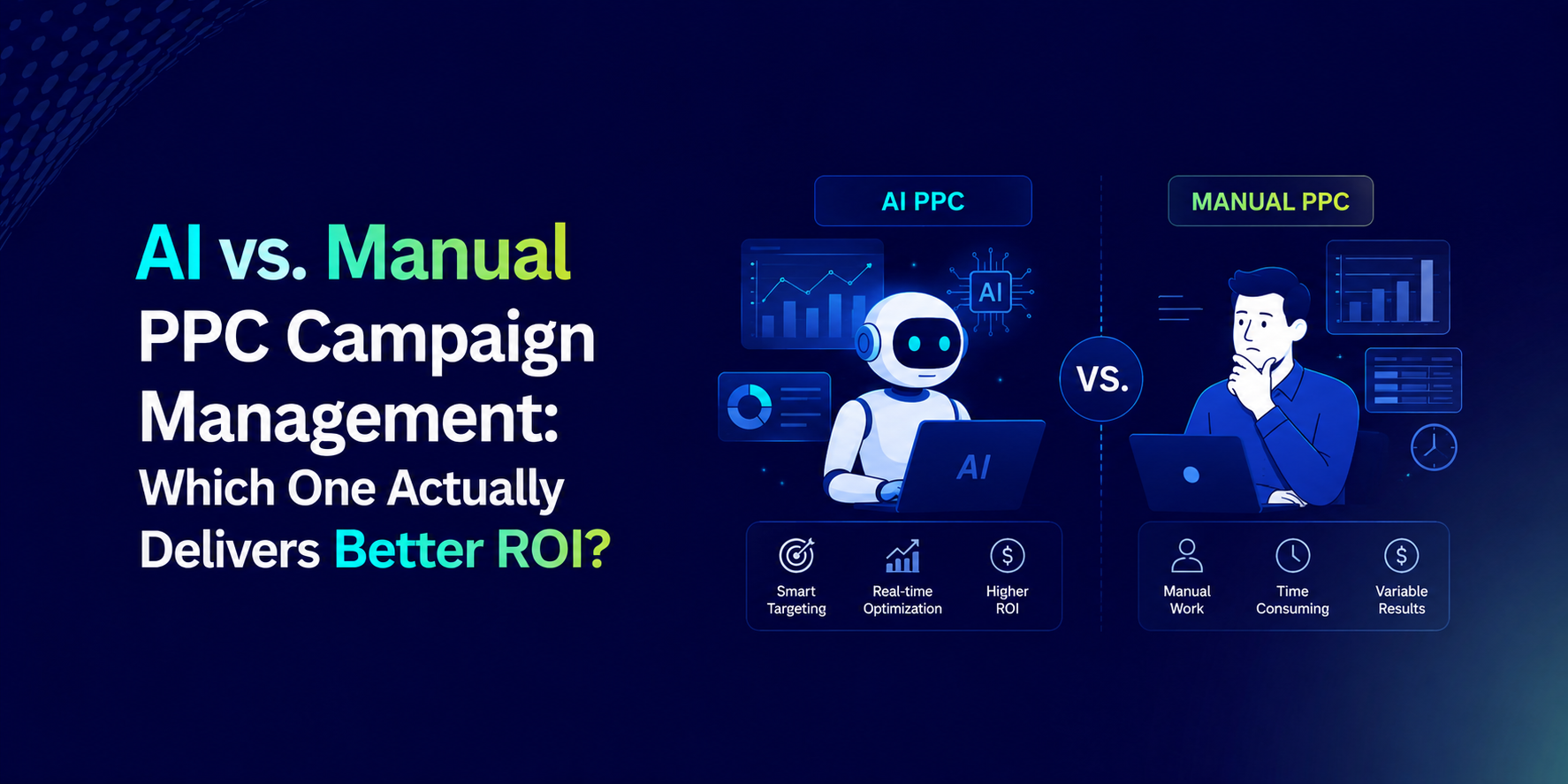
The debate between AI PPC management and manual PPC management is one of the most consequential decisions a modern advertiser faces, not because one is universally superior, but because choosing the wrong approach for the wrong situation is one of the fastest ways to waste a paid search budget.
Key Takeaways
- What is the difference between AI and manual PPC management? Manual PPC management means a human strategist controls every bid, keyword, audience, and budget decision. AI PPC management delegates those decisions, partially or fully, to Google's machine learning algorithms.
- Which delivers better ROI, AI or manual PPC? Neither is universally better. AI-driven campaigns outperform manual management in accounts with high conversion volume, diverse audience data, and clear optimization signals. Manual management consistently outperforms AI in compliance-heavy industries, low-volume accounts, and campaigns requiring granular message control that automated systems cannot replicate.
- When should I use AI PPC management? When your account generates at least 30 to 50 conversions per month per campaign, has accurate conversion tracking in place, and operates in an industry where Google's auction signals reliably predict purchase intent. E-commerce, home services, and consumer retail are strong candidates.
- When should I use manual PPC management? When your industry is compliance-sensitive (legal, healthcare, financial services), your conversion volume is too low to feed Smart Bidding algorithms effectively.
- What is the conversion data threshold for Smart Bidding? Google recommends a minimum of 30 conversions per month per campaign for Maximize Conversions, and 50 per month for Target CPA and Target ROAS.
Paid search advertising has never been more powerful, or more contested. On one hand, Google's AI systems offer real-time bid optimization across billions of auction signals, promising conversion volume and efficiency that no human team can match manually. On the other hand, experienced PPC managers argue that algorithmic control without human oversight is a shortcut to wasted spend, compliance violations, and campaigns optimized for Google's revenue rather than yours.
Both sides have a point. That is what makes this decision genuinely difficult.
AI PPC management has transformed what is achievable at scale. Advertisers using Performance Max and Smart Bidding strategies saw a 14% average increase in conversions at a similar cost-per-action compared to standard Search campaigns. Google's algorithms process over 70 million signals per auction- context, device, location, time, search history, audience behavior- and adjust bids in milliseconds in ways that no human bid management system can replicate.
The right answer to AI versus manual PPC management is not a matter of preference; it is a diagnosis. The correct approach depends on your conversion data quality, your industry's compliance requirements, your account's maturity, and what "success" actually means for your business. The most effective PPC services evaluate these factors before determining the right balance between AI automation and human expertise.
In this guide, you will learn exactly how AI PPC and manual PPC management compare across the metrics that matter, which industries benefit most from each approach, how conversion data quality determines which strategy is viable, and real-world ROI benchmarks for both approaches:
How AI PPC Management Works
AI PPC management refers to the use of Google's machine learning systems, primarily Smart Bidding strategies and Performance Max campaigns, to automate bid decisions, audience targeting, and in some cases creative testing and budget allocation.
The core of AI PPC is Smart Bidding: a suite of automated bid strategies that adjust bids in real time at the individual auction level. Unlike manual bids set once per keyword, Smart Bidding evaluates dozens of contextual signals simultaneously, including the user's device, physical location, time of day, search history, browser, and on-site behavior, and calculates the optimal bid for that specific impression in milliseconds.
Smart Bidding strategies include:
- Maximize Conversions spends the full budget to maximize conversion volume
- Target CPA bids to achieve a specific cost per acquisition
- Target ROAS bids to achieve a specific return on ad spend
- Maximize Conversion Value optimizes for total revenue rather than conversion volume
Each strategy relies on conversion data from your account to learn which users and auctions are most likely to convert. More data means better decisions. Less data means the algorithm is essentially guessing, and guessing expensively.
How Manual PPC Management Works
Manual PPC management means a human strategist makes the core campaign decisions: which keywords to bid on, at what price, with what ad copy, targeting which audience segments, on which devices, at which times of day. All major optimizations, bid adjustments, keyword additions and exclusions, ad copy testing, and audience layering are reviewed and executed by a person.
The strength of manual PPC management is precision and accountability. A skilled human manager can:
- React immediately to compliance requirements or policy changes
- Control exact messaging to align with brand standards or legal restrictions
- Apply strategic judgment that goes beyond conversion signal optimization
- Investigate anomalies, diagnose attribution problems, and make context-aware decisions that algorithms are not designed to make
- Manage low-volume accounts where insufficient data would cause Smart Bidding to underperform
The limitation is scale. A human manager optimizing bids across hundreds of keywords, audiences, devices, and time slots is always working with a snapshot of historical data, never the real-time, auction-level precision that AI systems apply automatically.
The Control vs. Scale Trade-Off
The central tension in the AI vs manual PPC debate is a trade-off between control and scale. Understanding it clearly is the key to making the right choice for any given account.
| Dimension | Manual PPC Management | AI PPC Management |
| Bid precision | Per keyword, updated periodically | Per auction, updated in milliseconds |
| Signals used | Historical data, human judgment | 70M+ real-time signals per auction |
| Message control | Complete, human-approved | Partial, RSA combinations, PMax assets |
| Compliance suitability | High, human review at every step | Lower, automated copy can trigger violations |
| Scale efficiency | Limited by team bandwidth | Scales across unlimited keywords and audiences |
| Learning curve | Immediate (no data threshold) | Requires 30–50+ conversions/month |
| Best for | Low-volume, compliance-heavy, precision-critical | High-volume, conversion-rich, scalable accounts |
The trade-off is not binary. Most mature, well-performing accounts use a hybrid approach, applying Smart Bidding where data volume justifies it and retaining manual control in campaigns where it doesn't.
Conversion Data Quality: The Deciding Factor
Conversion data quality is the single most important variable in the AI vs manual PPC decision, more than industry, budget size, or campaign type. This is because every AI bidding strategy learns from the conversions your account reports. If that data is inaccurate, incomplete, or misattributed, the algorithm optimizes toward the wrong goal with high confidence.
The minimum data threshold
Google's own recommendations establish clear minimum thresholds:
- Maximize Conversions: 30+ conversions per month per campaign
- Target CPA/Target ROAS: 50+ conversions per month per campaign
- Performance Max: 50+ conversions in the past 30 days recommended for optimal learning
Below these thresholds, AI PPC strategies enter an extended learning phase that consumes budget generating data rather than revenue. In practice, accounts below 30 monthly conversions consistently see better cost-per-acquisition results from enhanced manual bidding than from Smart Bidding strategies.
Conversion tracking accuracy
Before enabling any Smart Bidding strategy, verify that:
- All conversion events are firing accurately in Google Ads and verified in Tag Manager
- Conversion values are assigned correctly; not all conversions are equal in revenue impact
- No duplicate conversion events are inflating reported volume
- Offline conversions (phone calls, in-store visits, CRM-matched leads) are being imported and attributed
A campaign reporting 60 conversions per month from duplicate tracking events is not a 60-conversion campaign; it is a campaign feeding corrupted data into an algorithm that will optimize confidently in the wrong direction.
Industry-by-Industry Analysis: AI vs. Manual PPC
The correct approach to PPC campaign management looks different across industries because the compliance requirements, conversion volumes, and audience signal quality vary dramatically.
Legal Services
Recommended approach: Manual-led with selective AI assistance
Legal services advertising operates under strict bar association guidelines, platform-level restrictions on specific legal claim types, and reputational requirements that make automated creative control a genuine risk. AI-generated ad copy combinations, especially in Responsive Search Ads or Performance Max, can produce headline combinations that imply guarantees, use prohibited terminology, or make comparative claims that violate professional standards. The average CPA for legal keywords on Google Search is $73.70, making every misaligned ad conversion expensive.
Manual PPC management gives legal advertisers the message control needed to ensure every impression reflects compliant, professionally appropriate copy. Smart Bidding can be layered selectively, particularly Target CPA on well-established ad groups with clean conversion data , but creative and keyword control should remain human-reviewed.
Healthcare
Recommended approach: Manual-first with tight AI guardrails
Healthcare PPC campaign management faces some of the strictest advertising policies of any industry, from HIPAA considerations around audience targeting and remarketing to Google's certification requirements for certain medical categories. AI systems do not inherently understand the clinical sensitivity of healthcare messaging, which means automated copy generation can produce ad combinations that are factually questionable, tonally inappropriate, or non-compliant with platform health advertising policies.
Healthcare advertisers should maintain manual control over ad copy and keyword inclusion, use exact and phrase match keywords to prevent irrelevant query triggering, and apply strict negative keyword lists reviewed weekly. Smart Bidding strategies can be used once conversion volume and tracking accuracy meet threshold requirements, but audience targeting automation should be approached cautiously given privacy and compliance sensitivities. The average healthcare CPA is $78.09, underscoring the cost of misaligned clicks.
E-Commerce/Retail
Recommended approach: AI-first, manual oversight
E-commerce is where AI PPC management delivers its most compelling results. High conversion volumes, clear revenue attribution through e-commerce tracking, diverse product catalogs, and repeat-purchase audience signals all feed Google's algorithms exactly what they need to optimize effectively. Performance Max campaigns drive over 75% of U.S. retail search ad spend, and Shopping campaigns powered by Smart Bidding consistently outperform manually managed equivalents once sufficient conversion data is established.
Retailers using AI-driven bidding with Target ROAS report 25 to 35% improvements in return on ad spend compared to manual bidding on equivalent budgets. Manual oversight remains important for product feed quality management, promotional period bid strategy adjustments, and ensuring Performance Max doesn't cannibalize branded search traffic, but the core bidding and audience decisions are best delegated to AI in this sector.
Real Estate
Recommended approach: Hybrid, manual for creative, AI for bidding
Real estate advertising sits at an interesting intersection: relatively high conversion data volume in active markets but significant lead quality variation that pure conversion-volume optimization can miss. A campaign optimized to maximize form submissions may attract unqualified leads at the expense of serious buyers, making raw conversion volume a misleading optimization signal.
The most effective real estate PPC strategy uses manual control for keyword selection and ad copy (ensuring geographic and property-type precision) while applying Smart Bidding on high-volume, well-tracked conversion events. Importing offline conversion data, qualified leads, booked appointments, and completed transactions from a CRM gives Google's algorithm the quality signal it needs to differentiate high-value leads from form fill volume. Average real estate CPA sits at $116.61, making lead quality optimization significantly more valuable than volume maximization.
Home Services
Recommended approach: AI-first
Home services- plumbing, HVAC, electrical, roofing, and landscaping- are one of the clearest cases for AI PPC management. High-intent local searches, consistent conversion patterns (calls or form fills), strong geographic targeting signals, and high call volume create ideal conditions for Smart Bidding. Businesses that invest in professional Google Ads management services can further optimize these AI-driven campaigns for stronger lead quality and improved ROI. Google Local Services Ads, which operate on a pay-per-lead model and are heavily algorithm-driven, are particularly effective for home services businesses and should be the first platform investment before standard Google Ads for most local service providers.
Home services advertisers using Smart Bidding with call tracking as a primary conversion event consistently report lower CPAs and higher qualified lead volumes than equivalent manual campaigns. AI's ability to adjust bids based on proximity, time of day, and seasonal demand patterns, all critical variables in local service demand, makes algorithmic management genuinely superior in this sector.
Financial Services
Recommended approach: Manual-led with strict compliance guardrails
Financial services advertising is among the most tightly regulated in digital marketing. Google requires certification for financial product advertisers in most markets. Ad copy for financial products must comply with specific disclosure requirements, prohibited claims restrictions, and in many jurisdictions, financial regulatory body guidelines that go well beyond platform policy.
AI PPC management in financial services carries meaningful compliance risk. Automated copy generation can produce combinations that imply returns, make comparative rate claims, or use language that triggers regulatory review. Manual control over every headline and description, with legal review for high-stakes campaigns, is not optional in this sector. Smart Bidding can be used selectively for bid management on compliant, pre-approved campaigns, but creative automation should be disabled. The average financial services CPA is $81.93, expensive enough that compliance-driven campaign failures carry real cost.
Real-World ROI Benchmarks: AI vs. Manual PPC
| Metric | Manual PPC (Average) | AI/Smart Bidding (Average) | AI Advantage |
| Conversion volume | Baseline | +14% vs. standard Search | Yes, at sufficient data volume |
| Cost per conversion | Stable, controlled | 10–25% lower at scale | Yes, above 50 conv/month |
| ROAS (E-commerce) | 3:1 to 4:1 | 4:1 to 6:1 with Target ROAS | Yes |
| Compliance risk | Low, human review | Higher, automated combinations | Manual wins |
| Learning curve cost | None | $1,000–$5,000+ during learning phase | Manual wins at low volume |
| Performance at low conv. volume | Consistent | Erratic and often expensive | Manual wins |
| Time to stable performance | Immediate | 4–6 weeks post-launch | Manual wins early |
Building a Hybrid PPC Campaign Management Strategy
For most businesses, the answer to AI vs manual PPC is not a binary choice; it is a calibrated allocation of each approach to the campaigns where it performs best.
Apply AI management where:
- Conversion volume exceeds 50 per month per campaign
- Conversion tracking is verified accurate and complete
- The industry does not impose compliance restrictions on automated creative
- Scale and efficiency are the primary objectives
Apply manual management where:
- Conversion volume is below the Smart Bidding threshold
- Industry regulations require human review of all ad copy
- Campaign strategy is in a testing or restructuring phase
- Conversion data quality is uncertain or being rebuilt
- Message precision is non-negotiable for brand or legal reasons
Apply hybrid management where:
- Smart Bidding handles bid decisions on proven campaigns
- Human oversight controls creative assets, keyword lists, and negative keyword maintenance
- Offline conversion data is imported from CRM to improve algorithm signal quality
- Manual override is maintained for compliance-sensitive ad groups within broader AI-managed campaigns
Common AI and Manual PPC Mistakes
Mistake #1: Enabling Smart Bidding before conversion tracking is verified. The most expensive AI PPC mistake is launching automated bidding before confirming that conversion events are firing accurately. An algorithm optimizing toward duplicate or misfired conversions will spend confidently and deliver nothing.
Mistake #2: Assuming AI eliminates the need for active management. AI PPC management automates bid decisions; it does not manage keyword strategy, negative keyword lists, landing page performance, creative quality, or budget allocation. Accounts running on full automation without weekly human review consistently drift toward wasted spend and declining Quality Scores.
Mistake #3: Using manual bidding on high-volume e-commerce accounts. For accounts generating hundreds of conversions per month across thousands of product SKUs, manual bid management is operationally impossible to execute accurately. Attempting it consistently results in missed bid opportunities, overexposure on low-value keywords, and underinvestment in high-converting product lines.
Mistake #4: Applying AI creative automation in compliance-heavy industries. In legal, healthcare, and financial services, allowing Responsive Search Ads or Performance Max to automatically generate headline combinations without review is a compliance risk. Pinning compliant headlines removes some automation benefit, but it is a necessary trade-off.
Mistake #5: Not importing offline conversions. For B2B, legal, healthcare, and financial services advertisers where the conversion is a qualified lead rather than an online transaction, feeding only form-fill data to Smart Bidding optimizes for quantity over quality. Importing CRM-matched qualified lead and won-deal data teaches the algorithm to target users who convert into actual revenue, not just form submissions.
How Shankom Can Help
Shankom solutions designs and manages PPC campaign management strategies that apply the right blend of AI PPC management and manual PPC management for your specific industry, data volume, and compliance requirements. From Smart Bidding strategy selection and conversion tracking audits to compliance-safe creative management for legal, healthcare, and financial services clients, Shankom builds the account architecture that gets the most from both approaches, without the risks of applying either blindly. Whether you need to rescue an AI-automated account that has drifted off target or build a precision-controlled manual strategy for a regulated industry, Shankom delivers data-driven PPC campaign management that puts ROI above platform convenience.