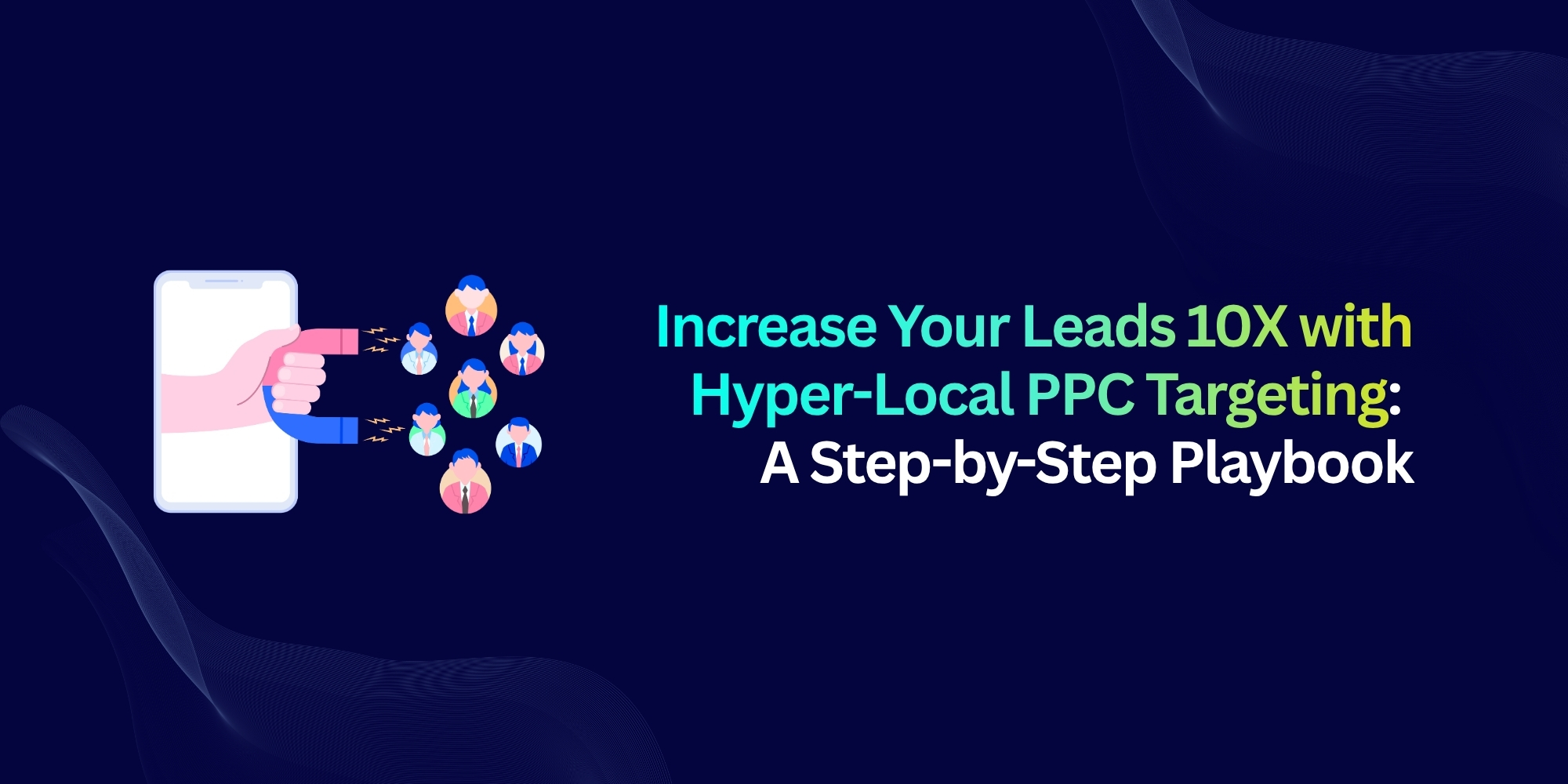
Increase Your Leads 10X with Hyper-Local PPC Targeting: A Step-by-Step Playbook
Businesses running Google Ads without hyper-local targeting are essentially putting up a billboard on the highway and hoping the right person drives by. A 2025 BrightLocal study found that 98% of consumers used the internet to find local businesses, and 76% of people who search for something nearby visit a business within a day. To maximize these opportunities, businesses need data driven ppc campaigns that focus on customer locations, search behavior, and conversion insights. If your PPC campaigns are not built around where your customers actually are, you are competing for attention from people who will never walk through your door or pick up the phone.
Key Takeaways
What is hyper-local PPC targeting?
It is the practice of narrowing your Google Ads campaigns to the specific geographic areas, neighborhoods, and radius zones where your best customers are, rather than running broad city- or region-wide targeting.
Why does it increase leads?
Because it puts the right ad in front of the right person at the right location. Hyper-local campaigns consistently deliver higher click-through rates, lower cost per lead, and better conversion quality than broader geographic targeting.
How much of a difference does it actually make?
Google reports that "near me" searches have grown by over 500% in recent years. Campaigns optimized for local intent produce 2 to 5 times more qualified leads per dollar spent compared to non-localized equivalents.
Which industries benefit most?
Legal services, healthcare, home services, real estate, retail, and any business where the customer's physical location determines whether they can actually become a customer.
Is hyper-local PPC complicated to set up?
It requires more strategic thinking than broad targeting, but once the structure is in place, it runs efficiently and consistently outperforms broader campaigns on every cost and quality metric.
Most businesses running local Google Ads make the same mistake. They select their city, set a radius that feels roughly right, and run campaigns targeting everyone inside it. It looks logical on the surface. In practice, it means a plumber in South Florida is paying for clicks from users in South Carolina who would never hire a business that far away. A dental clinic in one part of a city is spending on queries from neighborhoods it cannot realistically serve.
The result is a campaign that produces impressions and clicks, but not the conversion volume the budget should support. The problem is not the ad creative. It is not the landing page. It is the targeting. Hyper-local PPC targeting solves this by working at the level of actual customer behavior: the specific radius a person is willing to travel, the neighborhood-level trust signals that drive local service decisions, and the real-time location intent signals that influence purchase decisions. Along with precise targeting, using negative keywords helps remove irrelevant searches, ensuring your ads are shown only to users with genuine intent and improving overall campaign efficiency.
Google can be used to deliver your ad at the exact moment someone nearby needs what you offer.
Step 1: Define Your True Service Area Before Touching the Platform
The most important step in hyper-local PPC happens before you open Google Ads. It is a realistic assessment of where your customers actually come from.
Pull your last 12 months of customer data and map out where completed jobs, appointments, or purchases originated geographically. Most businesses find that 70 to 80% of their revenue comes from a much smaller area than their current campaign targeting covers.
This exercise identifies your core service zone, the boundary where your conversion rate drops, and the areas where you are currently spending budget on traffic that almost never closes.
Questions to answer at this stage:
- What is the maximum distance a customer will realistically travel or wait for your service?
- Are there specific neighborhoods or zip codes that consistently produce your highest-value customers?
- Are there areas within your current targeting where customers inquire but rarely convert, suggesting a geographic mismatch in your campaign?
- Do your competitors have a stronger local presence in any of your targeted zones, reducing your realistic win rate there?
This data becomes the blueprint for your targeting structure. Without it, every radius and location setting you apply is a guess.
Step 2: Choose the Right Geographic Targeting Method
Google Ads offers multiple ways to define where your ads show. Understanding which method to use in which situation is what separates a precise hyper-local PPC strategy from a slightly more specific broad one.
Radius Targeting
Radius targeting draws a circle of a defined distance around a specific address or pin. It is the most practical method for service-area businesses like home services, healthcare practices, legal offices, and restaurants where proximity is the primary driver of customer decisions.
Best practice is to create layered radius zones rather than a single circle. For example:
- 0 to 3 km: Highest bids, most specific local ad copy referencing the immediate neighborhood
- 3 to 8 km: Standard bids, general service area messaging
- 8 to 15 km: Lower bids, broader messaging focused on availability and reach
This bid layering ensures your highest spend goes toward the people most likely to convert, while still capturing demand from further afield at a cost that reflects the lower probability of conversion.
Location Targeting by Zip Code or Neighborhood
For businesses with multiple service zones or retail locations, targeting by specific PIN codes or neighborhoods gives more surgical control than radius targeting. This method is particularly effective for real estate, legal services, and financial services businesses where neighborhood-level specificity in ad copy drives significantly higher engagement.
Location Intent vs. Physical Presence
Google Ads gives you two options: targeting people physically located in your area, or targeting people who have shown interest in your area through search behavior. For most local businesses, targeting physical presence is the right choice. The exception is real estate, relocation services, and hospitality businesses, where someone planning a visit or move searches locally from a different location.
Step 3: Write Ad Copy That Feels Local
One of the most underused advantages of hyper-local PPC is the ability to write ad copy that speaks directly to the neighborhood or area you are targeting. Generic ad copy that could apply anywhere performs significantly worse than copy that signals local familiarity and community presence.
A roofing company running one generic ad across an entire city is competing on price and features. The same company running an ad that references a specific neighborhood, mentions local weather events, or names local landmarks is competing on trust and proximity, which are the two factors that drive local service decisions more than anything else.
Practical ways to localize ad copy:
- Include the neighborhood or area name in the headline: "Roof Repair Specialists in the Bay Area."
- Reference local context where relevant: "Serving SF Bay Area Homeowners Since 2010."
- Use local phone numbers rather than national hotlines to reinforce community presence
- Mention proximity or speed of service where relevant: "Same-Day Electrician in South Florida."
Ad customizers in Google Ads allow you to dynamically insert location variables into ads, making it possible to run neighborhood-specific copy at scale without writing individual ads for every location.
Step 4: Build Location-Specific Landing Pages
Sending hyper-local ad traffic to a generic homepage is one of the most common and costly mistakes in local PPC. When someone clicks an ad that mentions their neighborhood and lands on a page with no local reference, the trust signal established by the ad disappears immediately.
Location-specific landing pages do not need to be entirely unique pieces of content. The elements that make the biggest conversion difference are:
- A headline that mirrors the ad copy and references the target area
- A local phone number that connects to someone who knows the area
- Customer reviews or testimonials from clients in that specific neighborhood or city
- A map or service area visual showing the location you serve
- Local trust signals such as community affiliations, local business certifications, or recognizable neighborhood references
Google's Quality Score assessment also rewards landing page relevance to the ad and keyword. A locally relevant landing page improves Quality Score, which lowers cost per click and improves ad position simultaneously.
Step 5: Layer Audience Targeting on Top of Geographic Targeting
Geographic targeting tells Google where to show your ads. Audience layering tells Google who, within that location, to show them to. Combining both is what makes hyper-local PPC genuinely powerful.
- In-Market Audiences: Google identifies users actively researching services in your category. Layering in-market audiences onto your geographic targeting ensures your ads prioritize users in your area who are already in a buying mindset.
- Remarketing Audiences: Users who have already visited your website but did not convert are your highest-probability leads. Remarketing campaigns with location targeting help re-engage these users with a second touchpoint, often delivering a lower cost per conversion than cold audience campaigns. By tracking user behaviour and campaign performance, businesses can improve their marketing ROI by focusing their budget on audiences who have already shown interest in their products or services.
- Customer Match: Upload your existing customer list to Google Ads and use it to build a lookalike audience of people who share characteristics with your best customers. Targeting this audience within your hyper-local zones directs your budget toward people who match your highest-converting customer profile.
- Demographic Adjustments: Apply bid adjustments for age, household income, and homeownership status where relevant to your service. A luxury home renovation company targeting high-income homeowners in premium zip codes, for example, can increase bids for users in the top household income brackets within their target radius.
Step 6: Use Ad Scheduling to Match Local Search Patterns
When your ads run is just as important as where they run. Most local businesses have distinct peak hours when purchase-intent searches happen, and running campaigns at full budget outside those windows wastes money on lower-intent browsing.
Pull your Google Ads conversion data by hour and day of the week. Look for patterns: when do the majority of conversions happen? When do clicks occur that never convert? Use this data to set bid adjustments that increase spend during peak conversion hours and reduce it during low-performance windows.
For emergency home services businesses, 24-hour coverage is necessary. For healthcare practices, appointment-request traffic tends to concentrate in early mornings and lunch hours on weekdays.
For legal services, research-driven searches peak in evenings and weekends when potential clients have time to look into their situation. For retail, weekend afternoon patterns dominate in most categories.
Step 7: Track the Metrics That Actually Measure Local PPC Performance
Standard campaign metrics tell you what happened. Local PPC metrics tell you whether the right people are finding you.
Metrics that matter most for hyper-local PPC:
- Call conversion rate by location: If you serve multiple zones, which areas produce the most phone calls per click? This tells you where your local presence is strongest and where it needs reinforcement.
- Click-to-direction requests: Users clicking for directions from Google Maps ads have high purchase intent. This metric is particularly important for retail and healthcare.
- Cost per lead by radius zone: Break down CPA by the geographic layers in your campaign. If your inner radius costs $30 per lead and your outer radius costs $90, that data justifies restructuring your budget allocation.
- Impression share by location: Are you losing impression share in your core service zones? This means budget or bid constraints are preventing your ads from reaching the most valuable local queries.
- Conversion rate by neighborhood: Some areas convert far better than others. Over time, this data should inform where you increase bids, create dedicated campaigns, or invest in additional local trust-building.
Common Hyper-Local PPC Mistakes to Avoid
- Setting one radius and treating it as the whole strategy. A single radius applied uniformly gives every location within it the same budget and the same bids. Layered radius zones with differentiated bids deliver far better results because they reflect the reality that conversion probability drops with distance.
- Running the same ad copy across all locations. Generic copy that does not reference the target area removes the primary trust advantage of local targeting. Location-specific headlines and copy are not optional extras in hyper-local campaigns. They are the conversion mechanism.
- Sending local ad traffic to a generic homepage. Without a location-specific landing page, the local trust signal from the ad is broken the moment the user arrives on site. This is one of the most measurable conversion killers in local PPC.
- Not excluding locations where you cannot actually serve customers. Broad radius settings frequently include areas outside the realistic service boundary. These clicks cost the same as in-zone leads and almost never convert. Exclusion of specific zones outside your service area is as important as the inclusions.
- Ignoring Google Maps and Local Search ad formats. For local businesses, Google Maps ads and Local Search ads appear directly in map results for nearby queries. These formats carry strong purchase intent signals and are underused by most local advertisers despite delivering some of the highest conversion rates on the Google Ads platform.
- Evaluating local campaigns on impressions and clicks alone. Local PPC success is measured in leads and customers from the target area, not traffic volume. An account showing strong impression share in non-converting outer zones looks good on a traffic report and fails on a revenue report.
How Shankom Can Help
Shankom solutions builds hyper-local PPC strategies for businesses that want leads from the right locations, not just clicks from the right keywords. From service area mapping and radius targeting architecture to location-specific ad copy, neighborhood-level landing pages, audience layering, and conversion tracking by geographic zone, Shankom designs local PPC campaigns that match your ad spend to the areas that generate your best customers. Whether you are a single-location service business or a multi-location brand managing campaigns across several markets, Shankom provides the structure and ongoing management that turn local search intent into qualified leads.
FAQs
What is hyper-local PPC targeting?
It is the practice of focusing Google Ads campaigns on the specific geographic zones, neighborhoods, or radius areas where your customers actually are, rather than broad city- or region-wide settings. It improves lead quality and reduces wasted spend by matching ads to users with genuine proximity-based purchase intent.
How much can hyper-local targeting improve PPC lead volume?
Campaigns optimized for local intent produce 2 to 5 times more qualified leads per dollar spent compared to non-localized equivalents. Google reports that 28% of local searches result in a purchase, a conversion rate that significantly exceeds most broad keyword categories.
What is the best geographic targeting method for local businesses?
Layered radius targeting works best for most service-area businesses. Creating inner, mid, and outer radius zones with differentiated bids ensures the highest budget concentration in the areas with the highest conversion probability, while still capturing demand from broader zones at an appropriate cost level.
Do I need separate landing pages for each location I target?
Not necessarily entirely different pages, but location-specific elements on the landing page make a significant difference in conversion. A headline that references the target area, local testimonials, a local phone number, and a service area map are the minimum elements that reinforce the local trust signal your ad created.
Which industries benefit most from hyper-local PPC?
Home services, healthcare, legal services, real estate, and retail benefit most because their service delivery or customer acquisition is fundamentally geography-dependent. Any business where the customer's location determines whether they can realistically become a customer should be running hyper-local campaigns.