How We Improved Organic Calls for a Med Spa in Orlando Without Increasing Ad Spend
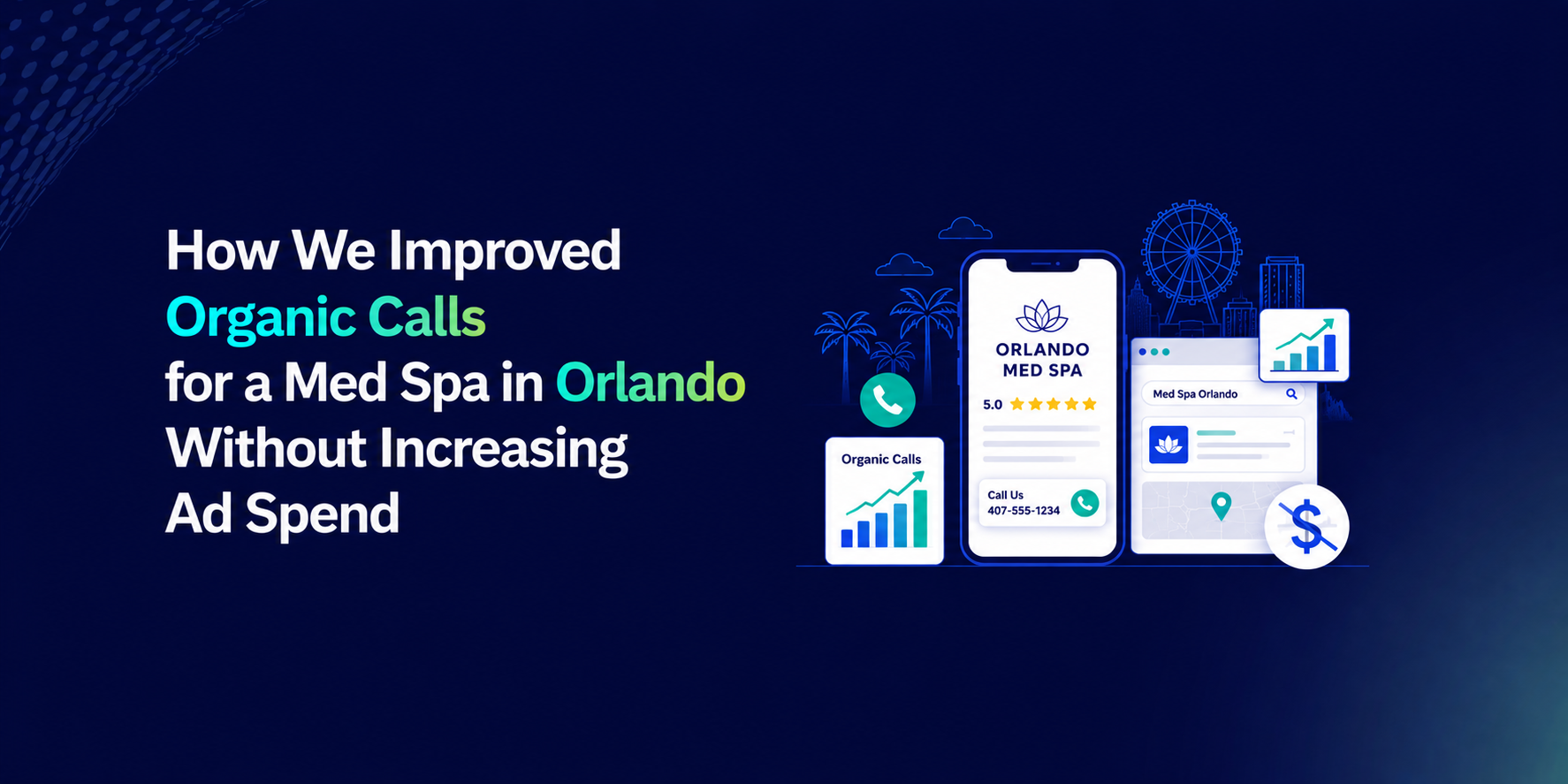
A well-reviewed Orlando med spa with a strong service menu was generating fewer than 11 organic calls per month because its website was technically weak, its Google Business Profile was incomplete, it had no treatment-specific or neighborhood-specific content, and its E-E-A-T signals were invisible to Google. Our local SEO audit services uncovered these issues and helped prioritize the improvements that would have the greatest impact. A structured local SEO strategy implemented in four phases, covering technical fixes, content depth, Google Business Profile optimisation, and authority building, produced a 340% increase in organic calls over 16 weeks. No additional ad spend. No new service offerings. Only a search presence rebuilt to reflect the quality of the business behind it.
Key Takeaways
- Why do med spas struggle with organic traffic despite strong reviews? Because reviews build trust but do not build search visibility. Organic rankings require a technically sound website, deep treatment-specific content, a fully optimised Google Business Profile, and E-E-A-T signals that establish practitioner credibility. Reviews contribute to one component. The others require deliberate SEO work.
- What makes med spa SEO different from other local businesses? Google classifies aesthetic medical services as healthcare-adjacent content, applying stricter E-E-A-T evaluation than it would for a standard beauty or wellness business. Named practitioner credentials, treatment safety information, and professional certifications are ranking signals on a med spa website in ways they would not be on a nail salon website.
- Is paid advertising necessary to generate leads for a med spa? Not as the primary channel. Med spa lead generation through organic search delivers exclusive, high-intent leads at zero cost per click once the ranking foundation is built. The compounding return from organic visibility increases over time while paid advertising costs remain constant or rise.
- How long did this improvement take? The full 340% organic call increase was achieved over 16 weeks. Meaningful improvement in local search visibility began appearing from week six as technical fixes were indexed and location content was crawled.
When a mid-size med spa in Orlando came to us in early 2025, they were spending $4,200 per month on Google Ads and generating a reasonable number of leads. The problem was that when the ads paused for two weeks during a billing issue, the phone stopped ringing almost entirely. Their organic presence was generating fewer than 11 calls per month. The business had been operating for four years, had 61 Google reviews averaging 4.7 stars, and offered a strong menu of treatments including Botox, dermal fillers, laser hair removal, CoolSculpting, and skin rejuvenation services. The reviews were there. The reputation was there. The organic visibility was not. This is the case study of how that changed over 16 weeks without a single dollar of additional ad spend.
The Starting Point: What the Audit Found
Before any optimization work began, a comprehensive SEO audit services process was carried out to evaluate the med spa website across four key areas: technical health, content quality, local SEO signals, and E-E-A-T credibility. The findings reflected a common pattern seen across many underperforming local business websites: the business itself was strong, but the digital infrastructure behind it was not built to rank.
Technical audit findings:
- Core Web Vitals failing on mobile for Largest Contentful Paint (5.1 seconds against the 2.5-second passing threshold) and Interaction to Next Paint
- No schema markup of any kind on any page
- Duplicate title tags across seven treatment pages
- No XML sitemap submitted to Bing Webmaster Tools
- Three broken internal links on the services navigation menu
Content audit findings:
- Average treatment page length of 290 words against the 1,100 to 1,600 word average of the top three Google-ranking competitors for each treatment query
- No FAQ sections on any treatment page
- No Orlando-specific content on any page referencing local neighborhoods, climate context, or community relevance
- A single "About" page with a team photo and three sentences of biography, no named practitioners with credentials visible
Local SEO audit findings:
- Google Business Profile primary category is set to "Beauty Salon" rather than "Medical Spa"
- Only four services are listed on a treatment menu with eighteen offerings
- No Google Posts in the previous 11 weeks
- NAP data inconsistency across four directories, including Yelp, Vagaro, and StyleSeat, with an old phone number still live
E-E-A-T audit findings:
- No named medical director or lead practitioner profile with credentials on the website
- No certifications, licensing information, or professional affiliations displayed
- No treatment safety information or FDA-approval context on aesthetic treatment pages
- No external directory presence on RealSelf, Healthgrades, or medical association listings
Each of these gaps was fixable. The audit prioritized them by ranking impact and implementation speed, and the recovery plan was built around that prioritization.
Phase 1: Technical Foundation (Weeks 1 to 3)
Technical fixes were implemented first for two reasons. They register with Google faster once implemented, and content improvements on technically broken pages produce less impact than the same improvements on technically sound ones.
Core Web Vitals remediation: All treatment page images were compressed and converted to WebP format. Render-blocking JavaScript from the booking widget was deferred. A caching layer was implemented at the hosting level. Largest Contentful Paint improved from 5.1 seconds to 1.8 seconds on mobile within ten days, moving all key pages from failing to passing scores.
Schema markup implementation: MedicalBusiness, LocalBusiness, MedicalProcedure, AggregateRating, and FAQPage schema were deployed across the full site. The MedicalBusiness schema included practitioner credentials and licensing information for the medical director, establishing the structured data signal that Google uses to assess healthcare-adjacent credibility.
Technical cleanup: Duplicate title tags were replaced with unique, keyword-specific titles for every treatment page. Broken internal links were repaired. An XML sitemap was submitted to Bing Webmaster Tools, opening the site to ChatGPT and Microsoft Copilot citation visibility.
NAP correction: The old phone number was corrected across all four inconsistent directories. The business name format was standardized across every citation to match the Google Business Profile exactly.
Phase 2: Treatment Page Content Expansion (Weeks 4 to 8)
The eight highest-search-volume treatment pages were prioritized for content expansion based on keyword search volume and the gap between existing page length and competing page length. Each was expanded from an average of 290 words to between 1,100 and 1,600 words using a content structure built around the search intent behind each treatment query.
The content structure applied to every treatment page:
- What the treatment is and the specific concern it addresses, written in plain language for a first-time patient
- How the treatment works at the Orlando med spa specifically, including the consultation process, session structure, and what patients experience
- Who is a candidate with clear, medically accurate candidacy criteria
- What results look like, including realistic expectations, timeline, and maintenance requirements
- Orlando-specific context relevant to the treatment, for example, Orlando's year-round sun exposure and its relevance to laser treatment timing and skin preparation protocols
- Cost and package information in general terms that give searchers enough context to qualify themselves as a prospect
- A FAQ section of 6 to 8 questions drawn directly from Google's "People Also Ask" boxes for each treatment query in the Orlando market
The Orlando-specific content layer was the element that most competitors had not included. Any med spa can publish a page about Botox. Only an Orlando-specific page can reference the humidity and sun exposure conditions that affect treatment scheduling, the specific concerns of Orlando's outdoor-active and tourism-industry-employed patient demographic, and the local context that signals genuine local relevance to Google.
Treatment pages expanded in Phase 2:
| Treatment Page | Pre-Audit Word Count | Post-Expansion Word Count |
| Botox and Dysport | 310 | 1,380 |
| Dermal Fillers | 280 | 1,240 |
| Laser Hair Removal | 260 | 1,520 |
| CoolSculpting | 340 | 1,460 |
| Chemical Peels | 220 | 1,180 |
| Microneedling | 290 | 1,310 |
| Skin Rejuvenation | 270 | 1,200 |
| PRP Treatment | 310 | 1,420 |
Phase 3: Google Business Profile and Location Content (Weeks 6 to 11)
While treatment page content was being expanded, the Google Business Profile was fully rebuilt from the incomplete state the audit had identified.
Primary category change: The primary category was updated from "Beauty Salon" to "Medical Spa," which immediately improved relevance matching for med spa queries. Secondary categories for "Skin Care Clinic," "Laser Hair Removal Service," and "Medical Aesthetics" were added.
Service menu completion: All 18 treatments were added as individual services with keyword-rich descriptions, including the treatment name, the concern it addresses, and a reference to Orlando. Where relevant, popular brand names such as Botox, Juvederm, Sculptra, and CoolSculpting were included in service descriptions.
Google Posts program: A weekly Google Posts calendar was implemented, covering rotating topics: treatment education content, seasonal skin care tips relevant to Orlando's climate, before-and-after results where consent permitted, limited-time consultations, and staff introduction posts. Post frequency is a business activity signal that Google weights as a prominence indicator.
Neighborhood location pages: Three dedicated location pages were built for the highest-case-volume Orlando neighborhoods in the med spa's service area:
- Winter Park: Upscale residential demographic, emphasis on anti-aging treatments, fillers, and skin rejuvenation
- Dr. Phillips: Affluent family demographic, emphasis on body contouring, laser hair removal, and preventative treatments
- Lake Nona: Medical City adjacent population, emphasis on medical-grade skincare, PRP, and science-backed aesthetic treatments
Each location page included the neighborhood name in the title tag, H1, and URL, a Google Maps embed, LocalBusiness schema with geo-coordinates, and an FAQ section referencing the specific patient profile and treatment preferences of that community.
Phase 4: E-E-A-T and Authority Building (Weeks 10 to 16)
The final phase addressed the credibility gaps that had made the site structurally vulnerable to Google's quality evaluation of healthcare-adjacent content.
Named practitioner profiles: A dedicated "Our Team" section was built with individual pages for the medical director and two lead aesthetic practitioners. Each profile included full name, medical credentials and license numbers, specializations, years of experience in aesthetic medicine, and professional certifications, including board certification details and brand-specific training credentials such as Allergan and Galderma injector certification.
Every treatment page was updated with an author byline linking to the relevant practitioner's profile page. This authorship signal is one of the most direct E-E-A-T improvements available on a medical or healthcare-adjacent website.
External directory presence: Profiles were created or claimed and optimized on RealSelf, Healthgrades, Vagaro, and the American Med Spa Association member directory. Each profile carried consistent NAP data and a link to the website. RealSelf, in particular, carries strong domain authority for aesthetic treatment searches and functions as a trust signal for both Google and prospective patients conducting research.
Local backlink acquisition: Three Orlando-specific backlinks were secured during this phase: a feature in an Orlando lifestyle blog covering aesthetic trends, a listing in the Orlando Business Journal's health and wellness directory, and a community sponsorship with a local women's professional network that included a website mention and backlink.
Review velocity program: An automated SMS review request was implemented through the spa's booking software, triggered 24 hours after each completed appointment. In the six weeks of Phase 4, 34 new Google reviews were generated, bringing the total from 61 to 95 and adding consistent review velocity that Google weights as an active prominence signal.
AI SEO enhancements
To improve visibility in ChatGPT, Google AI Overviews, Gemini, Perplexity, and Copilot, the following AI-focused steps were added on top of the traditional SEO work:
- Structured answers on key pages: Each major treatment page was updated with short, stand‑alone answer blocks (40–60 words) to common questions like “How long does Botox last?” and “Is CoolSculpting safe?” using clear headings and FAQ sections. This made it easier for AI systems to extract and quote accurate information.
- Clear clinic and provider entities: The clinic’s name, address, phone, treatments, and provider details were made fully consistent across the website, Google Business Profile, and major directories to reduce ambiguity when AI models attempted to match “med spa in Orlando” or “Botox near me” to a specific practice.
- Schema tuned for AI discovery: The existing schema was refined to ensure treatments, reviews, and providers were all clearly marked up and connected, increasing the likelihood that AI models see a unified, trustworthy entity with medical oversight.
- Reputation and recency: The new review workflow increased review velocity and kept the average rating high, signaling that AI engines increasingly factor into which local clinics they mention or emphasise.
- Broader index coverage: With sitemaps in both Google and Bing, the med spa’s content became easier for AI-driven tools that lean on those indices to find and evaluate.
Review velocity program: An automated SMS review request was implemented via the spa’s booking software, triggered 24 hours after each completed appointment. In the six weeks of this phase, 34 new Google reviews were generated, bringing the total from 61 to 95 and adding consistent review velocity.
The Results: 16-Week Performance Summary
| Metric | Pre-Optimisation | Week 16 | Change |
| Monthly organic calls | 11 | 48 | 340% increase |
| Google Business Profile views | 420/month | 1,840/month | 338% increase |
| Map Pack impressions | 1,200/month | 5,600/month | 367% increase |
| Organic website sessions | 310/month | 1,140/month | 268% increase |
| Google reviews | 61 | 95 | 56% increase |
| Treatment pages ranking page 1 | 2 | 11 | 9 additional pages |
The most significant shift was in Map Pack visibility. Moving from a "Beauty Salon" primary category to "Medical Spa" and completing the service listings produced the first measurable ranking improvement within 12 days of implementation, confirming that the primary category error had been suppressing Map Pack visibility for the full period the incorrect category had been in place.
The treatment page expansions produced their most significant ranking improvements between weeks 8 and 12, as Google recrawled and re-evaluated the expanded content. The Botox page moved from position 14 to position 3 for "Botox Orlando." The CoolSculpting page moved from position 22 to position 7 for "CoolSculpting Orlando."
By week 16, the med spa's organic call volume had exceeded its paid ad call volume for the first time. The paid advertising budget remained unchanged throughout the entire process.
What This Case Study Demonstrates for Every Med Spa
The results achieved for this Orlando med spa were not produced by a proprietary technique or a tactic unavailable to competitors. They were produced by identifying the specific gaps between what the business's digital infrastructure was and what Google requires to rank a med spa digital marketing program competitively, and fixing each gap systematically.
Every med spa generating fewer organic leads than its review count and service quality suggest it should be generating has the same diagnosis available through a structured audit. The gaps are almost always the same. The fixes are almost always the same. The results, when implemented consistently, follow the same trajectory.
The businesses winning med spa Google rankings in every competitive market in 2026 are not the ones with the largest ad budgets. They are the ones with the most complete, credible, and technically sound search presence.
How Shankom Can Help
Shankom solutions provides med spa SEO and Orlando med spa marketing services for aesthetic clinics that need organic traffic for med spas to generate a consistent flow of booked consultations without relying entirely on paid advertising. From comprehensive med spa digital marketing audits and technical website fixes, to treatment page content expansion, Google Business Profile optimization, neighborhood location page development, E-E-A-T signal building, review generation workflows, and ongoing local SEO for med spas that compounds in value over time, Shankom builds the complete search presence that turns a well-reviewed, high-quality med spa into the most visible one in its market.
FAQs
Why is my med spa not generating organic leads despite good reviews?
Because reviews build trust but do not build search visibility. Organic rankings require a technically sound website with passing Core Web Vitals scores, treatment-specific content pages with sufficient depth to rank competitively, a fully optimised Google Business Profile with the correct primary category and complete service listings, and E-E-A-T signals establishing named practitioner credentials. Reviews contribute to one component of Google's local ranking algorithm. The others require deliberate SEO work independent of review count.
What is the most important Google Business Profile fix for a med spa?
The primary category. Most med spas are categorized as "Beauty Salon" or "Spa" rather than "Medical Spa," which fundamentally misrepresents the business type to Google and suppresses Map Pack visibility for med spa-specific queries. Updating the primary category to "Medical Spa" with relevant secondary categories for each treatment discipline is the fastest single fix available for improving local search relevance matching.
How long does med spa SEO take to produce results?
The Orlando case study documented here produced a 340% increase in organic calls over 16 weeks. Meaningful initial improvements in Map Pack visibility typically appear within 4 to 6 weeks of technical fixes and Google Business Profile optimisation being implemented. Significant organic ranking improvements on competitive treatment queries typically develop over 8 to 14 weeks as expanded content is indexed and re-evaluated by Google.
Why do treatment pages need to be long to rank for med spa queries?
Because Google evaluates content depth relative to competing pages for the same query. If the top three ranking pages for "CoolSculpting Orlando" average 1,400 words with structured sections covering treatment process, candidacy, results timeline, and FAQ content, a 300-word page cannot compete on content relevance regardless of other signals. Content depth is not about word count for its own sake. It is about matching the comprehensiveness of the content Google has determined serves the search intent behind each query.
What E-E-A-T signals matter most for a med spa website?
Named medical director and practitioner profiles with credentials, license numbers, and professional certifications prominently displayed. Author bylines on all treatment content, attributing each page to a named credentialed practitioner. Active profiles on RealSelf, Healthgrades, and medical association directories. Treatment safety information and FDA-approval context on aesthetic treatment pages.