What’s Stopping Personal Injury Lawyers in Miami From Generating Organic Leads?
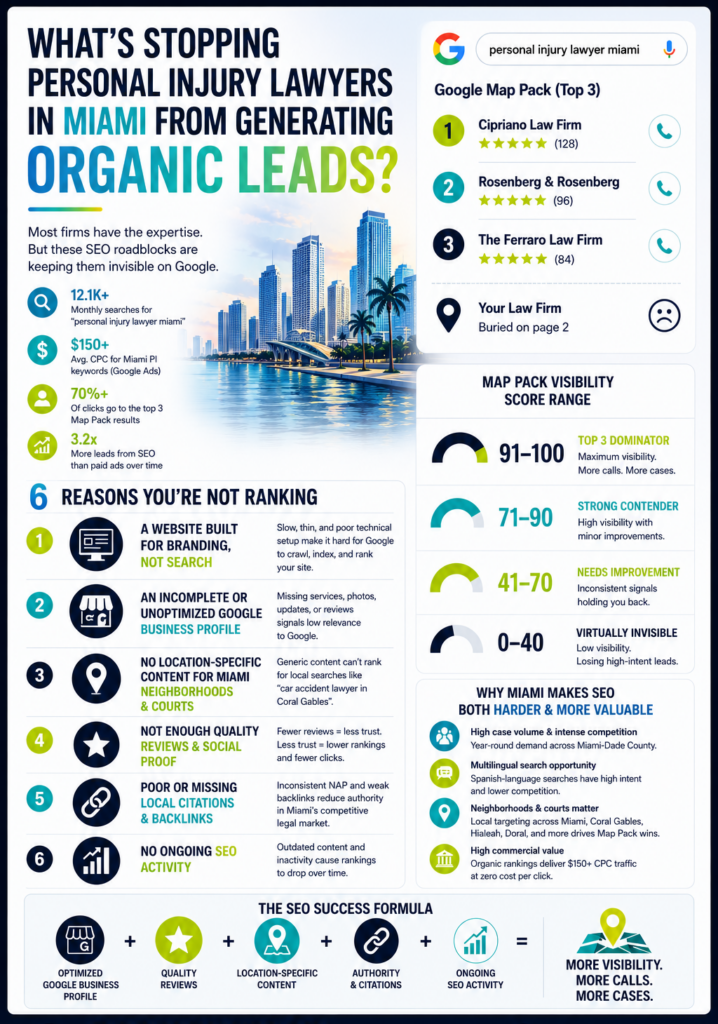
Most personal injury lawyer SEO failures in Miami trace back to the same set of problems: a website built for appearance rather than search performance, a Google Business Profile that is incomplete or unmanaged, no location-specific content targeting Miami's neighborhoods and courts, too few quality reviews, and no ongoing SEO activity maintaining relevance signals over time. These are not abstract problems. Each one has a specific fix, and the firms implementing them consistently are the ones appearing at the top of Google for the queries that generate signed retainers.
Key Takeaways
- Why is organic search so valuable for personal injury law firms? Because personal injury clients search urgently and with high intent. A person injured in a car accident in Miami is not browsing legal blogs. They are searching "Miami personal injury lawyer" or "car accident attorney near me" and calling the first credible result they find. Organic rankings capture this intent at zero cost per click.
- How competitive is Miami personal injury SEO? Extremely. Keywords like "personal injury lawyer Miami" carry cost-per-click values exceeding $150 in paid search, reflecting the commercial value each search represents. Organic ranking for these terms delivers the same high-intent traffic without the per-click cost, which is why firms investing in Miami law firm SEO have a compounding advantage over those relying entirely on paid advertising.
- What does Google prioritize for law firm local rankings? Relevance, prominence, and distance for Map Pack results. For organic rankings, Google prioritizes E-E-A-T signals: demonstrated experience, expertise, authoritativeness, and trustworthiness across the website, author profiles, and external citations.
- Can smaller Miami personal injury firms compete with large ones in search? Yes, particularly in specific practice areas and neighborhood-level searches. A firm specializing in motorcycle accidents, slip and fall cases, or medical malpractice with deep, well-structured content in that niche regularly outranks larger general practice firms with broader but shallower content coverage.
Miami is one of the most competitive legal markets in the United States. There are thousands of licensed attorneys in Miami-Dade County, and personal injury is among the most contested practice areas in the city. Yet the majority of personal injury lawyers in Miami generating consistent organic leads are a relatively small group of firms that have invested in a structured legal SEO strategy. As part of comprehensive digital marketing services in Miami, SEO helps law firms improve search visibility, attract qualified leads, and reduce reliance on referrals or paid advertising. Many firms, however, continue to depend primarily on referrals, paid ads, or word of mouth. The gap is not about legal expertise. It is about search visibility, and closing it starts with understanding exactly why most Miami personal injury lawyer websites are structurally incapable of ranking for the queries that bring in cases.
Why Miami Makes Personal Injury SEO Both Harder and More Valuable
Miami's legal market has characteristics that make search visibility both more competitive and more commercially significant than in most other US cities.
The volume of personal injury cases in Miami-Dade County is consistently among the highest in Florida. A city with high traffic density, a large population of pedestrians and cyclists, significant construction activity, and one of the busiest port and logistics corridors in the southeast generates personal injury cases at a volume that sustains intense competition for search visibility year-round. Building topical authority through comprehensive, location-specific legal content is essential for law firms looking to stand out in this highly competitive market.
Miami's multilingual population adds a dimension most law firm SEO programs ignore entirely. A significant portion of Miami's personal injury clients are Spanish-speaking, and Spanish-language searches for personal injury attorneys in Miami carry meaningful volume with far lower keyword competition than their English equivalents. Firms with Spanish-language service pages, a bilingual Google Business Profile, and Spanish-language content targeting queries like "abogado de accidentes en Miami" are capturing a high-intent audience that many English-only competitors leave uncontested.
Miami's geography also matters for local SEO. A firm based in Coral Gables needs a different location targeting than one based in Miami Beach, Hialeah, or Doral. The neighborhoods, zip codes, and proximity signals that determine Map Pack visibility vary significantly across Miami-Dade County, and a single generic location setting does not serve a firm trying to be visible across the full metro area.
The Six Reasons Miami Personal Injury Firms Are Not Generating Organic Leads
1. A Website Built for Branding, Not Search
The most common reason personal injury lawyer SEO fails before it starts is a website designed to impress existing clients and referral sources rather than to rank for the queries that generate new ones. A strong local SEO strategy begins with a technically sound website, yet visually impressive law firm websites with JavaScript-heavy design, slow load times, minimal on-page text, and no technical SEO foundation remain the norm in Miami's legal market.
What Google needs to rank a law firm website and what a web designer typically prioritizes are not the same thing. Google needs:
- Fast page load times on mobile, where the majority of personal injury searches happen
- Substantial, well-structured content on each practice area page with enough depth to match the search intent behind high-value queries
- Clear title tags and meta descriptions with the target keyword and location
- Proper heading hierarchy that tells Google what each page is about
- Internal linking connects practice area pages, location pages, and attorney bio pages into a coherent topical structure
- Schema markup including LegalService, Attorney, AggregateRating, and LocalBusiness schema
A law firm website that looks professional but loads slowly, has thin practice area pages, and lacks proper technical foundations is invisible to Google regardless of how much was spent building it.
2. An Incomplete or Unmanaged Google Business Profile
For local SEO for attorneys, the Google Business Profile is the single highest-leverage asset available. It determines Map Pack visibility, which is what most searchers see before organic results. Yet many Miami personal injury law firm profiles are incomplete, have not been updated in months, and show no recent activity.
A fully optimised Google Business Profile for lawyers includes:
- Primary category set to "Personal Injury Attorney" with relevant secondary categories such as "Legal Services" added
- Every practice area listed as a service: car accidents, slip and fall, medical malpractice, motorcycle accidents, wrongful death, and any other areas the firm handles
- Office hours, including consultation availability clearly stated
- A keyword-natural description referencing Miami, specific practice areas, and the firm's experience
- High-quality photos of the office, attorneys, and team are updated regularly
- Weekly Google Posts covering case results, legal tips, community involvement, or FAQ answers
- Active Q&A management with answers to questions prospective clients actually ask
- Consistent review response within 48 hours of every new review
The firm name, address, and phone number on the Google Business Profile must match exactly what appears on the website footer and across every legal directory. Inconsistency in this data reduces Google's confidence in the listing and suppresses Map Pack rankings directly.
3. No Neighborhood or Practice Area Specific Content
Google validates local ranking eligibility by checking whether the website reinforces the relevance signals claimed in the Google Business Profile. A Miami personal injury lawyer website with a single "Service Areas" page listing 20 neighborhoods does not carry the same local authority signal as a website with dedicated pages for each major service area.
For a Miami personal injury firm, this means building individual pages targeting the specific communities generating the highest case volume:
- Miami Beach: Pedestrian accidents, hotel liability, bicycle accidents
- Hialeah: Car accidents, workplace injuries, Spanish-language content
- Coral Gables: Medical malpractice, premises liability
- Doral: Commercial truck accidents, logistics corridor incidents
- Miami Gardens: Sports injuries, slip and fall, premises liability
- Little Havana: Spanish-language content, car accidents, wrongful death
Each location page should include the neighborhood name in the title tag, H1, and URL. It should reference local courts, hospitals, and high-accident corridors relevant to that area, carry the LocalBusiness schema with geo-coordinates, and include genuine content specific to that community rather than templated copy with the location name swapped in.
Practice area depth matters equally. A page targeting "car accident attorney Miami" that covers the topic in 400 words will not outrank a competing firm's page covering the same topic in significantly greater depth, with Florida statute references, local court procedures, Miami-Dade accident statistics, and an FAQ section addressing the specific questions Miami accident victims ask.
4. Weak E-E-A-T Signals Across the Website
Google applies its E-E-A-T framework with particular scrutiny to legal websites because they fall under the YMYL category: Your Money or Your Life content, where inaccurate information can cause real-world harm. A lawyer website SEO program that ignores E-E-A-T signals consistently underperforms against competitors who have invested in building demonstrable credibility.
Specific E-E-A-T signals that personal injury law firm marketing needs to prioritize:
- Named attorney bio pages with Florida Bar number, years of experience, case results, and professional credentials prominently displayed
- Case results and settlements are published where permitted under Florida Bar advertising rules
- Third-party mentions and features in Miami legal publications, local news coverage, and legal directory profiles
- Peer endorsements on major legal directories, which Google treats as external authority signals
- Author bylines on all legal content, attributing each article to a named attorney with a link to their bio page
- Regular content updates with dates visible to readers, signalling that the information is current and maintained
5. Too Few Reviews and No Strategy to Generate Them
Reviews are a primary Map Pack ranking factor and a primary conversion factor for personal injury clients, making them one of the most important decisions of their lives. Many Miami personal injury firms have inconsistent review counts and no systematic process for generating new ones.
The specific review factors Google weighs for Miami law firm SEO:
- Total review count relative to competing firms in the same practice area
- Average rating, with 4.0 and above considered a minimum threshold for competitive Map Pack placement
- Review recency and velocity, with firms receiving new reviews monthly outranking firms with older review bases of the same total size
- Review response rate and quality, as consistent responses signal active business management to Google
For personal injury firms, the timing of review requests matters. The highest-response moment for a review request is immediately following a positive case resolution, when client satisfaction is at its peak. A text or email with a direct Google review link sent within 24 hours of a settlement or verdict acceptance consistently outperforms delayed or generic follow-up.
6. No Ongoing SEO Activity: Maintaining Relevance
The firms generating consistent organic leads for law firms in Miami are not firms that optimised their website once and moved on. They are firms with an ongoing legal SEO strategy that continuously builds relevance signals, updates content, and expands local authority.
An effective ongoing local SEO cadence for a Miami personal injury firm includes:
- Weekly Google Posts on the Business Profile covering recent case outcomes, legal FAQ answers, or community news relevant to the firm's practice areas
- Monthly content updates refresh high-traffic pages with new statistics, updated Florida statute references, and new case examples
- Quarterly citation audits across Avvo, FindLaw, Justia, Martindale, and other legal directories to maintain NAP consistency
- Active pursuit of local backlinks from Miami-area sources: local news outlets, community organizations, Miami Bar Association, and legal content platforms
- Ongoing review generation following every case resolution
Law firm SEO services that operate on a one-time or set-and-forget model produce short-term gains that erode as competitors with active programs build past them.
The Technical SEO Failures Most Law Firm Websites Have Not Addressed
Beyond content and profile optimisation, technical website health directly affects personal injury lawyer SEO performance in Miami's competitive market. Common issues include:
- Core Web Vitals failures: Slow Largest Contentful Paint, unstable layouts, and delayed interactivity all contribute to ranking and conversion losses.
- Missing or incorrect schema markup: Attorney, LegalService, LocalBusiness, FAQ, and Review schema provide structured data signals that increase the confidence of both Map Pack and organic ranking.
- Duplicate or thin content across practice area pages: Templated pages with only the location or case type swapped in are flagged as thin or duplicate content and suppressed in rankings.
- No XML sitemap submitted to major search engines: Without a clean sitemap, important practice and location pages can be missed or crawled inefficiently.
- Indexing and crawl issues: Orphan pages, redirect chains, and broken internal links dilute the authority of key pages and confuse search engines.
A technically sound site gives every other SEO effort leverage; without it, even strong content and authority signals underperform.
AI SEO: Showing Up in ChatGPT, Google AI Overviews, Gemini, Perplexity, and Copilot
Search is no longer limited to ten blue links and a Map Pack. AI assistants and AI-powered search experiences increasingly act as the first touchpoint for people researching legal options, summarising the landscape and recommending a small set of firms.
To improve visibility in AI environments like ChatGPT, Google AI Overviews, Gemini, Perplexity, and Microsoft Copilot, Miami personal injury firms need both traditional SEO and deliberate AI SEO:
- Structured, attorney-authored Q&A content: Create in-depth answers to real client questions ("How long do I have to file a personal injury claim in Florida?", "What does a car accident lawyer do in Miami?") using clear headings, FAQ blocks, and concise explanations that AI systems can easily extract.
- Strong entity and jurisdiction signals: Make it unambiguous who you are, what you do, and where you practice. Ensure firm name, address, practice areas, and jurisdictions are consistent across your website, Google Business Profile, and major legal directories so AI models can confidently connect your firm to Miami personal injury queries.
- Enhanced E-E-A-T for AI retrieval: Highlight attorney credentials, Bar numbers, years of experience, case results (where permitted), and media or publication mentions so AI systems treating your site as a source can see clear signs of expertise and trustworthiness.
- Schema and answer formatting for AI Overviews: Implement LegalService, FAQPage, and Review schema on key pages and structure content with short, direct answer paragraphs to increase eligibility for inclusion in AI-generated summaries and answer cards.
- Reputation signals across platforms: Maintain strong, recent reviews on Google and major third-party sites; AI assistants increasingly factor reputation and recency into which firms they name in recommendations.
When AI SEO is layered on top of a strong local and technical SEO foundation, your firm is more likely to be the one AI tools retrieve, summarise, and recommend when prospective clients ask for a “personal injury lawyer in Miami.”
What the Top-Ranking Miami Personal Injury Firms Are Doing Differently
The personal injury firms consistently visible in Miami's Map Pack and organic results share an execution pattern that has less to do with firm size and more to do with strategic consistency. They have:
- A technically sound, fast-loading website with deep practice area content and proper schema markup
- A fully completed and actively managed Google Business Profile with 50 or more reviews and consistent new review velocity
- Dedicated location pages for Miami's highest-case-volume neighborhoods with genuine local content
- Named attorney bio pages with credentials, Bar numbers, and case results, building E-E-A-T signals
- Active legal directory presence on Avvo, Justia, FindLaw, Martindale, and Super Lawyers with consistent NAP data
- An ongoing content, link-building, and AI SEO program expanding local and AI authority month over month
None of these is a one-time task. They are operational habits. The firms that adopt them and maintain them are the firms that dominate search and AI-generated visibility for the terms that drive new cases.
How Shankom Can Help
Shankom provides law firm SEO services for Miami personal injury lawyers who need organic visibility to generate a consistent flow of qualified leads without relying entirely on paid advertising. From technical website audits and lawyer website SEO improvements, to Google Business Profile optimisation, neighborhood-specific location page development, E-E-A-T signal building, review generation systems, and ongoing local SEO for attorneys that compounds in value over time, Shankom solutions delivers the complete Miami law firm SEO program that moves personal injury firms from invisible to consistently visible for the searches that generate signed retainers.
In our recent engagement, a Coral Gables–based personal injury firm that was stuck on page three for core terms like "personal injury lawyer Miami" implemented a structured program of technical fixes, neighborhood-specific pages, bilingual content, Google Business Profile optimization, and review velocity. Within eight months, they moved into the top three results for several high-intent queries and increased qualified organic case enquiries by more than 80%, while simultaneously improving their visibility inside AI-powered legal searches.
Whether you are starting from minimal search visibility or you are already ranking but not yet turning those rankings into signed cases, Shankom provides the traditional SEO and AI SEO expertise and execution that position your firm where Miami injury clients are actually looking—on Google, on Maps, and inside the AI tools they increasingly rely on before they ever make a call.
FAQs
Why is SEO important for personal injury lawyers in Miami?
Because personal injury clients search with high intent and urgency, the firms appearing at the top of Google for queries like "personal injury lawyer Miami" or "car accident attorney near me" capture the majority of those calls. With paid search cost-per-click values for top personal injury keywords in Miami often exceeding three figures, organic rankings deliver the same high-intent traffic with no per-click cost and a compounding return over time.
What is the most important SEO factor for Miami personal injury lawyers?
No single factor determines ranking, but the Google Business Profile is the most high-leverage starting point for Map Pack visibility, and E-E-A-T signals are the most critical factor for organic rankings. Google applies its strictest quality standards to legal websites under its YMYL framework, meaning demonstrated credibility through named attorney profiles, case results, external citations, and legal directory presence is non-negotiable for competitive rankings.
How do reviews affect personal injury lawyer SEO?
Reviews are a direct Map Pack ranking factor. Google weighs total review count, average rating, review recency, and velocity of new reviews. A firm with 40 reviews and three new ones this month can regularly outrank a firm with 80 reviews and none in the past quarter. For personal injury firms, the highest-response moment for a review request is within 24 hours of a positive case resolution.
How long does it take for SEO to generate leads for a Miami law firm?
Most law firms with a complete technical foundation and active optimization program see measurable ranking improvements within 90 to 120 days. Significant organic lead volume from competitive queries like "personal injury lawyer Miami" typically develops over 6 to 12 months as content depth, E-E-A-T signals, and local authority compound. Neighborhood-specific and long-tail practice area queries often produce results faster, within 60 to 90 days.
What legal directories matter most for Miami personal injury SEO?
Avvo, Justia, FindLaw, Martindale-Hubbell, and Super Lawyers are among the highest-authority legal directories for E-E-A-T and citation signals. Each profile should carry consistent NAP data matching the Google Business Profile exactly. Peer endorsements and client reviews on these platforms provide external authority signals that support both traditional SEO and AI-driven visibility.