Why Your Social Media Followers Are Growing But Your Sales Aren’t: How to Fix the Disconnect
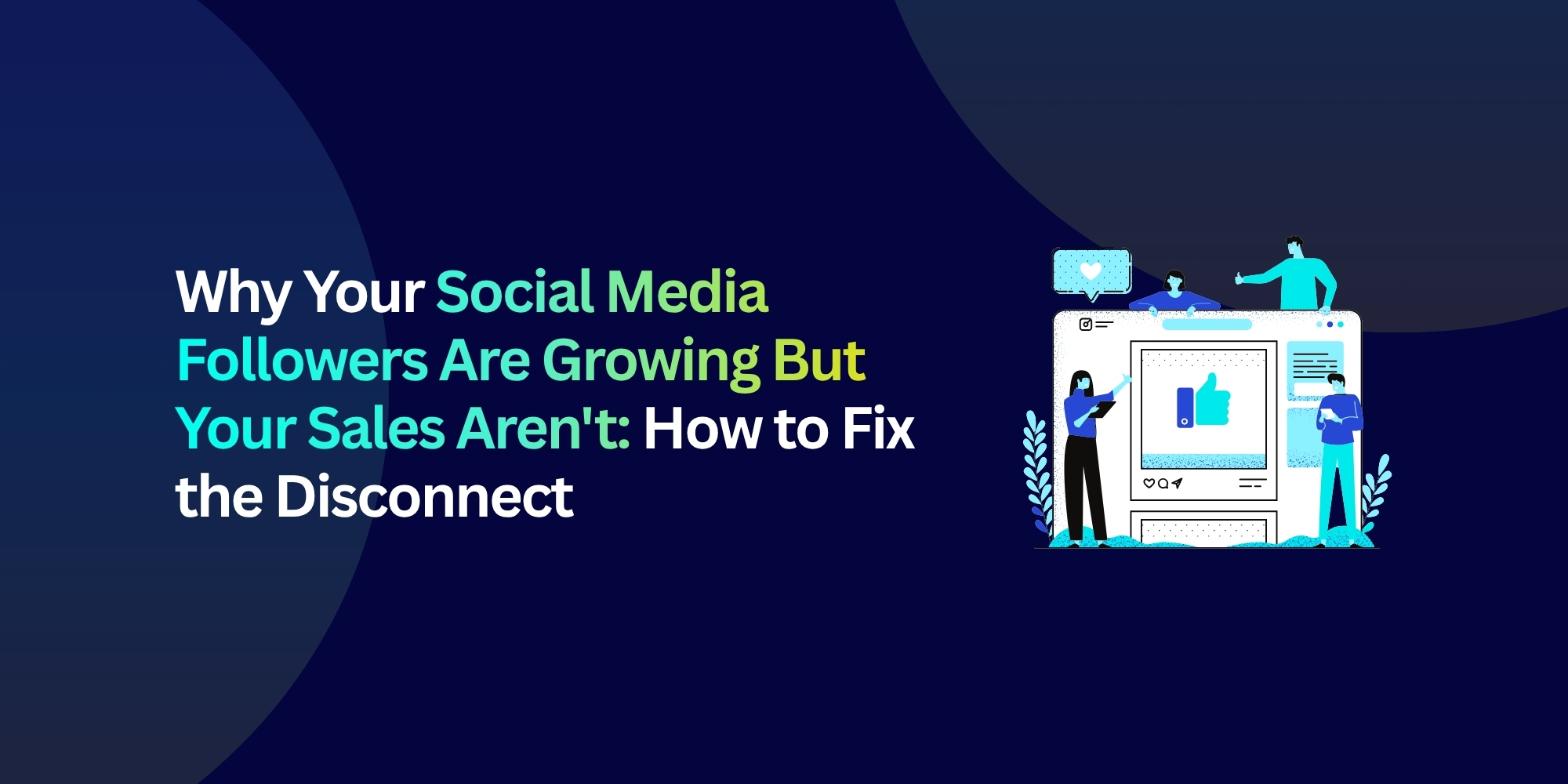
Growing a social media following feels like progress. And it is, but only if that following is converting into customers. A 2025 HubSpot report found that 57% of businesses say social media generates leads, but fewer than 1 in 3 say those leads consistently convert into sales. The problem is almost never the size of the audience. It is the gap between an audience that follows you and an audience that trusts you enough to buy from you.
Key Takeaways
Why do followers not automatically translate into sales?
Because follower growth measures awareness, not intent. A person can follow your account for months, enjoy your content, and never consider buying from you unless there is a deliberate strategy connecting your content to a clear next step.
What is the core reason for the disconnect?
Most businesses treat social media as a broadcast channel and never build the trust, specificity, and conversion pathway that turn passive followers into active buyers.
How do you fix it?
By auditing the full journey from follower to customer, identifying exactly where it breaks down, and building content and conversion touchpoints that move people through awareness, consideration, and decision stages deliberately.
How long does it take to see results?
Businesses that restructure their social media strategy around conversion rather than vanity metrics typically see measurable improvement in lead quality within 60 to 90 days and revenue impact within 90 to 120 days.
The Vanity Metric Trap Most Businesses Fall Into
Follower counts, likes, and impressions are the metrics that social media platforms surface most prominently. They are also the metrics least connected to revenue. A business with 50,000 followers and no conversion strategy is generating brand awareness for free with no commercial return. A business with 5,000 highly engaged, niche-specific followers and a clear content-to-conversion pathway is building a sales channel.
The reason so many growing social media accounts produce flat sales is that the content strategy was built to attract followers rather than convert them. Broad, relatable, high-reach content performs well on reach and engagement metrics. It does not necessarily attract people who have a problem your product or service solves. And even when it does attract the right person, there is frequently no content or conversion pathway designed to move them from interested follower to paying customer.
This is the disconnect. It is not a content quality problem. It is a strategy structure problem. The fix requires understanding the difference between content that builds audience engagement and content that converts one. Here’s a step-by-step guide to fix your sales on social media.
Step 1: Audit Your Current Follower Quality
Before restructuring your strategy, understand who is actually following you. A large following built on broad content, viral posts, or giveaway campaigns is frequently made up of people with no genuine purchase intent. This is not a criticism of growth tactics. It is a diagnosis of why growth and sales can move in opposite directions.
Questions to answer in your audit:
- What percentage of your followers match your actual customer profile in terms of industry, location, income level, or problem set?
- Which posts attracted the most followers? Do those posts reflect your product or service, or are they general-interest content?
- What is your profile visit-to-website-click ratio? If people are visiting your profile but not clicking through, your bio and link strategy needs work.
- Which content generates direct messages, inquiries, or link clicks versus which content generates only likes and comments?
Most social media marketing services provide audience demographic data through their native analytics tools. Instagram Insights, LinkedIn Analytics, and Facebook Audience Insights show valuable information such as age, location, interests, and audience behavior. If this data does not align with your ideal customer profile, it may indicate that your current content strategy is attracting the wrong audience. In such cases, adjusting your content mix can help attract followers who are more likely to become customers.
Tools that help: Sprout Social and Hootsuite both offer advanced audience quality analysis beyond what native platform analytics provide. For businesses running Meta ads alongside organic content, Meta's Audience Insights provides purchase behavior data that native Instagram analytics does not.
Step 2: Map the Gap Between Awareness and Purchase
Most businesses have awareness-stage content and purchase-stage offers, with nothing in between. A follower who discovers your account through a helpful post has moved into awareness. To buy from you, they need to move through consideration, understanding specifically what you offer, why it is better than alternatives, and whether you are credible enough to trust with their money.
The consideration-stage content that drives this journey is the most underproduced content type on most business social media accounts. It includes:
- Specific case studies and client results with real numbers, not just testimonials
- Behind-the-scenes content showing how you work, not just what you offer
- Comparisons and honest breakdowns of your service versus alternatives
- FAQ content that addresses the exact objections a potential customer has before buying
- Social proof in the form of tagged customer posts, user-generated content, and third-party reviews
Without this content consistently appearing in your feed, a follower can spend months engaging with your awareness-stage posts and never develop the specific trust required to make a purchase decision. They like your content. They do not yet trust your product.
Step 3: Fix Your Bio, Link, and Profile Conversion Architecture
Your social media profile is the moment of first commercial intent for most new followers. If a person is interested enough in your content to visit your profile, they are telling you something important: they want to know more. Optimizing your presence across the best social media channels helps turn that interest into meaningful engagement. Most business profiles, however, waste this valuable opportunity completely.
A profile that converts has four elements working together:
- A bio that states specifically what you do and who you do it for. "Helping small business owners in the UAE reduce their tax liability" converts better than "Tax and financial services." Specificity signals relevance to the right audience and filters out the wrong one.
- A link that goes somewhere with a clear next step. Sending profile traffic to a homepage with no direction loses the majority of visitors within seconds. A link to a lead magnet, a free consultation booking page, a specific service page, or a gated resource converts significantly better than a generic homepage link. Tools like Linktree or Later's Link in Bio allow multiple destination links from one URL, which is particularly important for Instagram, where only one link is available in the bio.
- A pinned post or highlight that functions as a conversion asset. The first piece of content a new profile visitor sees should tell them exactly what you offer and what a customer outcome looks like. A pinned post featuring a specific client result, a service overview, or a strong offer performs this function more effectively than any general content.
- Story Highlights (Instagram) or Featured Posts (LinkedIn) organized by customer journey stage. A visitor should be able to navigate from "what you do" to "proof it works" to "how to start" without leaving your profile.
Step 4: Build a Content Mix That Covers All Three Sales Stages
The most common structural reason followers do not convert is that all content is being produced for one stage of the buyer journey. A practical weekly content mix that covers awareness, consideration, and decision stages simultaneously:
| Stage | Content Type | Example | Platform |
| Awareness | Educational, save-worthy, shareable | "5 signs your business is overpaying taxes." | Instagram, LinkedIn, Facebook |
| Consideration | Case studies, client results, behind-the-scenes | "How we helped a retail client cut their ad spend by 35%." | LinkedIn, Instagram Stories |
| Consideration | FAQ and objection-handling content | "Why businesses hesitate on [service] and what the data actually shows." | LinkedIn, Facebook |
| Decision | Offer-specific posts with a clear CTA | "Free 30-minute audit for businesses spending over $3,000/month on ads" | All platforms |
| Trust-building | Social proof, user-generated content, reviews | Client testimonial video or tagged customer post | Instagram, Facebook |
Most business accounts produce awareness and occasional decision-stage content, with almost no consideration-stage content in between. That gap is where potential customers lose momentum and where competitors with better content infrastructure win the conversion.
Step 5: Create Direct Pathways From Content to Conversion
Content that educates without directing the reader anywhere loses the conversion opportunity the engagement created. Every piece of content should have a deliberate next step built in, matched to the stage of the buyer journey it is serving.
- Awareness-stage content: "Save this for your next tax review" or "Follow us for more on this topic", deepens the relationship without asking for a sale prematurely.
- Consideration-stage content: "Read the full case study at the link in bio" or "DM us [keyword] and we will send you the full breakdown", moves interested followers into a higher-intent touchpoint.
- Decision-stage content: "Book a free 20-minute call this week" or "We have 3 spots open in June, link in bio to apply", creates urgency and specificity that moves ready buyers to act.
Instagram's Direct Message automation through tools like ManyChat allows businesses to set up automated responses to specific keywords in comments or DMs, delivering lead magnets, booking links, or consultation resources instantly without manual follow-up. This single tool consistently improves the conversion rate from social media engagement to actual inquiries.
Step 6: Track the Metrics That Connect Social Media to Sales
Followers, likes, and reach are activity metrics. The metrics that connect social media to revenue are different:
- Profile visits to link clicks: Measures how effectively your content drives profile traffic and how well your profile converts that traffic into website visits
- Direct messages and inquiry volume: The most direct signal that your content is creating commercial intent in the right audience
- Link-in-bio click-through rate: Measures whether your call-to-action and destination link are converting profile visitors
- Content-attributed leads in your CRM: Tag leads by source in your CRM to identify which social media content is generating customers, not just followers
- Conversion rate from social traffic in Google Analytics: Social referral traffic that converts at a higher rate than average indicates your social audience is well-qualified. Social traffic with low conversion rates indicates an audience mismatch.
Tools like HubSpot CRM, Zoho CRM, and Monday.com all support UTM parameter tracking that allows you to attribute specific revenue back to specific social media campaigns and content types. Without this attribution, you are measuring social media performance in isolation from the business outcomes it should be driving.
How AI Can Help Close the Gap
AI tools are particularly useful for the specific content types that fill the consideration-stage gap most businesses are missing.
- ChatGPT and Claude can generate case study structures, FAQ content built around real customer objections, and comparison-format posts quickly when given real data to work from. Feed them your actual client results, and they help you frame those results as compelling social content.
- Canva AI builds client result graphics, testimonial cards, and social proof visual assets in minutes, the exact content type that drives consideration-stage trust-building.
- ManyChat automates the conversion pathway from social engagement to lead capture, delivering resources and booking links instantly in response to comments and DMs.
- Buffer and Sprout Social identify which of your current posts are generating link clicks and DMs versus passive engagement, showing you precisely where your content mix needs rebalancing between awareness and conversion.
Common Mistakes That Keep the Gap Open
- Posting only broad, high-reach content to grow followers while expecting that audience to convert. The content that grows the fastest is rarely the content that converts. Both are necessary, but they require different formats, different specificity, and different calls to action.
- Sending all social traffic to a generic homepage. A homepage is not a conversion tool for social media traffic. A specific landing page matched to the content that drove the click is.
- Treating every platform as a follower-building channel rather than a conversion channel is a common mistake. LinkedIn is a direct sales channel for B2B businesses. Instagram can be a direct sales channel for retail and service businesses. Facebook ad campaigns are highly effective for building communities, generating referrals, and driving targeted leads for businesses. Each platform has a specific commercial role, and the content strategy needs to reflect it.
- Not following up on engagement with a commercial touchpoint. Someone who comments on your posts, saves your content, or visits your profile repeatedly is showing commercial intent. Without a follow-up mechanism, a retargeting ad, an automated DM, or a content upgrade, that intent evaporates.
- Measuring success at the platform level rather than the business level. The only question that matters for a business social media account is: how much revenue did this activity generate? Every other metric is useful only insofar as it helps answer that question.
How Shankom Can Help
Shankom Solutions helps businesses close the gap between social media growth and actual sales by building content strategies and conversion pathways designed from the beginning to generate customers, not just followers. From audience quality audits and content mix restructuring to profile conversion architecture, consideration-stage content production, and CRM-connected attribution tracking, Shankom Solutions creates a complete system that transforms an engaged social media audience into a predictable lead source. Whether you are frustrated with a growing account that is not producing commercial results or are building a social media strategy from scratch with revenue as the primary metric, Shankom Solutions provides the strategy and execution needed to connect your content investment directly to your business growth and bottom line.
People Also Ask
Why are my social media followers growing but not buying?
Because follower growth measures awareness, not purchase intent. Most business social media accounts produce content that attracts a broad audience but lack the consideration-stage content, profile conversion architecture, and clear calls to action that move a follower through the buyer journey to a purchase decision.
How do I convert social media followers into customers?
By building a content mix that covers all three buyer journey stages: awareness content to attract the right audience, consideration-stage content including case studies, FAQ posts, and client results to build purchase-specific trust, and decision-stage content with clear, specific calls to action that give ready buyers a low-friction path to convert.
What social media metrics actually matter for sales?
Profile visits to link clicks, direct message volume, link-in-bio click-through rate, social traffic conversion rate in Google Analytics, and CRM-attributed leads from social media. These metrics connect social media activity to commercial outcomes. Followers, likes, and impressions measure reach but not revenue.
How long does it take to turn a social media following into a sales channel?
Businesses that restructure their social media strategy around conversion rather than vanity metrics typically see measurable improvement in lead quality within 60 to 90 days and revenue impact within 90 to 120 days, depending on average sales cycle length and the size of the existing qualified audience.
Which tools help convert social media followers into leads?
ManyChat for DM automation and keyword-triggered lead capture. Buffer and Sprout Social for content performance analytics. Canva AI for social proof and case study visual content. HubSpot or Zoho CRM for UTM-based revenue attribution from social media campaigns. Linktree or Later's Link in Bio for multi-destination profile links.