Why Most HVAC Companies in Seattle Struggle to Rank in Google’s Map Pack
Google's Map Pack shows the three most locally relevant, credible, and well-optimised HVAC businesses for any given search. Most HVAC companies in Seattle miss out on these top positions due to an incomplete or unmanaged Google Business Profile, inconsistent NAP data across directories, too few recent reviews, weak or missing location-specific service pages on their website, and a lack of ongoing local SEO services to signal relevance to Google. Every one of these issues is fixable. The businesses dominating Seattle HVAC local search rankings are not necessarily bigger or better than their competitors; they are simply more visible online and more consistent in their local SEO efforts.
Key Takeaways
- What is the Google Map Pack? The block of three business listings that appears at the top of Google search results for local service queries. For searches like "HVAC repair Seattle" or "furnace replacement near me," Map Pack listings receive the majority of clicks before a user ever reaches organic results.
- Why does Map Pack ranking matter so much for HVAC? Because HVAC searches are high-intent and urgent. A homeowner whose furnace stopped working at 9 pm is not browsing options; they are calling the first credible business Google shows them. If that business is not yours, the lead goes to a competitor.
- What does Google use to rank businesses in the Map Pack? Three core factors: relevance (how well your profile and website match what the searcher needs), distance (how close your business is to the searcher's location), and prominence (how well-known and credible your business appears based on reviews, citations, links, and overall online presence).
- Is Map Pack ranking achievable for smaller HVAC companies? Yes. A Reddit case study from March 2026 documented an HVAC Google Business Profile ranked within 30 days using structured optimisation. Prominence and relevance signals can be built by any business willing to execute the fundamentals consistently.
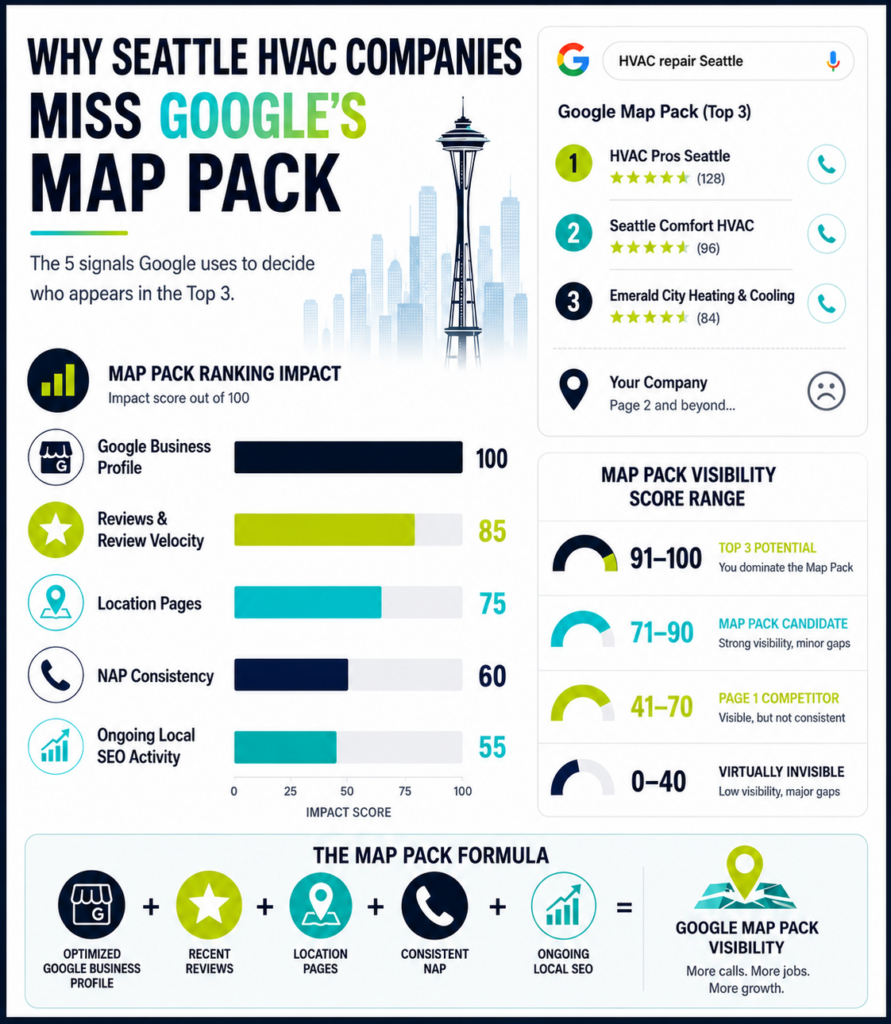
Seattle's HVAC market has specific characteristics that make Google Map Pack ranking more competitive than average and more valuable when you achieve it.
Seattle's climate creates genuine year-round HVAC demand. Unlike markets with a single peak season, Seattle homeowners search for heating system maintenance in autumn, heat pump installations ahead of summer, air quality solutions year-round, and emergency furnace repair throughout the wet winter months. That sustained, multi-season search volume means the Map Pack is contested continuously, not just during peak periods.
Seattle's geography also compounds the challenge. A business based in Bellevue, Redmond, or Kirkland may have strong Map Pack visibility in its immediate location but drop to position 20 or lower just ten miles into Seattle proper. Recent local SEO research published in early 2026 found that HVAC rankings often disappear beyond about five miles from the registered business address without clear service area configuration and location-focused website structure in place.
The result is a market where HVAC lead generation through Google Maps depends heavily on precision, not just being optimised in general, but being optimised specifically for the Seattle neighbourhoods and suburbs where your best customers are located.
The Five Reasons Most Seattle HVAC Companies Miss the Map Pack
1. An Incomplete or Neglected Google Business Profile
The Google Business Profile is the single most important asset in HVAC Google Maps SEO, and the majority of profiles in Seattle are incomplete, outdated, or both. Google uses the completeness and activity level of a Business Profile as a direct ranking signal. A profile that has not been updated in months, has no recent photos, is missing service descriptions, or has unanswered reviews is a profile Google has limited confidence in.
A fully optimised Google Business Profile for an HVAC company includes:
- Correct business name, address, and phone number matching exactly what appears on the website and all directories
- Primary category set to "HVAC contractor" with relevant secondary categories added
- Every service listed individually: AC installation, furnace repair, heat pump installation, duct cleaning, emergency HVAC, and any other service offered
- Business hours, including emergency availability, are clearly stated
- A keyword-natural business description referencing Seattle and specific service areas
- A minimum of 10 high-quality photos of real work, team members, and equipment, updated regularly
- Weekly Google Posts covering seasonal tips, promotions, completed jobs, or FAQ answers
- Q&A section actively managed with answers to the questions customers actually ask
Structured data on the website, such as HVAC-specific and LocalBusiness schema, should mirror this profile data precisely. Inconsistency between what appears on the profile and what Google finds on the website reduces the confidence score Google assigns to the listing.
2. Inconsistent NAP Data Across the Web
NAP stands for Name, Address, and Phone Number. Google cross-references the NAP data on a business's Google Business Profile against every directory, review site, and citation across the web. When the business name appears differently on Yelp than on Angi, the phone number on Thumbtack is an old number, or the address format differs between HomeAdvisor and the website, Google's confidence in the business's legitimacy and location accuracy drops.
For HVAC companies in Seattle, the most important citation sources to audit and clean include:
- Yelp
- Angi
- HomeAdvisor
- Thumbtack
- Bing Places
- Apple Maps
- Better Business Bureau
Tools like BrightLocal or Semrush's listing management features can audit citations automatically, identify inconsistencies, and push corrected data to multiple directories simultaneously.
3. Too Few Reviews, and No Review Velocity
Reviews are one of the three primary Map Pack ranking factors, and an SEO audit can help identify opportunities to strengthen your local visibility. It's not just the total number of reviews that matters, Google also considers the recency and frequency of new reviews. A business with 85 reviews but none in the past four months can often be outranked by a business with 40 reviews and three new reviews this week, as Google interprets consistent review velocity as a strong signal of ongoing business activity and customer satisfaction.
Recent 2026 HVAC local search research suggests that HVAC companies with 50 or more Google reviews tend to rank substantially higher in local search than those with fewer. For most Seattle HVAC marketing programs, getting to that first 50-review milestone and then maintaining a steady cadence of new reviews is the single highest-leverage activity available for Map Pack improvement.
An effective review generation process for HVAC companies typically:
- Sends an automated SMS review request within 30 minutes of job completion, when customer satisfaction is highest
- Includes a direct Google review link, not a general "leave us a review" prompt
- Trains technicians to verbally mention the review request at job completion
- Responds to every review, positive and negative, within 48 hours. Responses are visible both to Google and to every future customer reading the profile
Popular home services CRMs like HouseCall Pro, ServiceTitan, and GoHighLevel all include automated review request functionality designed for contractors.
4. No Location-Specific Pages on the Website
HVAC local search rankings are not determined by the Google Business Profile alone. Effective local search optimisation requires Google to verify that a business's website reinforces its relevance for specific service locations. A website with a single generic "Service Areas" page listing twenty neighbourhoods does not carry the same local relevance signal as a website with dedicated, individually optimised pages for each major service area.
For a Seattle HVAC company, this means building individual pages for the neighbourhoods and suburbs that represent the highest search volume and highest-value customer locations:
- Seattle proper neighbourhoods: Capitol Hill, Ballard, Fremont, Queen Anne, Magnolia, West Seattle
- Eastside suburbs: Bellevue, Redmond, Kirkland, Issaquah
- North end: Shoreline, Edmonds, Lynnwood
- South end: Renton, Kent, Federal Way
Each location page should:
- Include the specific city or neighbourhood name in the H1, title tag, and URL
- Describe the services available in that specific area
- Reference local climate or property considerations relevant to that microclimate
- Embed a Google Map
- Carry a genuine LocalBusiness schema with geo-coordinates for that location
Recent research into hyper-local HVAC service area pages has documented conversion rates more than double those of generic service pages, making location page development one of the most commercially significant investments available through local SEO services for HVAC companies.
5. No Ongoing Local SEO Activity
The HVAC companies dominating Seattle's Map Pack are not companies that optimised once and walked away. They are companies with an ongoing local SEO activity cadence that continuously signals relevance and authority to Google.
Ongoing activities that sustain and improve Map Pack rankings include:
- Weekly Google Posts on the Business Profile covering seasonal tips, promotions, or recently completed jobs
- Monthly citation audits to catch new inconsistencies as directories update their data
- Consistent review generation after every completed job
- Quarterly location page updates refresh content, add new customer testimonials, and updating seasonal service messaging
- Active pursuit of local backlinks from Seattle-area sources: Chamber of Commerce listings, local home improvement blogs, community sponsorships, and neighbourhood association directories
HVAC Google Maps SEO is not a one-time project. It is an ongoing operational commitment, and the businesses treating it as such widen their Map Pack advantage over competitors every month.
The Technical Foundation Most HVAC Websites Are Missing
Beyond content and profile optimization, resolving technical SEO issues directly affects HVAC SEO performance in Seattle. Recent 2026 HVAC SEO guides consistently highlight several technical elements that most contractor websites have not yet addressed.
- Schema markup: HVACBusiness, LocalBusiness, Service, AggregateRating, and GeoCoordinates schema working together give Google structured data signals that increase the confidence of Map Pack inclusion.
- Page speed on mobile: The majority of HVAC searches happen on mobile devices; a website loading in over three seconds can lose a significant proportion of visitors before they see anything.
- NAP consistency between website footer and Google Business Profile: The phone number, address format, and business name in the website footer should be an exact character-for-character match to what appears on the Google Business Profile.
- XML sitemap submitted and clean: Orphan pages and redirect chains on service or location pages confuse crawl budget and reduce the ranking signal of the pages that matter most.
AI SEO: Showing Up in ChatGPT, Google AI Overviews, Gemini, Perplexity, and Copilot
Local search is no longer just about blue links and the Map Pack. AI assistants and AI-powered search results increasingly act as gatekeepers, summarising options and recommending a short list of local HVAC providers.
To improve visibility in AI environments like ChatGPT, Google AI Overviews, Gemini, Perplexity, and Microsoft Copilot, Seattle HVAC companies need both strong traditional SEO and deliberate AI SEO:
- Entity clarity and consistency: Ensure your business name, categories, services, and service areas are consistent across your website, Google Business Profile, and major directories so AI models can confidently recognise your company as a single, well-defined entity.
- FAQ and problem-solution content: Publish clear, structured answers to common homeowner queries ("Why is my furnace blowing cold air?", "Heat pump vs furnace in Seattle's climate?") using headings and FAQ schema so AI systems can surface your brand when answering those questions.
- Reputation and review signals: Maintain high review counts and recent positive feedback on Google and major third‑party sites; AI assistants increasingly factor reputation and recency into which businesses they mention.
- Authoritative mentions and links: Earn mentions and links from reputable local and industry websites so AI engines see third‑party confirmation of your expertise and service area.
- Up-to-date business data feeds: Keep opening hours, service areas, and contact details current everywhere, as AI systems often pull directly from Google Business Profile, Maps, and structured data on your site.
When these AI SEO fundamentals are layered on top of strong Map Pack optimisation, your brand is more likely to appear both in traditional local results and in AI-generated recommendations.
What the Seattle Map Pack Leaders Are Doing Differently
The HVAC companies consistently appearing in Seattle's Map Pack share a pattern that is less about budget and more about execution consistency. They have:
- A fully completed and actively managed Google Business Profile updated at least weekly
- 50 or more Google reviews with a consistent cadence of new reviews arriving monthly
- NAP data that matches precisely across every major directory and citation source
- Dedicated location pages for every neighbourhood and suburb they serve, with genuine local content
- A website with proper schema markup, fast mobile load times, and location-specific service content
- A growing footprint of local backlinks from Seattle-area sources that signals community authority
None of these is technically complex. All of them require consistent execution over time. The businesses that win the Map Pack in Seattle are the ones that built these foundations and maintained them, not the ones with the biggest trucks or the most years in business.
How Shankom Can Help
Shankom provides seo services in Seattle for contractors, building the complete Google Maps and AI search presence that moves HVAC companies from invisible to consistently visible. From Google Business Profile optimization and citation cleanup to location page development, review generation systems, schema implementation, and ongoing local and AI SEO management, Shankom delivers a full-stack Seattle HVAC marketing program that generates a steady, predictable flow of local leads.
In one recent engagement, a Seattle HVAC company that had never appeared in the Map Pack increased calls from Google Maps by 78% in just five months after implementing a structured program of profile optimisation, location page build-out, review velocity, and local link acquisition. That same work also improved their visibility in AI-powered results, with their brand beginning to appear more frequently in assistant-style answers for Seattle HVAC searches.
Whether you are starting from no Map Pack presence at all or you are ranking intermittently and need to hold position consistently, Shankom solutions provides the local and AI SEO expertise and execution that puts your business in front of Seattle homeowners at the exact moment they need HVAC service.
FAQs
Why is Google Map Pack ranking important for HVAC companies in Seattle?
Map Pack listings capture the majority of clicks on local HVAC searches, and HVAC searches are among the highest-intent local queries a business can rank for. A homeowner with a broken furnace is not browsing; they are calling the first credible business Google shows them. Businesses outside the Map Pack are effectively invisible to this customer, regardless of how long they have been operating.
What does Google use to rank HVAC businesses in the Map Pack?
Three factors: relevance, which measures how well the profile and website match the search query; distance, which measures proximity to the searcher; and prominence, which measures how well-known and credible the business appears based on reviews, citations, backlinks, and overall online presence. Optimising all three simultaneously is what produces consistent Map Pack visibility.
How many Google reviews does an HVAC company need to rank in Seattle?
Recent HVAC local search studies indicate that companies with at least 50 Google reviews tend to rank significantly higher in local search than those with fewer. In a competitive market like Seattle, review velocity, the consistent arrival of new reviews, matters as much as total count. A business with 40 reviews and three new ones this month can regularly outrank a business with 80 reviews and none in the past quarter.
How do location-specific pages help HVAC Google Maps rankings?
Google validates Map Pack eligibility by checking whether a business's website confirms its relevance to specific locations. Dedicated pages for the Seattle neighbourhoods and suburbs an HVAC company serves, each with genuine local content and proper LocalBusiness schema, reinforce the relevance signal that the Google Business Profile alone cannot provide.
What is NAP consistency and why does it matter for HVAC local SEO?
NAP stands for Name, Address, and Phone Number. Google cross-references this data across every directory and citation on the web. Inconsistencies, different phone numbers, varied address formats, or name variations across Yelp, Angi, HomeAdvisor, and other directories reduce Google's confidence in the business's legitimacy and location accuracy, directly suppressing Map Pack rankings.