Why Google’s 2026 Algorithm Is Making Unedited AI Content a Ranking Liability
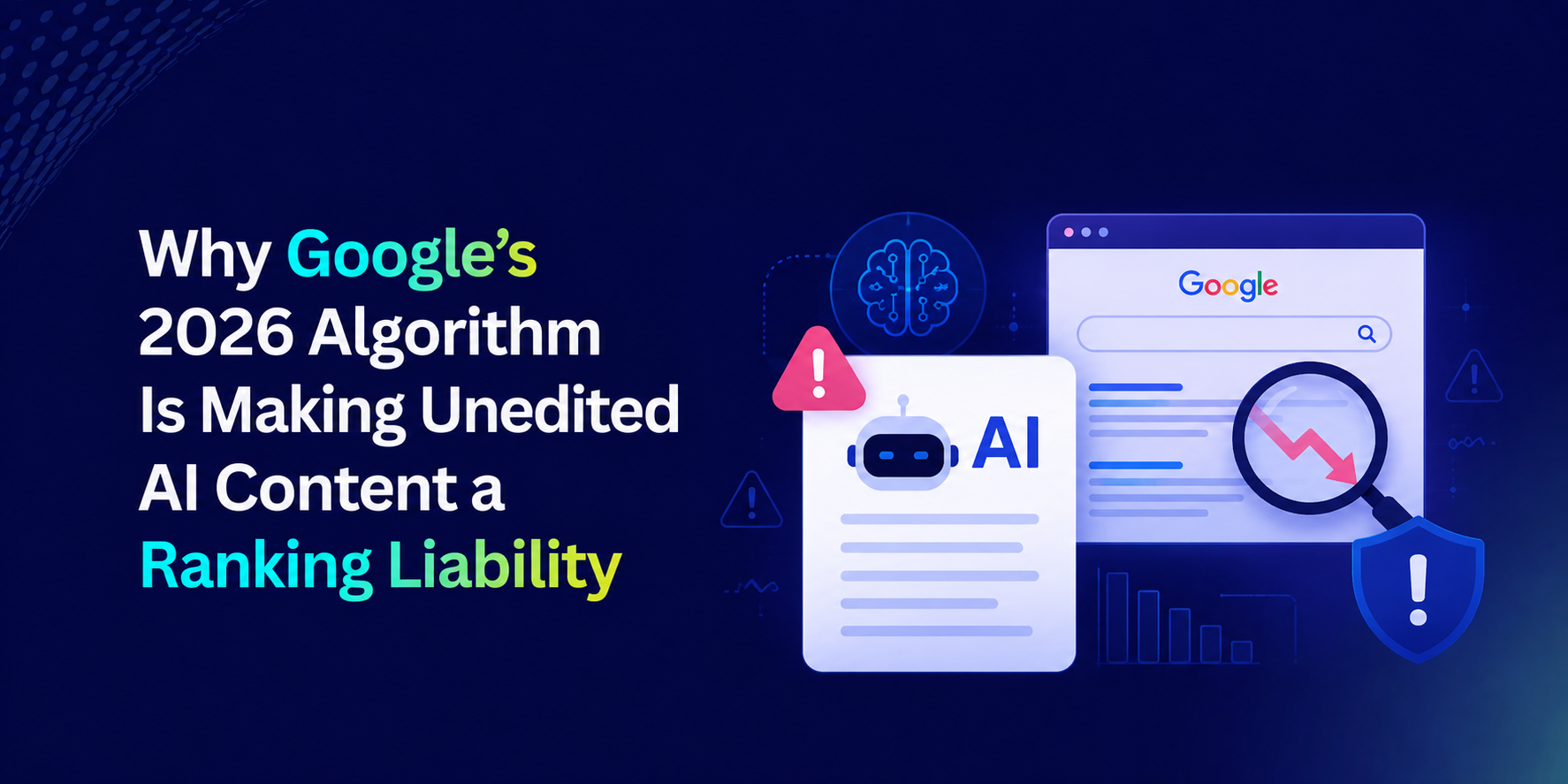
Google's 2026 algorithm updates have made one thing unmistakable: unedited AI content is no longer a neutral ranking factor; it is an active liability. Businesses that built content programs around AI-generated volume are now confronting declining organic visibility, and the pattern is consistent enough across industries to be treated as a strategic warning, not an isolated anomaly.
Key Takeaways
- Why is unedited AI content a ranking risk in 2026? Google's Helpful Content system and E-E-A-T evaluation framework are increasingly effective at identifying content that lacks genuine expertise, firsthand experience, and user-first intent.
- Has Google confirmed it penalizes AI content? Google has not issued a blanket AI content penalty, and it does not need to. Its quality evaluation systems reward Experience, Expertise, Authoritativeness, and Trustworthiness.
- Which industries face the highest risk from AI content? YMYL industries- Healthcare, Legal Services, and Financial Services- face the highest ranking and liability risk. But E-Commerce, SaaS/B2B, and Home Services all face meaningful consequences.
- What is the right content approach in 2026? A hybrid content strategy- AI for research, structure, and optimization; human expertise for substance, experience signals, and compliance review- consistently outperforms pure AI content.
- How does unedited AI content affect conversions beyond rankings? The impact extends beyond organic visibility. In E-Commerce, human-written product copy consistently outperforms AI-generated copy in A/B tests. In B2B SaaS, thin AI content fails to sustain the engagement required across long consideration cycles.
When Google's September 2023 Helpful Content update rolled out, the SEO community debated its impact for weeks. By the start of 2026, that debate was largely settled: sites that had invested heavily in AI-generated content at scale saw measurable organic visibility declines, and the pattern was consistent enough to stop being controversial. By 2026, Google's continued refinement of its quality evaluation systems has moved the conversation from "will unedited AI content be penalized?" to "how quickly, and across which industries?"
The answer, increasingly, is: faster than expected, and across all of them, with some sectors facing consequences far more severe than a ranking drop.
This is not an argument against AI in content production. AI tools have fundamentally changed what is achievable in SEO research, content briefing, keyword optimization, and technical auditing. The problem is not AI assistance; it is unedited AI content: content published with no substantive human expertise layered in, no firsthand experience reflected, no compliance review applied, and no genuine value added beyond what an algorithm assembled from existing web sources.
In 2026, Google's systems are better than ever at distinguishing content that genuinely serves users from content that was produced to fill a keyword gap. The former earns rankings. The latter earns rankings briefly, and then loses them to competitors who invested in the real thing.
In this guide, you will learn why Google's 2026 algorithm treats unedited AI content as a ranking liability, how this plays out across six key industries, what the data shows about AI content's ranking trajectory versus human-edited content, and what a practical hybrid content strategy looks like for businesses that want sustainable organic growth rather than a short-lived traffic spike.
Why Google's 2026 Algorithm Flags Unedited AI Content
Google's quality evaluation framework has three primary mechanisms that disproportionately affect unedited AI content: the Helpful Content system, E-E-A-T evaluation, and engagement-based quality signals.
The Helpful Content system
Introduced in 2022 and significantly strengthened through 2024 and 2025, Google's Helpful Content system applies a sitewide quality assessment based on whether a site's content is created primarily for users or primarily for search engines. Unedited AI content consistently triggers the latter classification, not because Google detects AI per se, but because AI-generated content exhibits the patterns the system is specifically designed to catch: shallow coverage of broad topics, absence of firsthand experience, and a structural focus on keyword presence over genuine user value.
Critically, the Helpful Content system's penalty is sitewide. A single section of a website populated with low-quality AI content can suppress rankings across the entire domain, including human-written pages that would otherwise rank competitively on their own merits.
E-E-A-T evaluation in 2026
Google's Experience, Expertise, Authoritativeness, and Trustworthiness framework has evolved from a content quality guideline into an increasingly algorithmic ranking input. In 2026, the "Experience" component, added in December 2022, is particularly consequential for AI content. Experience asks: has the author actually done what they are describing? Has the reviewer used the product? Has the advisor navigated the process?
AI cannot answer yes to these questions, because AI has no experience. Unedited AI content structurally lacks the signals, personal accounts, original data, specific observations, and authentic perspective that the Experience component is designed to reward. Human-written content, by contrast, naturally reflects these signals when authored by someone with genuine subject expertise.
Engagement-based quality signals
Google's algorithms incorporate user engagement data, time on page, scroll depth, bounce-back rate, and return visits as quality signals that inform ranking adjustments after initial indexing. Unedited AI content consistently produces weaker engagement metrics than human-written equivalents because readers recognize generic content and disengage from it. This engagement deficit compounds over time: pages that fail to retain user attention accumulate negative quality signals that progressively erode their rankings.
Industry research tracking content performance over five months found human-written content generating 5.44 times more organic traffic than AI-generated equivalents, a gap driven as much by engagement signal accumulation as by initial quality evaluation.
Industry Analysis: Where Unedited AI Content Causes the Most Damage
Healthcare
Risk level: Critical, ranking liability and patient safety liability simultaneously
Healthcare is the industry where unedited AI content carries the most severe consequences, extending well beyond ranking risk into genuine patient safety territory. AI language models generate medically plausible content by pattern-matching from existing sources, but they do not understand clinical context, cannot distinguish current treatment guidelines from outdated ones, and are not equipped to recognize when a generalization is dangerous in a specific patient scenario.
From a ranking perspective, medical content undergoes Google's most stringent YMYL (Your Money or Your Life) evaluation. Pages covering symptoms, diagnoses, treatments, and medications must demonstrate physician-reviewed accuracy, cite authoritative clinical sources, and carry verifiable author credentials. Unedited AI content fails every one of these criteria, and because Google's quality rater training specifically focuses on YMYL accuracy, AI-generated medical pages are among the most efficiently filtered content on the platform.
The consequences compound: a healthcare site that populates its blog with AI-generated symptom and treatment content not only loses organic visibility, it actively damages the E-E-A-T foundation of its entire domain, suppressing even the human-written, expert-reviewed content it publishes alongside the AI material. 88% of patients research health information online before making care decisions; content that loses their trust loses their business permanently.
Legal Services
Risk level: Critical, professional liability risk compounds ranking risk
Legal services content faces a dual liability from AI content: the SEO consequences of low E-E-A-T signals, and the professional liability consequences of AI-generated legal guidance that is inaccurate, jurisdiction-incomplete, or misleading.
AI tools frequently generate legal content that conflates jurisdictions, cites superseded statutes, or frames general principles as applicable guidance without the disclaimers and qualifications that professional legal publishing requires. For a law firm, publishing this content, even inadvertently, creates a reputational and liability exposure that far exceeds any organic traffic gain.
From an SEO perspective, legal content competes in some of the most expensive and competitive paid and organic search markets in digital advertising. The average CPC for legal keywords on Google Search is $6.75, reflecting how much a qualified legal lead is worth, and therefore how high the quality bar is for ranking organically. Ranking for high-value legal queries requires content that demonstrates specific, verifiable attorney expertise: case study context, jurisdiction-specific accuracy, and the kind of nuanced professional guidance that only a licensed practitioner can credibly provide.
Financial Services
Risk level: Critical; compliance gaps create regulatory as well as ranking exposure
Financial services content shares healthcare's YMYL classification with an additional dimension: regulatory compliance requirements that govern what financial advice can be communicated, how it must be disclaimed, and who is authorized to provide it. Unedited AI content in financial services regularly produces content that implies investment returns, states interest rate figures that may be outdated, or frames general financial principles as personalized advice, each of which can trigger platform policy violations or regulatory scrutiny depending on the jurisdiction.
Trust-building through demonstrable human expertise is the primary competitive differentiator in financial services SEO. Consumers making decisions about investments, tax strategies, or lending products want evidence of credentialed human judgment, not generic AI-assembled guidance. Financial services companies that invest in expert-authored, compliance-reviewed content consistently outrank AI-content-heavy competitors over a 6-to-12-month horizon. The average financial services CPA of $81.93 reflects the value of each converted lead, and the trust deficit created by low-quality AI content shows up directly in conversion rate data, not just rankings.
E-Commerce/Retail
Risk level: High, thin content penalties, conversion damage, and brand erosion
E-commerce is the industry where AI content has been most aggressively deployed, and where the consequences of getting it wrong are most directly measurable in revenue rather than just rankings. AI-generated product descriptions that offer no genuine buying guidance, category pages that regurgitate manufacturer specifications without comparative context, and blog content that targets informational keywords without connecting to purchase decisions all contribute to the thin content patterns that Google's Helpful Content system identifies and suppresses.
The conversion impact is equally significant. A/B tests comparing AI-generated product copy against human-written alternatives consistently show human copy outperforming on add-to-cart rates, time on page, and completed purchase conversion- the engagement signals that tell Google a page is genuinely serving users. In one documented comparison, human-written product copy achieved a 30% higher conversion rate than the AI-generated alternative for the same product. Brand storytelling, the authentic voice and perspective that builds customer loyalty and justifies premium pricing, is categorically beyond the capability of unedited AI content to replicate.
SaaS/B2B
Risk level: High, programmatic SEO risks, thought leadership deficit, sales cycle misalignment
SaaS and B2B technology companies have been among the most aggressive adopters of programmatic AI content strategies, generating thousands of pages targeting long-tail queries at scale. Google's Helpful Content updates specifically targeted these patterns, and multiple high-profile SaaS content programs experienced significant organic traffic losses as a result.
The deeper problem is structural. SaaS buying cycles are long, typically 3 to 6 months from initial research to purchase decision. The content that earns and retains a prospective buyer's attention across that cycle needs to demonstrate genuine technical depth, product expertise, and thought leadership that distinguishes the brand from competitors. Unedited AI content cannot deliver this, not because the information is necessarily wrong, but because it lacks the specificity, the original perspective, and the demonstrated practitioner expertise that technical buyers use to evaluate vendor credibility. Thin AI content that ranks briefly for top-of-funnel queries fails to nurture prospects toward conversion, making the organic traffic it generates largely worthless in commercial terms.
Home Services
Risk level: Moderate-to-High; local trust signals and community voice are non-replicable
Home services businesses- plumbing, HVAC, electrical, roofing, landscaping- compete primarily on local trust. The content that earns rankings and conversions in local home services SEO is fundamentally about community credibility: service area pages that reflect real local knowledge, blog content that addresses neighborhood-specific concerns, and a brand voice that feels like a neighbor rather than a corporation.
AI content consistently fails the local authenticity test. Generic service area pages generated by AI, "We provide expert plumbing services to homeowners in [City]", are recognizable to both Google and users as placeholder content. Google's local search algorithm weighs genuine community engagement signals,
Google Business Profile reviews, local citation consistency, and hyperlocal content specificity that AI tools cannot generate. Companies in competitive home services markets that invest in human-written, locally specific content consistently outrank competitors relying on AI volume. 92% of consumers read online reviews before choosing a local service provider, and the authentic brand voice that earns those reviews is the same voice that needs to permeate every piece of published content.
The Hybrid Content Strategy: What Actually Works in 2026
The evidence across every industry points to the same practical conclusion: AI content tools and human expertise are not competitors; they are a production system that delivers the best results when each is applied to the tasks it performs best.
| Content Task | AI Role | Human Role |
| Keyword research & clustering | Leads | Reviews and prioritizes |
| Content brief creation | Generates | Adjusts for brand and compliance |
| First draft | Optional accelerator | Leads for YMYL, authority content |
| Expertise and experience layer | Cannot contribute | Non-negotiable |
| Compliance review | Cannot contribute | Required for YMYL industries |
| E-E-A-T signals (author credentials) | Cannot contribute | Required |
| Real-time SEO scoring | Leads | Reviews final output |
| Local and community content | Cannot contribute | Required |
| Technical accuracy (SaaS/B2B) | Cannot verify | Required |
| Content refresh monitoring | Leads | Interprets and acts |
Human-edited AI content ranks 34% higher on average than unedited AI output. Hybrid content programs see 2.3 times faster ranking improvements than manual-only approaches, capturing AI's efficiency advantage while protecting the E-E-A-T foundation that sustains rankings beyond the initial indexing window.
Common Mistakes Businesses Make with AI Content
Mistake #1: Measuring AI content success at the 30-day mark. AI content often ranks quickly due to keyword optimization. The meaningful measurement window is five months, by which point human-edited content generates 5.44 times more organic traffic. Short evaluation windows lead to continued investment in a strategy whose ceiling is already built into its structure.
Mistake #2: Publishing AI content sitewide without segmenting by content type. AI is appropriate for some content tasks and not others. Applying it uniformly, including to YMYL pages, thought leadership pieces, and local authority content, creates quality signals that suppress even the strong content on the same domain.
Mistake #3: Removing author attribution to scale faster. Anonymous content is one of the clearest E-E-A-T red flags in Google's quality evaluation. Scaling AI content by stripping author bylines removes the human credibility signal the content needs to rank sustainably.
Mistake #4: Confusing AI SEO tools with AI content generation. AI-powered tools for keyword research, technical audits, content scoring, and performance monitoring deliver genuine, low-risk efficiency gains. Unedited AI content generation is the source of ranking liability, not AI tooling in general. These are categorically different applications.
Mistake #5: Not auditing existing AI content before expanding. Businesses that published significant AI content volumes in 2023 and 2024 frequently carry ranking liabilities in their existing library. Before investing in new content, audit current AI-generated pages for thin content patterns, missing E-E-A-T signals, and Helpful Content flags, and remediate the worst offenders before they suppress domain-wide performance.
How Shankom Can Help
Shankom solutions builds hybrid content strategies that protect businesses from the ranking liabilities of unedited AI content while capturing the efficiency advantages that AI tools genuinely deliver. From comprehensive content audits that identify which existing AI-generated pages are creating sitewide quality risk, to full content programs that pair AI-assisted research and structure with credentialed human authorship, Shankom designs content operations that earn durable rankings in 2026's increasingly quality-sensitive algorithm environment. Whether you are managing YMYL compliance risk in healthcare or legal services, building technical thought leadership for a SaaS audience, or establishing local trust signals for a home services brand, Shankom provides the strategy and execution that turns content investment into compounding organic growth.