Ecommerce Marketing in NJ: A Step-by-Step Guide for D2C Brands
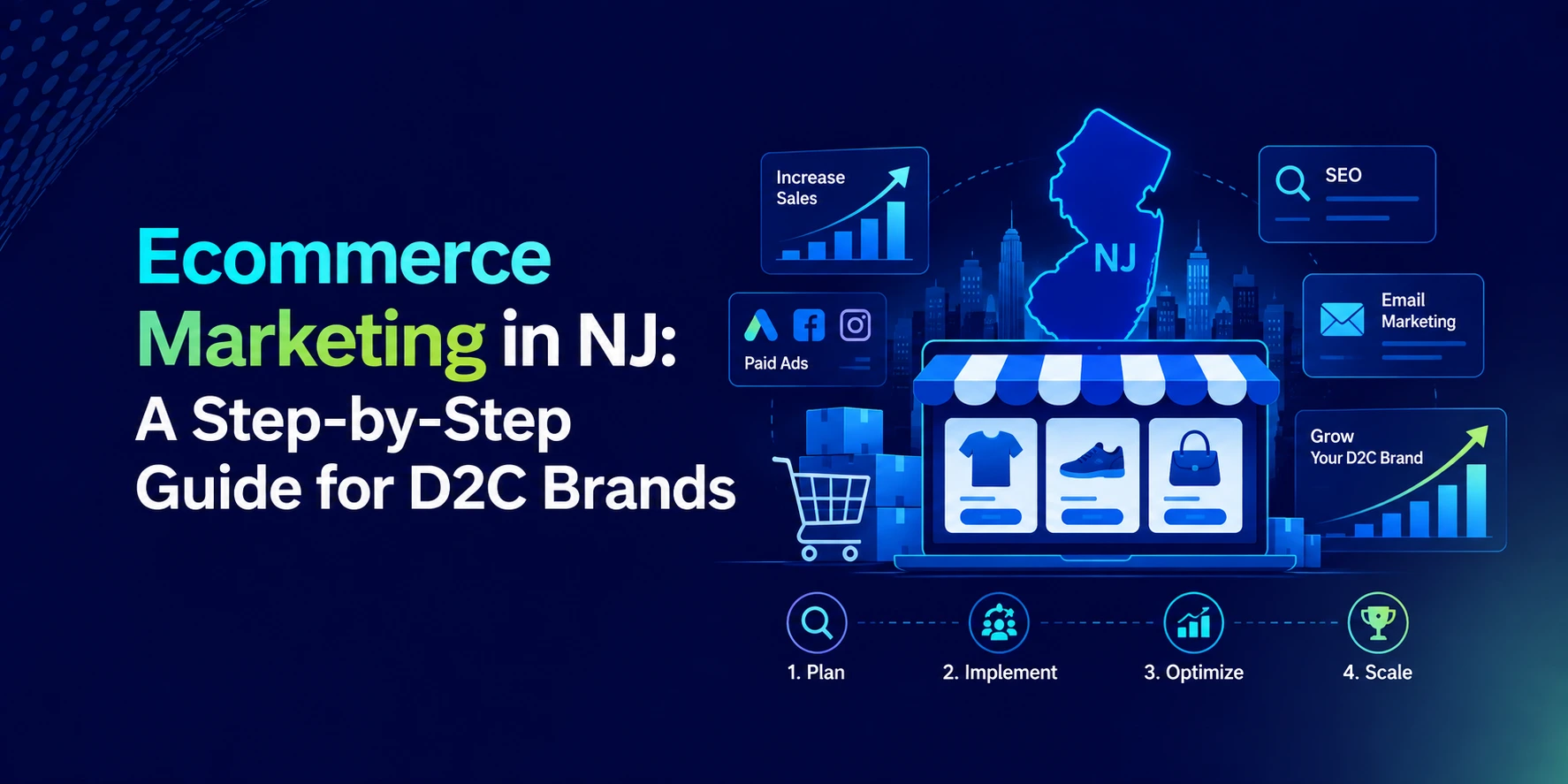
Winning at ecommerce marketing in New Jersey comes down to a repeatable seven-step system: nail your foundation, get your Shopify SEO right, build content that earns organic traffic, run paid acquisition efficiently, deploy email and SMS automation to capture revenue on autopilot, optimize for conversions, and measure what matters. New Jersey’s dense, high-income, online-first market rewards D2C brands that treat marketing as a system rather than a series of one-off campaigns. This guide covers each step, recommends the right tools for 2026, shares real brand examples, and includes a downloadable roadmap so you can start executing today.
Key Takeaways
- What is the first step in ecommerce marketing? A solid foundation: a fast, well-structured store with clear positioning and accurate tracking in place.
- How important is SEO for D2C brands? Very. Search optimization earns durable organic traffic that lowers your reliance on paid ads over time.
- What is the highest-ROI channel for D2C? Email and SMS automation are consistently among the highest-return channels, capturing a large share of revenue automatically for top-performing stores.
- Why does location matter for a NJ brand? New Jersey’s density, income, and shipping proximity give local D2C brands a real logistical and targeting edge.
- Do I need every tool at once? No. Start with your platform, an email tool, and analytics, then layer in more as you scale.
New Jersey is one of the best places in the country to run a direct-to-consumer brand, and one of the most competitive. Dense population, high household income, proximity to New York and Philadelphia shipping lanes, and a customer base that shops online constantly all work in your favor. But those same advantages draw in national competitors and well-funded startups, which means a NJ D2C brand cannot rely on a great product alone. It needs a marketing system.
What Is Ecommerce Marketing?
At its simplest, ecommerce marketing is everything you do to drive shoppers to an online store and turn them into repeat customers. It spans how people first discover you (search, content, ads, and social), how your store persuades them to buy (product pages, pricing, and checkout experience), and how you bring them back afterward (email, SMS, and loyalty). For a direct-to-consumer brand that sells straight to shoppers without a retail middleman, these pieces are not separate campaigns but parts of one funnel, and the brands that grow profitably are the ones that connect them.
That is the whole idea behind the framework below. Rather than chasing one channel at a time, it sequences the moving parts into a system where each step makes the next one work harder. Here is how it fits together, and how a New Jersey D2C brand can put it to use.
Why New Jersey Is a D2C Advantage
Before the framework, it helps to understand why marketing to your home region deliberately is worth the effort. New Jersey combines a large, affluent, digitally active population with a unique logistical position between two major metros. That means faster, cheaper shipping to a huge customer base, strong local demand across nearly every category, and the ability to target geographically with real precision. A NJ D2C brand can build a loyal regional following while still selling nationally, which is a foundation many brands in less dense markets would envy.
The 7-Step Ecommerce Marketing Framework
The brands that win at direct-to-consumer marketing rarely do one thing brilliantly. They do seven things consistently. Here is the framework, in the order you should build it.
Step 1: Build a Strong Foundation
Everything downstream depends on getting the basics right. That means a fast-loading, mobile-first store, clear brand positioning that explains why you exist, compelling product pages, and accurate analytics and conversion tracking from day one. Marketing that drives traffic to a weak foundation just spends money exposing the weakness. Fix the store before you scale the traffic.
Step 2: Get Your Shopify SEO Right
Organic search is the traffic source that compounds. For a D2C brand on Shopify, that means optimized product and collection pages with unique descriptions, clean site architecture, fast load speeds, structured data so products appear as rich results, and a logical internal linking structure. Unlike ads, the visibility you earn here keeps working long after the effort, steadily lowering your cost of acquisition.
Two areas deserve extra attention on Shopify specifically. First, collection pages are often the highest-intent commercial pages on a store, yet many brands leave them with no descriptive copy at all. Adding genuine, keyword-relevant content to your top collections is one of the fastest SEO wins available. Second, unique product descriptions matter more than most owners think, because copying manufacturer text that appears on dozens of other sites gives search engines no reason to rank yours. Writing original descriptions that answer real buyer questions, combined with review content and structured data, turns product pages into pages that actually earn traffic rather than just receive it.
Step 3: Create Content That Earns Traffic
Product pages alone rarely build authority. Content does. Buying guides, how-to articles, and topic-based content answer the questions your customers ask before they buy, earning organic traffic and trust that funnels into your products. For a New Jersey brand, content that speaks to local interests and seasons can also deepen regional loyalty while still ranking nationally.
Step 4: Run Paid Acquisition Efficiently
Paid ads deliver immediate, scalable traffic, but only profitably when they are built on the foundation above. Start with the platforms where your audience already spends time, use precise targeting, and feed the algorithms clean conversion data so they can optimize toward real buyers. Treat paid as an accelerator on top of organic, not a substitute for it.
Step 5: Deploy Email and SMS Automation
Email and SMS automation are consistently among the highest-return channels in D2C. Well-run automation captures revenue while you sleep through flows like welcome series, abandoned cart recovery, post-purchase sequences, and win-back campaigns. The reason is efficiency: according to Klaviyo’s ecommerce benchmarks, automated flows generate a large share of total email revenue from only a small fraction of sends, and top-performing stores draw roughly 30 to 40 percent of total revenue from email and SMS combined. Results vary by brand and category, but for most stores this is the fastest place to recover revenue that is otherwise left on the table. If you do only one thing after fixing your foundation, this is a strong candidate.
Sources: Klaviyo / Darkroom ecommerce email benchmarks 2026; Omnisend 2026 ecommerce report
A few core flows deliver most of that value, and they are worth setting up in order. The welcome series greets new subscribers, tells your brand story, and often includes a first-purchase incentive, converting curiosity into a first sale. Abandoned cart and abandoned checkout flows recover shoppers who left before buying, which is frequently the single highest-revenue automation a store runs. The post-purchase sequence thanks buyers, sets expectations, and begins turning a one-time customer into a repeat one. A browse-abandonment flow re-engages visitors who looked but never added to cart. And a win-back campaign reaches lapsed customers before they are gone for good. Layering SMS onto these flows for time-sensitive moments, like a cart about to expire, lifts results further because text messages are seen almost immediately.
Step 6: Optimize for Conversion
Getting traffic is only half the equation. Conversion rate optimization turns more of your existing visitors into buyers through clearer product pages, smoother checkout, trust signals like reviews, and continuous testing. A small lift in conversion rate compounds across every channel at once, which makes it one of the most efficient investments you can make.
Step 7: Measure and Iterate
What gets measured gets improved. Track the metrics that actually matter, including customer acquisition cost, lifetime value, conversion rate, and revenue by channel, then use that data to double down on what works and cut what does not. The framework is a cycle, not a checklist: measure, learn, adjust, repeat.
The Proof: Real D2C Brands Using This Framework
The framework is not theory. The three examples below show how it plays out across different kinds of D2C brands - one fighting to reduce paid dependence, one balancing SEO and paid acquisition, and one rebuilding a durable organic channel after outgrowing its foundation. Different starting points, but the same underlying system: connected steps, each making the next one work harder.
Client A - DTC compression-legwear brand (Steps 2, 3, and 6)
- Challenge: Growth had stalled behind rising ad costs, and the store's product and collection pages weren't ranking for the non-branded terms buyers actually searched, so paid acquisition was carrying nearly all the traffic.
- Strategy: We ran a full technical SEO overhaul, then built content around real buyer intent - sizing, compression levels, use cases, and care - and rebuilt the internal linking so authority flowed from the content into the pages that convert. In parallel, we tightened the product pages themselves, sharpening copy, trust signals, and checkout to lift conversion on the traffic already arriving.
- Results: +400% organic search traffic · +21% conversion rate within six months
- Impact: Organic shifted from a minor channel to a primary one, steadily lowering the brand's cost of acquisition and reducing its dependence on paid spend - growth that kept compounding rather than resetting with each campaign.
Client B - DTC wellness and probiotics brand (Steps 2 and 4)
- Challenge: The brand was scaling on paid alone, with a blended cost of acquisition climbing to the point where profitable growth was getting harder every quarter.
- Strategy: We built out product-page and category SEO to earn organic traffic that paid didn't have to buy, then restructured the paid program around clean conversion data and programmatic targeting so that the audiences are most likely to convert. The two channels were run as one system - organic carrying the efficient base while paid accelerated on top - rather than competing for the same budget.
- Results: +530% organic revenue · −62% blended cost of acquisition
- Impact: The paid-plus-organic balance changed the unit economics of the whole business, letting the brand grow revenue and cut acquisition cost at the same time instead of trading one for the other.
Client C - DTC senior-wellness brand (Steps 3 and 7)
- Challenge: The brand was growing faster than its organic foundation could support and leaning ever harder on paid ads, leaving it exposed to rising costs and with no durable, lower-cost acquisition channel to fall back on.
- Strategy: We shifted the center of gravity toward topical-authority content, building guides and resources around the questions its customers ask before buying, each wired into the products they naturally lead to. Then we put measurement at the core - tracking acquisition cost, lifetime value, and revenue by channel - so the content program could be tuned toward the pieces that actually moved commercial metrics rather than vanity traffic.
- Results: +260% organic traffic · −35% reliance on paid acquisition over three quarters
- Impact: The brand traded a fragile, ad-dependent model for a compounding organic channel, building an asset that kept acquiring customers after the work was done instead of demand it had to keep buying.
Across all three, the throughline is the same: the framework doesn't just lift one metric; it changes the economics of acquisition - connecting the steps into a system that keeps working long after any single campaign ends. That durability, more than any headline percentage, is the real case for treating ecommerce marketing as a system rather than a series of one-off pushes.
How New Jersey D2C Brands Are Applying This
The framework looks different across categories. The scenarios below are illustrative composites, built from the documented patterns above rather than any single company, and they show how the seven steps map onto common New Jersey business types.
A Jersey Shore apparel brand might lean on content and email, building seasonal buying guides that rank in search and feeding subscribers with automated flows timed to the local season, so its welcome and abandoned-cart flows quietly become its most profitable channel while shore-season content pulls in organic traffic that paid ads would cost a fortune to match. A North Jersey specialty food brand might combine product-page SEO with abandoned-cart and post-purchase automation, turning first-time buyers into repeat subscribers and lifting the average customer’s lifetime value. A Central NJ wellness brand might use efficient paid acquisition to drive first purchases, then rely on lifecycle email and a subscription option to grow lifetime value well beyond the initial sale. In every case, the winning move is connecting the steps into one system rather than running each channel in isolation.
Tool Recommendations for 2026
You do not need a bloated tech stack. You need the right tools for your stage, connected cleanly. Here is a practical starting point for NJ D2C brands.
| Need | Recommended Tools | Notes |
| Store platform | Shopify, BigCommerce | Shopify is the default for most D2C brands in 2026 |
| Email and SMS | Klaviyo, Omnisend | Klaviyo for Shopify depth; Omnisend for multichannel |
| SEO and content | Google Search Console, keyword research tools | Start with free tools before paid suites |
| Analytics | Google Analytics, platform analytics | Verify tracking accuracy before scaling spend |
| Conversion and forms | OptinMonster, review apps | Capture leads and add trust signals |
| Subscriptions | ReCharge | Adds recurring revenue for suitable products |
A note of caution: the goal is simple, connected workflows, not tool overload. The most successful teams pick a focused stack and integrate it well rather than chasing every new app. For a Shopify-first NJ brand, the fastest returns usually come from your platform, Klaviyo, and clean analytics before anything more complex.
The Local Advantage: Marketing to New Jersey Customers
Here is a section most national D2C guides skip entirely, and it is where NJ brands can pull ahead. Selling nationally does not mean ignoring the market on your doorstep. Your home state is often your cheapest and most loyal customer base, and there are concrete ways to lean into it.
Geographic targeting lets you concentrate paid spend on New Jersey and the surrounding metros where your shipping is fastest, and your brand story resonates most. Local content, from seasonal guides to regional interests, builds a connection national competitors cannot easily replicate. Faster regional delivery is a genuine selling point worth featuring prominently, since shipping speed drives conversions. Local partnerships, pop-ups, and community involvement create word-of-mouth and content opportunities that feed the rest of your funnel. And a well-optimized local presence helps you show up when nearby customers search, blending ecommerce reach with local visibility. For many NJ D2C brands, this regional core becomes the profitable base that funds national expansion.
Your Ecommerce Marketing Roadmap
To make this framework easy to execute, here is a 90-day roadmap that sequences the seven steps into a realistic plan. Use it as a starting structure and adjust the pace to your resources.
| Phase | Focus | Key Actions |
| Days 1 to 30 | Foundation and SEO | Audit and optimize the store, fix tracking, and start SEO on product and collection pages |
| Days 31 to 60 | Content and email | Publish the first content pieces and set up core email flows: welcome, abandoned cart, post-purchase |
| Days 61 to 90 | Paid, CRO, and measurement | Launch efficient paid campaigns, run conversion tests, and establish your reporting dashboard |
| Ongoing | Iterate and scale | Review metrics monthly, double down on winners, and expand content and automation |
How Shankom Can Help
Shankom solutions helps New Jersey D2C brands turn this framework into revenue. From SEO and content strategy to email and SMS automation, efficient paid acquisition, and conversion optimization, Shankom builds the complete ecommerce marketing system rather than running channels in isolation. Whether you are launching or scaling, Shankom pairs national reach with the regional advantage that helps New Jersey brands grow profitably, so you can build a direct-to-consumer engine that acquires customers and keeps them, without the guesswork.
FAQs
How long before ecommerce marketing shows results?
Paid ads and email automation can produce results within weeks, while SEO and content compound over four to six months. The strongest brands run both: quick wins from paid and email fund the longer-term organic growth that lowers acquisition costs.
What budget do I need to start?
Less than most owners expect, because the highest-return early moves cost more in effort than in dollars. A realistic starting stack is modest: a store platform (Shopify runs roughly $39 a month on its basic plan), an email and SMS tool (Klaviyo is free up to a few hundred contacts, then scales with your list), and free analytics through Google Analytics and Search Console.
The work that drives the biggest early gains- fixing your store foundation, writing unique product and collection copy, and setting up your core email flows- is largely time rather than money spent. Paid ads are the one variable line item; many NJ D2C brands begin testing with $500 to $1,500 a month, then scale that budget only once the store converts and the email flows are capturing revenue.
Is Shopify the best platform for NJ D2C brands?
For most, yes. Shopify offers the deepest D2C tooling, the best app ecosystem, and native integrations with tools like Klaviyo. Larger or more complex catalogs sometimes suit BigCommerce, but Shopify is the sensible default in 2026.
Which step should I prioritize first?
Fix your foundation, then set up email automation. A solid store plus core email flows deliver the fastest, most reliable returns before you invest heavily in paid acquisition or content.