How Philadelphia Ecommerce Brands Are Winning with Content-Led SEO
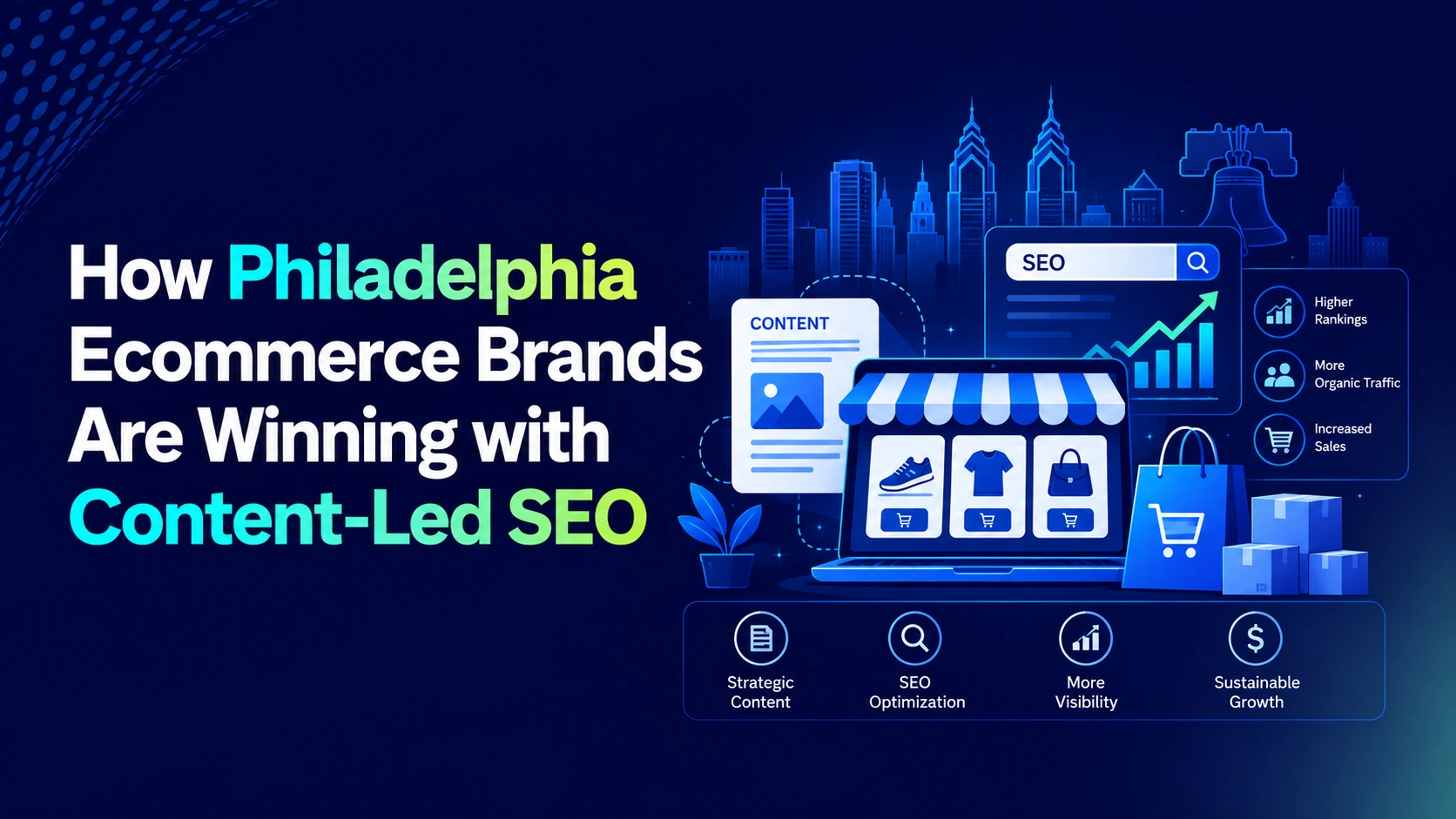
Philadelphia ecommerce brands are shifting from ad-dependent growth to content-led SEO. The framework centers on content clusters: a pillar page on a core topic, supported by interlinked articles that build topical authority. Paired with strong product-page optimization and keyword research around buyer intent, this approach earns durable organic traffic that compounds instead of disappearing when ad spend stops. A content marketing partner ties it all together with internal linking and measurement. This guide walks through the framework, the evidence behind it, local examples, keyword research tips, and where content and commerce connect.
Key Takeaways
- What is content-led SEO? An approach that uses interconnected, helpful content, not just product pages, to build authority and earn organic traffic.
- What are content clusters? A pillar page on a broad topic supported by interlinked articles targeting specific buyer questions, signaling expertise to search engines.
- Does it work for ecommerce? Yes. Brands relying on standalone product pages are losing ground, while cluster-based sites capture far more organic traffic.
- How does it help product pages? Content clusters funnel authority and qualified visitors into optimized product and category pages, lifting rankings across the site.
- Why not just run ads? Ads stop working the moment you stop paying. Content-led SEO builds an asset that compounds over time.
For years, the ecommerce playbook in Philadelphia looked the same for everyone: build product pages, buy ads, and hope the margins survived rising ad costs. That approach is quietly breaking. As paid acquisition gets more expensive and search itself is reshaped by AI, the brands pulling ahead are the ones that stopped treating content as an afterthought and started using it as the engine of their organic growth.
This shift has a name: content-led SEO. Instead of relying on isolated product pages to do all the ranking work, smart Philadelphia brands are building interconnected ecosystems of content that answer real customer questions, build topical authority, and funnel qualified shoppers toward the buy button. Whether you work with an ecommerce agency or build the capability in-house, this model is proving more durable and more profitable than the ad-dependent alternative. Here is how it works, and how you can apply it.
Why Content-Led SEO Is Winning in 2026
The reason this model is gaining ground is simple: the old one is getting harder. Paid acquisition costs keep climbing, and standalone product pages no longer carry the weight they used to. In 2026, ecommerce sites that rely on isolated product pages are increasingly left behind because Google’s AI-driven systems now evaluate the depth and coherence of an entire topic cluster rather than scoring isolated URLs. The Helpful Content system rewards topical depth, experience signals, and a coherent internal link structure all at once, which a single page cannot provide.
Source: Digital Applied, SEO Content Clusters 2026
The payoff for doing it right is well documented. HubSpot research found that organizations implementing topic clusters see an average 43 percent increase in organic traffic, and independent analyses report that clustered content tends to hold rankings roughly 2.5 times longer than standalone posts. A site with many interconnected articles on a subject consistently outranks a site with a single page, even a very good one. For a Philadelphia brand, that is the difference between competing for one keyword and owning an entire category in search, and unlike ads, that visibility does not vanish the moment the budget runs dry.
Sources: HubSpot research, via Whitehat SEO; Web Tonic/HireGrowth analysis
The Content-Led SEO Framework
The heart of content-led SEO is the content cluster model, sometimes called hub-and-spoke. It is straightforward to understand and powerful when executed consistently. Here are the four building blocks.
1. The Pillar Page
A pillar page is the authoritative, comprehensive resource on a broad topic central to your business. For a Philadelphia coffee brand, that might be a complete guide to brewing methods. For a home goods store, it could be a guide to choosing bedding. The pillar covers the topic at a high level, links out to every supporting article, and serves as the hub search engines and shoppers return to. In 2026, effective pillar pages tend to be genuinely thorough, often several thousand words, because depth is what signals real authority.
2. Cluster Articles
Cluster articles are the spokes: focused pieces that each answer a specific question or subtopic in depth. Around a bedding pillar, clusters might cover thread count, materials, care tips, and sizing. Each one targets a real search query a potential buyer is typing, and each links back to the pillar. Together they tell search engines that your site covers the topic comprehensively, which lifts the whole cluster.
3. Optimized Product and Category Pages
This is where content meets commerce. Optimizing your product pages ensures that when your content earns a visitor’s trust, the page they land on to buy is ready to convert. That means clear, unique product descriptions written for both shoppers and search, keyword-relevant category pages, structured data, fast load times, and internal links from your cluster content pointing to the right products. The content builds authority; the product pages capture the sale.
The details matter here more than most brands realize. Unique descriptions are essential because manufacturer-supplied copy, duplicated across dozens of retailers, gives search engines no reason to favor your page. Category pages deserve real attention too, since they often target the highest-intent commercial keywords and are frequently under-optimized with thin or missing copy. Adding structured data helps your products appear as rich results with pricing and review stars, which lifts click-through rates. And the internal links from cluster articles do double duty: they pass authority to your product pages and deliver pre-qualified readers who already trust you.
4. Internal Linking
Internal linking is the connective tissue that turns separate pages into a cluster. Every cluster article links back to its pillar, the pillar links out to each article, and relevant content links to the product and category pages it supports. This structure distributes authority across your site and guides shoppers naturally from learning to buying. Without deliberate internal linking, even great content sits isolated and underperforms.
The Evidence: What Content-Led SEO Actually Delivers
Because the results claimed for content-led SEO can sound too good to be true, it helps to see how the framework plays out across different kinds of ecommerce and content-driven businesses. The three examples below model that - a DTC brand fighting rising ad costs, a B2B company invisible in early-stage search, and a service provider whose content never compounded. Different starting points, but the same underlying move: authoritative content, organized into clusters, wired to the pages that convert.
Client A - DTC compression-legwear brand
- Challenge: Over-reliant on branded search and paid ads; product pages weren't ranking for the non-branded terms buyers actually searched, so acquisition costs kept climbing with every campaign.
- Strategy: We mapped non-branded search intent across the category and built content clusters around the questions buyers ask before purchase - sizing, compression levels, use cases, and care. Each cluster article linked back to a pillar guide and forward to the relevant product pages. In parallel, we cleaned up the product feed and rebuilt internal linking so authority flowed from the content into the pages that convert.
- Results: +410% organic traffic · +38% conversions · +52% revenue over 12 months
- Impact: The gains compounded instead of resetting each month, which steadily lowered the brand's cost of acquisition and reduced its dependence on paid spend - organic became the channel carrying growth rather than ads.
Client B - B2B cloud-integration company
- Challenge: Strong product, but no authoritative hub for its core topic, leaving it invisible for the high-value informational searches its buyers ran early in the journey.
- Strategy: We built a comprehensive pillar page on the company's core topic, deep enough to serve as the definitive resource for the category. Existing supporting content was audited, updated, and wired into the pillar with deliberate internal links, and gaps were filled with new cluster articles targeting specific subtopics. The structure signaled topical depth to search engines while giving readers a clear path from question to solution.
- Results: +53% organic traffic to the hub within two quarters
- Impact: The pillar captured buyers at the research stage the company had been missing entirely, feeding a warmer, better-informed pipeline into its product pages rather than paying to reach the same audience later in the funnel.
Client C - Third-party logistics provider
- Challenge: Fragmented content that never compounded; individual posts ranked in isolation and no single asset anchored the category or captured demand at scale.
- Strategy: We anchored the topic with an authoritative industry-report pillar page designed to earn links and rank for the category's head terms. Around it, we built cluster content answering the operational questions buyers ask, each piece linked into the pillar and into relevant service pages. Internal linking was restructured, so the whole cluster reinforced the hub rather than competing with it.
- Results: +880% organic traffic · +190% conversions
- Impact: One authoritative hub reframed the company from a minor voice into a category reference point, and because the cluster reinforced itself, the traffic and conversion gains held rather than fading the way isolated posts had.
At the market level, the pattern holds: Philadelphia is home to a deep bench of ecommerce SEO agencies whose published portfolios report organic-traffic gains in the low hundreds of percent for local online stores, typically by combining product-page optimization with supporting content and internal linking, the same ingredients described in this guide. The consistent thread is not a single magic tactic but the architecture: authoritative content, organized into clusters, wired to the product pages it supports.
How Philadelphia Brands Are Applying This
Across the city, ecommerce brands in different categories are putting this framework to work. The scenarios below are illustrative composites, built from the common patterns above rather than any one company, and they show how the model maps onto real Philadelphia business types.
A specialty food brand might build a cluster around regional cooking, with a pillar guide to the city’s food traditions and cluster articles on specific dishes, ingredients, and techniques, each linking to the relevant products so recipe searches become product discovery. A local apparel brand might create a pillar on seasonal dressing for Philadelphia’s climate, supported by style guides that point shoppers toward specific collections. A home and lifestyle store might anchor its strategy with buying guides, using cluster content to answer the practical questions shoppers ask before a purchase, then routing that qualified traffic to optimized category pages.
A few cluster types tend to work especially well for ecommerce. Category-mastery clusters cover every angle of a product category, with a broad pillar and satellites on features, comparisons, price tiers, and use cases. Problem-solution clusters start from a customer pain point and connect it to the products that solve it, which is powerful for brands whose products address a specific need. Use-case clusters organize content around how and when a product is used, meeting shoppers who search by situation rather than by product name. Choosing the right cluster type depends on how your customers actually search, which is why keyword research comes first.
The common thread is that none of these approaches treat content and commerce as separate. Each uses helpful content to earn attention and trust, then connects it directly to the products that content naturally leads to. That integration is what a strong ecommerce SEO service is built to deliver.
Keyword Research Tips for Content-Led SEO
A content cluster is only as good as the keywords behind it. The goal is not to chase the highest-volume terms but to map the full range of questions your buyers ask across their journey. Here are practical tips for getting it right.
- Start with buyer intent, not just volume. Group keywords by what the searcher wants: informational (“how to choose running shoes”), commercial (“best trail running shoes”), and transactional (“buy trail running shoes”). A healthy cluster serves all three.
- Build around a core topic. Pick a topic broad enough to support a pillar and many clusters, then list every subtopic and question a buyer might have. Each becomes a candidate cluster article.
- Mine real questions. Look at what customers actually ask, in reviews, support tickets, and search suggestions. These long-tail, question-based queries are exactly what AI-driven search now surfaces.
- Prioritize by opportunity. Favor terms where you can realistically compete and where intent aligns with a purchase, rather than high-volume terms that rarely convert.
- Map keywords to page types. Informational queries become cluster articles, commercial queries become comparison or buying guides, and transactional queries map to optimized product and category pages.
This intent-based approach matters more than ever in 2026, because search now rewards depth and relevance over raw keyword matching. A cluster that genuinely answers the questions around a topic will outperform a page that simply repeats the same keyword.
How the Pieces Fit Together
| Buyer Stage | Search Intent | Content Type | Goal |
|---|---|---|---|
| Awareness | Informational | Pillar page and cluster articles | Build authority and earn traffic |
| Consideration | Commercial | Buying guides and comparisons | Guide the decision and build trust |
| Purchase | Transactional | Optimized product and category pages | Convert the visitor into a customer |
| Retention | Post-purchase | How-to and care content | Increase loyalty and repeat sales |
Reading the table from top to bottom shows the real advantage of the model: it meets shoppers at every stage of their journey with the right content, then connects each stage to the next through internal links. A single visitor can enter through an informational article, move to a buying guide, and land on a product page ready to purchase, all within your own ecosystem.
How to Measure Content-Led SEO
One reason content-led SEO gets abandoned too early is that brands measure the wrong things or measure too soon. Because the model compounds, the meaningful signals show up in stages, and knowing what to watch keeps you from pulling the plug before the payoff arrives.
In the first few months, look at leading indicators: keyword rankings climbing, pages getting indexed, and impressions rising in search. These show the strategy is taking hold before traffic spikes. As the cluster matures, shift attention to organic traffic growth, the keywords each cluster ranks for, and how visitors move from content into product pages. The most important measures are commercial: assisted conversions from content, revenue influenced by organic traffic, and the gradual drop in how dependent your sales are on paid ads. A cluster that quietly lowers your cost of acquisition is doing exactly what it should, even if any single article looks modest on its own.
Common Mistakes Ecommerce Brands Make
Mistake #1: Relying only on product pages. Product pages alone rarely build the topical authority search engines now reward. Without supporting content, they compete with one hand tied behind their back.
Mistake #2: Publishing disconnected blog posts. Random articles with no cluster structure or internal linking do little for rankings. Content needs to be organized around topics to compound.
Mistake #3: Ignoring buyer intent. Writing only informational content, or only sales pages, misses most of the journey. A cluster should serve awareness, consideration, and purchase alike.
Mistake #4: Weak internal linking. Even excellent content underperforms when it is not connected. Internal links are what turn separate pages into an authority-building cluster.
Mistake #5: Treating content and commerce separately. When content never links to products, it fails to convert. The whole point is to guide qualified readers toward the sale.
How Shankom Can Help
Shankom solutions help Philadelphia ecommerce brands turn content into a durable growth engine. Shankom designs and executes the full content-led SEO framework, from keyword research and pillar strategy to content clusters, internal linking, and product-page optimization that converts. By connecting helpful content directly to the products it supports, Shankom helps your organic traffic compound instead of disappearing when ad spend stops. Explore our content marketing services and ecommerce SEO services to see how the pieces fit together for your brand.
FAQs
How long does content-led SEO take to show results?
Most ecommerce brands see meaningful movement within four to six months, with authority and traffic compounding over time. Clusters build momentum as more articles are added and internal links strengthen, so the biggest gains often come after the first two quarters.
Is content-led SEO better than paid ads?
They serve different roles. Ads deliver immediate traffic that stops when spending stops, while content-led SEO builds a durable asset that compounds. Many brands use both, letting content lower their long-term reliance on paid acquisition.
How many articles does a content cluster need?
There is no fixed number. A cluster should cover the meaningful subtopics and questions around your core topic, which might be a handful of articles or several dozen for a large category. Completeness matters more than a specific count.
Can a small Philadelphia brand compete with larger stores?
Yes. Topical authority is buildable by smaller sites on focused topics. A local brand that deeply covers a narrow category can outrank a larger, less focused competitor on the searches that matter most to its business.