Can AI Tools Replace Manual Keyword Research? Here’s What SEOs Are Actually Finding
AI keyword research tools have transformed what is operationally possible in SEO, but the SEOs consistently generating the strongest organic results in 2026 are not the ones who handed keyword strategy entirely to an algorithm. They are the ones who figured out precisely where AI accelerates the process and where it quietly introduces the gaps that manual research was always designed to close.
Key Takeaways
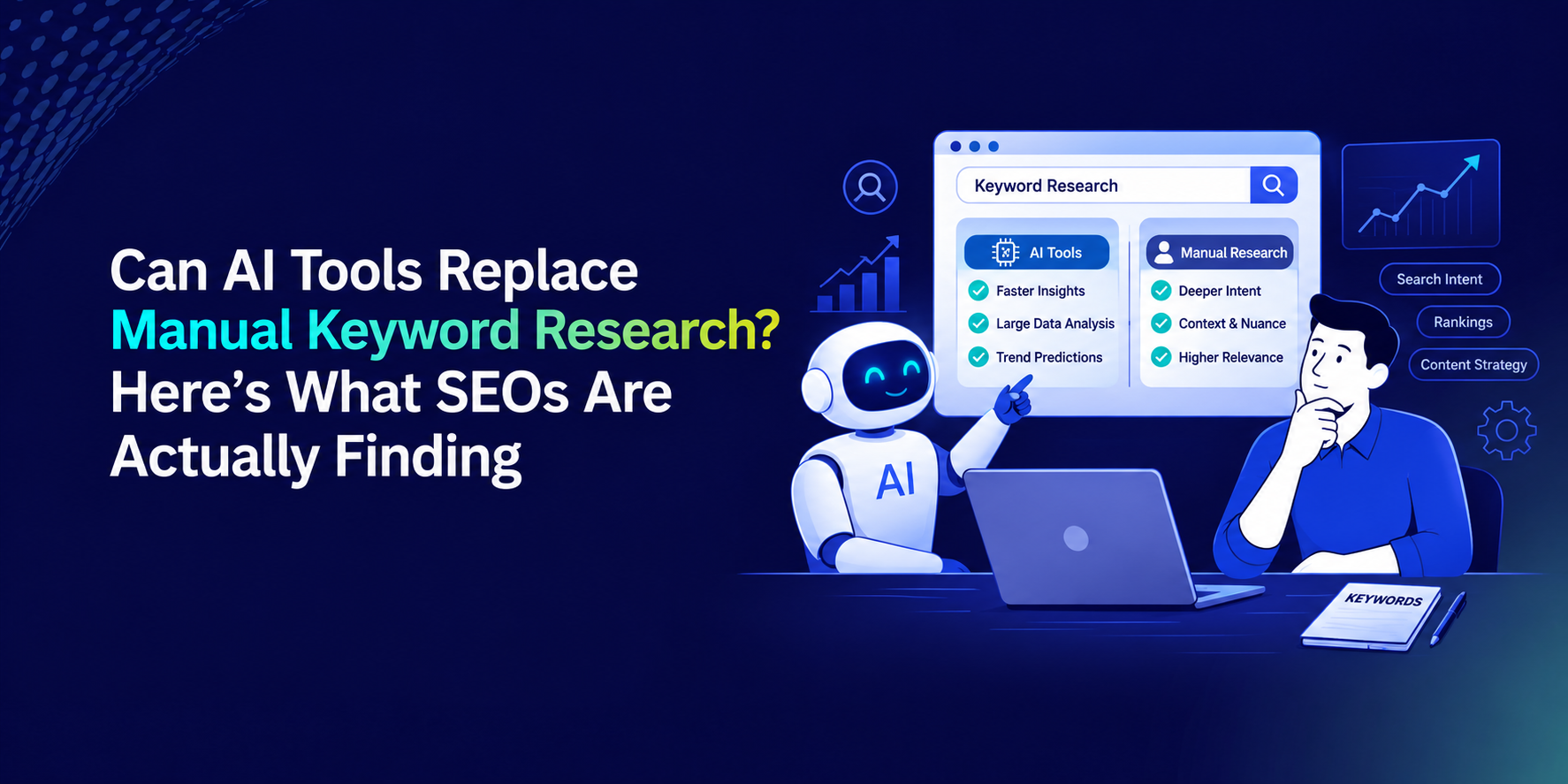
- Can AI tools fully replace manual keyword research? Not yet, and not in the ways that matter most for competitive rankings. AI keyword research tools excel at speed, volume, and pattern recognition across large data sets.
- What do AI keyword research tools do well? They generate keyword clusters at scale, identify semantic relationships between terms, surface related queries from large data sets, and produce content briefs faster than any manual process.
- Where does manual keyword research still outperform AI? On intent interpretation, understanding not just what a keyword means but what the person searching it is trying to accomplish and where they are in their decision journey. On competitive gap identification, recognizing opportunities that require knowledge of brand positioning, audience nuance, and business context that no tool has access to.
- What is the right approach to keyword research in 2026? A hybrid keyword research process- AI tools for discovery, clustering, and volume analysis; human strategists for intent mapping, competitive interpretation, and strategic prioritization- delivers stronger, more actionable keyword strategies than either approach alone.
- How has AI changed keyword research fundamentally? By shifting the bottleneck. The constraint in keyword research used to be discovery, finding enough relevant terms to work with. AI tools have largely solved that problem. The constraint in 2026 is judgment: knowing which of the thousands of terms an AI tool surfaces are actually worth targeting, and why.
The promise of AI keyword research was compelling: feed a tool your domain, your competitors, and your content objectives, and receive a comprehensive, prioritized keyword strategy in minutes rather than days. For teams drowning in manual research workflows, the efficiency gain alone justified adoption. Many SEO teams that implemented AI keyword tools reported immediate productivity improvements that were real and significant.
The difference between the accounts that performed well and those that didn't was which AI tool they used. It was whether a skilled strategist applied judgment to the tool's output, or whether the output went directly into a content plan.
This is what SEOs are actually finding in 2026: AI keyword research tools have genuinely changed what is possible in the discovery phase of keyword strategy. They have not changed what is required in the judgment phase. And it is the judgment phase that determines whether a keyword strategy produces rankings, or just a content calendar.
In this article, we cover what AI keyword research tools do well and where they fall short, what experienced SEOs are finding in practice, and how to build a hybrid keyword research process that captures AI's efficiency advantages.
What AI Keyword Research Tools Actually Do
Before evaluating whether AI keyword research can replace the manual process, it is worth being precise about what these tools actually do, because the category covers a wide range of capabilities, not all of which are equally mature. As search continues to evolve, many of these platforms are also incorporating features that support AI Search Optimization, helping marketers better understand how AI-driven search experiences influence keyword discovery and content strategy.
Semantic keyword clustering
AI tools are genuinely excellent at identifying semantic relationships between keywords, grouping terms by topic, intent family, and conceptual proximity in ways that would take a human analyst hours to replicate manually. This clustering capability is one of the most valuable contributions AI makes to keyword strategy because it helps build topical authority by revealing the topical architecture of a subject area comprehensively and quickly, giving strategists a complete map of the keyword landscape they are working in.
Related query and PAA surface area
AI-powered tools that analyze People Also Ask data, related searches, and autocomplete patterns can surface thousands of question-format and long-tail keywords that manual research typically misses, simply because the data volume involved makes comprehensive manual coverage impossible. For content teams building topic clusters or FAQ content, this capability delivers genuine, measurable value.
Competitor keyword gap analysis
AI tools can identify keywords that competitors rank for and your site does not, at scale, across thousands of competitor URLs simultaneously. This competitive gap analysis used to require hours of manual comparison work. AI tools perform it in minutes, and the output is generally reliable as a starting point for gap analysis.
Volume and difficulty estimation
Keyword volume and difficulty scores from AI-powered tools (Semrush, Ahrefs, Moz, and their AI-enhanced variants) have become more accurate as the underlying data models have matured. For established keyword categories with stable search behavior, volume and difficulty estimates are now reliable enough to use as planning inputs without extensive manual verification.
Where AI Keyword Research Falls Short
Search intent interpretation
Search intent, the actual goal behind a query, is the most important variable in keyword strategy, and it is where AI keyword research tools most consistently fall short. Tools can classify intent broadly (informational, navigational, commercial, transactional) but cannot reliably interpret the specific intent nuance that determines whether a keyword is actually worth targeting for a given business.
The query "best CRM for small business" is classified as commercial intent by every major tool. But the user's actual intent could range from "I'm three weeks from a purchase decision and comparing specific products" to "I'm a student writing a paper on business software" to "I'm a consultant researching for a client."
Each of these intents requires a different content approach, different messaging, and different conversion architecture, and the keyword tool cannot tell you which represents the majority of searchers, or which subset your specific business can actually serve and convert.
Experienced SEOs interpret intent from SERP analysis, examining which content types Google rewards, what angles the top-ranking pages take, and how the result page composition reflects the searcher population's actual goals. This analysis requires judgment that AI tools are currently not equipped to replicate reliably.
Emerging and low-volume keyword identification
AI keyword research tools surface keywords from historical search data. Emerging queries, new terminology, recently coined phrases, trending topics that haven't yet accumulated significant search volume are invisible in most AI tool data sets until they are no longer emerging. Manual research, which includes social listening, community monitoring, customer interview analysis, and sales team feedback, consistently surfaces emerging keyword opportunities weeks or months before they appear in volume data.
For businesses in fast-moving industries- technology, healthcare policy, financial regulation, social media marketing- the ability to identify emerging keyword opportunities before competitors is a significant organic traffic advantage. It is an advantage that AI keyword tools alone cannot provide.
Strategic prioritization given business context
The most consequential gap in AI keyword research is strategic prioritization: deciding which keywords to target, in which order, given the specific combination of domain authority, content capacity, competitive landscape, business objectives, and audience stage that applies to a particular business at a particular moment.
An AI tool does not know that your domain has strong authority in one subtopic and none in another. It does not know that your sales team has identified a specific customer segment as the highest-value conversion opportunity this quarter. It does not know that a keyword with strong volume data requires content your subject matter experts cannot credibly produce. It does not know that your content calendar for the next quarter is already at capacity for long-form pieces, making short-form content the practical constraint on keyword strategy execution.
All of these are inputs to strategic keyword prioritization, and none of them exist in a keyword tool's data model. They exist in the strategist's understanding of the business. This is why SEOs consistently find that AI-generated keyword lists require substantial human filtering before they become an actionable strategy.
Local and hyperlocal keyword nuance
For businesses competing in local search, legal services, healthcare practices, real estate, and home services, the keyword strategy requires granular geographic and community-level nuance that AI tools handle inconsistently. The difference between keyword targets for a personal injury law firm in downtown Chicago versus suburban Chicago is not just a geographic modifier; it is a difference in competitive landscape, audience demographics, local search behavior patterns, and Google Business Profile signal requirements that require human local market knowledge to navigate accurately.
AI keyword tools generate geographic keyword variants at scale. They do not interpret the local competitive context that determines which of those variants are winnable, at what authority level, and through what content approach.
What SEOs Are Actually Finding in 2026
The consensus emerging from SEO practitioners who have worked extensively with AI keyword research tools across competitive campaigns reflects a consistent pattern:
- AI tools are best used for: Discovery breadth, semantic clustering, competitor gap identification at scale, question-format and PAA keyword surfacing, volume and difficulty data, and content brief generation from established keyword targets.
- Manual analysis is still required for: Intent verification, strategic prioritization, emerging keyword identification, local nuance interpretation, competitive context assessment, and the judgment calls that connect keyword data to business outcomes.
SEOs who have removed manual analysis from their workflow report a recurring problem: keyword lists that are technically comprehensive but strategically diluted. High-volume targets with no realistic path to ranking. Keyword clusters that cover the right topics at the wrong intent stage. Emerging opportunities missed until competitors have already established authority. Content plans that generate impressions without generating leads.
The productivity data from AI keyword tool adoption is genuinely positive: research time reduced by 60–70% for discovery tasks, brief generation accelerated by 80%, cluster mapping that previously required days completed in hours.
Building a Hybrid Keyword Research Process
The keyword research workflow that consistently produces the strongest results in 2026 combines AI discovery with human judgment at each stage where judgment determines outcome quality.
Stage 1: AI-powered discovery
Use AI keyword research tools to generate the complete keyword landscape for your target topic area. This includes: seed keyword expansion, semantic cluster identification, competitor gap analysis, PAA and question-format query surfacing, and volume/difficulty data collection. The goal of this stage is breadth, capturing the full universe of potentially relevant terms. AI tools do this faster and more comprehensively than manual research.
Tools: Semrush, Ahrefs, Moz, Google Search Console data exports, AlsoAsked, AnswerThePublic
Stage 2: Human intent mapping
Review the AI-generated keyword list and apply intent classification that goes beyond the tool's broad category labels. For each keyword cluster, answer: What is the user actually trying to accomplish? Where are they in the decision journey? What content type does Google reward for this query? What conversion action is realistic from a user at this intent stage?
This stage cannot be automated; it requires a strategist who understands the business, the audience, and the competitive SERP landscape for the target keyword category.
Stage 3: Strategic prioritization
Apply business context to the intent-mapped keyword list. Which clusters align with current content capacity? Which represent realistic ranking opportunities given current domain authority? Which are highest priority given sales team feedback on customer acquisition stages? Which emerging terms, surfaced through social listening and customer conversations, not AI tools, should be added to the list before competitors identify them?
This prioritization produces a keyword strategy rather than a keyword list, and it is the output that determines whether the research investment translates into organic growth.
Stage 4: AI-assisted content briefing
Return to AI tools to generate content briefs from the prioritized, human-validated keyword targets. This is one of the strongest efficiency applications of AI keyword research tools; brief generation from a defined target keyword is fast, comprehensive, and reliable at a level that delivers real-time savings without the strategic gaps that affect the discovery and prioritization stages.
| Stage | AI Role | Human Role |
| Discovery | Leads, full keyword universe generation | Reviews output for obvious gaps |
| Intent mapping | Broad classification only | Leads, nuanced intent interpretation |
| Competitive analysis | Leads, gap identification at scale | Interprets in competitive context |
| Strategic prioritization | Cannot contribute | Leads, business context required |
| Emerging keyword identification | Cannot contribute | Leads, community and customer sourcing |
| Content brief generation | Leads | Reviews and adjusts for brand/compliance |
| Performance monitoring | Leads | Interprets and acts on data |
Common Keyword Research Mistakes with AI Tools
Mistake #1: Treating AI keyword output as strategy rather than input. An AI-generated keyword list is a discovery artifact, raw material for strategy, not strategy itself. Teams that move directly from AI keyword generation to content planning without a human prioritization and intent mapping stage consistently build content calendars around the wrong targets.
Mistake #2: Relying on volume data as the primary prioritization signal. High search volume is attractive but not necessarily actionable. A keyword with 50,000 monthly searches that requires DA 80+ to rank competitively, targets informational intent that your business cannot monetize, and sits in a SERP dominated by established media brands is not a strategic target, regardless of what the volume data says. Human judgment applied to the full competitive picture produces significantly better prioritization decisions than volume-first filtering.
Mistake #3: Missing emerging keywords because they are not in the tool's data. Emerging queries, the terminology, questions, and concerns that are forming in your audience right now but have not yet accumulated significant search volume, are invisible in AI keyword tools. Businesses that do not supplement AI discovery with community monitoring, customer interview analysis, and sales team feedback miss these opportunities until competitors have claimed them.
Mistake #4: Using AI keyword clustering without verifying SERP intent alignment. AI tools cluster keywords by semantic similarity, which does not always match the intent Google rewards. Two semantically similar keywords can require completely different content types to rank for. Verifying that the content approach AI clustering suggests matches what Google actually rewards for each cluster requires manual SERP analysis that no tool currently replaces.
Mistake #5: Not refreshing keyword strategy as AI Overview behavior evolves. Google's AI Overviews have materially changed which queries drive organic click-through and which are now largely satisfied within the SERP. Keyword strategies built before the widespread AI Overview rollout may include significant volume in categories that no longer drive clicks to organic results. Human analysis of AI Overview prevalence by keyword cluster is now an essential component of keyword research that AI tools do not yet systematically address.
How Shankom Can Help
Shankom solutions builds keyword research strategies that use AI tools where they genuinely accelerate the process, and apply experienced human judgment where the data shows that automation falls short. From competitive keyword gap analysis and semantic cluster mapping to intent-led strategic prioritization and emerging keyword identification, Shankom's hybrid keyword research process produces keyword strategies that translate into rankings, not just content calendars. Whether you are building a keyword strategy from scratch, recalibrating one that has plateaued, or evaluating where AI tools can improve your current research workflow, Shankom delivers the combination of analytical capability and strategic judgment that drives durable organic growth.