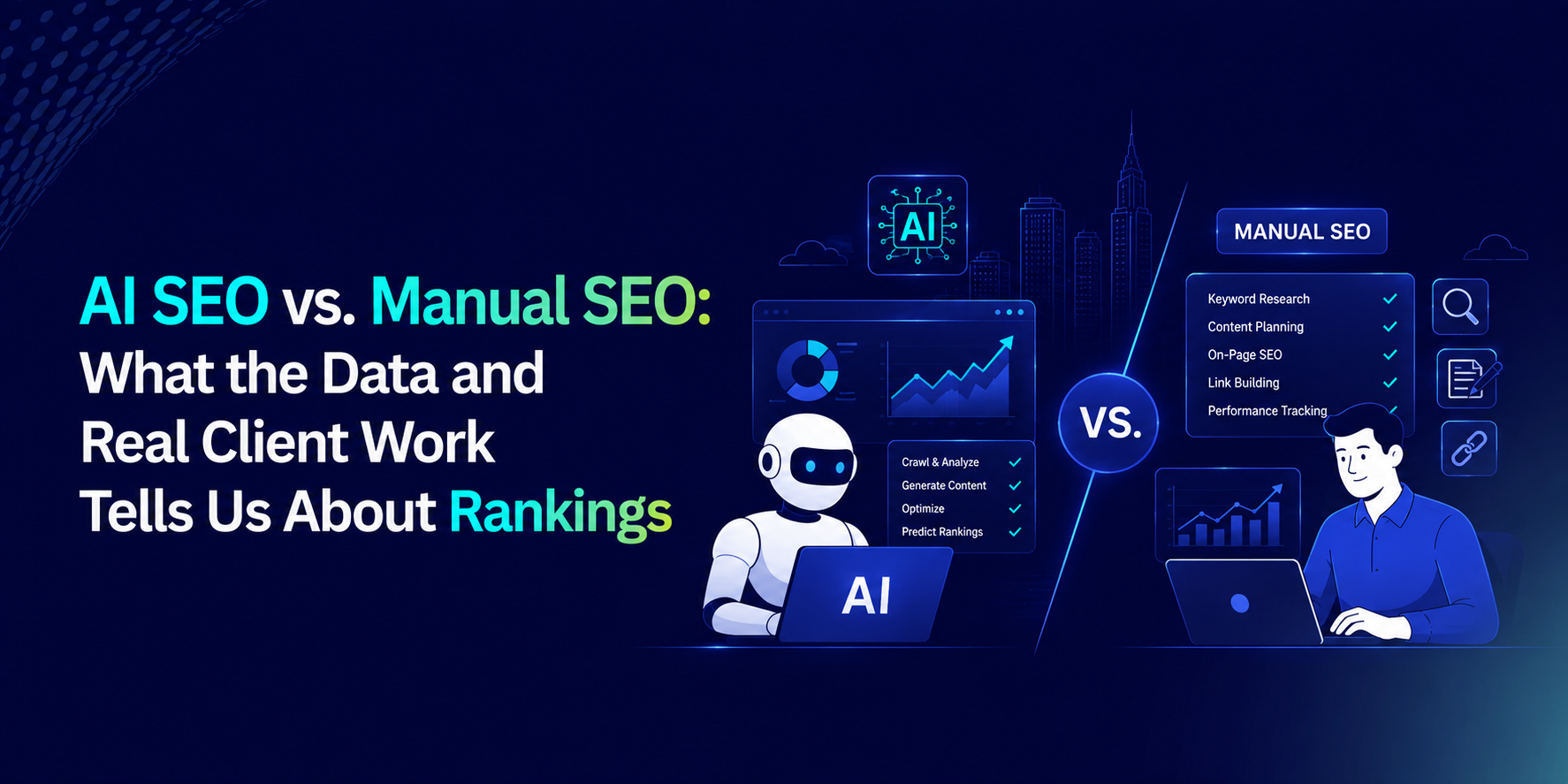
AI SEO vs. Manual SEO: What the Data and Real Client Work Tells Us About Rankings
The rise of AI SEO has produced one of the most consequential debates in digital marketing: is AI-generated content a legitimate path to organic growth, or a shortcut that looks like progress until it isn't? The data now available, from large-scale industry studies, algorithm behavior analysis, and on-the-ground client work, gives us a clearer answer than most SEO practitioners expected.
Key Takeaways
- Does AI content rank as well as human content? Initially, sometimes. Over time, consistently no. Industry research tracking content trajectories over a 5-month period found that human-written content generates 5.44x more organic traffic than AI-generated content, a gap that widens the longer the observation window extends.
- Why does AI content lose rankings over time? AI content often ranks quickly due to keyword optimization and structural clarity, but lacks the depth, firsthand experience, and topical authority that Google's E-E-A-T framework rewards at sustained positions.
- Is AI SEO ever the right approach? Yes, for specific, well-defined use cases. AI is highly effective for technical SEO tasks, content briefs, keyword clustering, metadata generation, and first-draft acceleration.
- What is the hybrid SEO approach? A hybrid SEO strategy uses AI for efficiency tasks, research, structure, optimization, and human expertise for the content that actually builds authority.
The proposition feels compelling: use AI to generate content at scale, cover more keywords, build topical breadth faster, and outpublish competitors. Many businesses, and many agencies, adopted this approach between 2022 and 2024. The early results seemed to validate it. AI-generated pages indexed quickly, picked up rankings within weeks, and in some cases drove meaningful early traffic.
Then the trajectory changed. A large-scale industry study tracking the performance of hundreds of articles over a five-month period found that human-written content generates 5.44 times more organic traffic than AI-generated content when measured over the same period. AI content ranked, often quickly, but the rankings didn't hold. Human content ranked slower but climbed steadily, accumulated backlinks, earned user engagement signals, and compounded in value over time.
At Shankom, this pattern aligns precisely with what we have observed across client accounts. The businesses that came to us after investing heavily in AI content production were not dealing with Google penalties. They were dealing with something harder to fix quickly: a content library full of pages that had touched rankings without earning them, and an authority deficit that no amount of additional AI content would close.
In this guide, you will learn what the data reveals about AI versus manual SEO content performance, how the 5-month ranking trajectory comparison changes the way high-volume AI publishing should be evaluated, how each approach performs across six key industries, and what a practical hybrid SEO strategy looks like in execution.
What the Research Tells Us: The 5-Month Trajectory
The most instructive data point in the AI SEO vs. manual SEO debate is not a snapshot; it is a trajectory. When content performance is measured at the point of publication or at the 30-day mark, AI and human content often look comparable. When the measurement window extends to five months, the performance gap becomes unmistakable.
Month 1–2: AI content's early advantage
AI-generated content is structurally optimized by default. It uses target keywords consistently, follows logical heading hierarchies, and is rarely underwritten for length. These characteristics help AI content index quickly and accumulate early impressions. In the first four to eight weeks, AI pages frequently outperform newly published human content, particularly on lower-competition keywords where topical relevance signals matter more than authority.
This early performance is real but misleading. It reflects Google's initial assessment of keyword relevance, not its deeper evaluation of quality, expertise, and user satisfaction, which takes more time and engagement data to surface.
Month 3-4: The divergence begins
As pages accumulate user engagement data- time on page, scroll depth, bounce rate, and return visits- the performance gap between AI Content vs. Human-Written Content becomes more apparent. Human-written content that delivers genuine depth, original perspective, and accurate, well-sourced information earns stronger engagement signals than AI-generated content, often lacking firsthand experience and nuanced expertise and typically cannot match. Google's quality rater-informed algorithms increasingly weigh these engagement signals as pages mature.
In client work at Shankom, this inflection typically occurs between the 8 and 14-week mark for competitive keywords. AI pages begin to plateau; human pages continue climbing.
Month 5: The 5.44x gap
By the five-month mark, industry research data shows human-written content generating 5.44 times more organic traffic than AI-generated equivalents across comparable keyword targets. The compounding effect of backlink acquisition, which human content earns at significantly higher rates due to genuine originality and citation-worthiness, accelerates the divergence further. 83% of top Google rankings are held by human-written content, and even AI systems like ChatGPT and Perplexity draw 82% of their cited sources from human-created content.
This trajectory has direct implications for businesses that have invested in AI content at scale: the return on that investment typically peaks early and declines, while the return on well-executed manual SEO content builds over the same period.
Industry Analysis: AI SEO vs. Manual SEO
The correct balance between AI SEO and manual SEO varies significantly across industries, primarily because E-E-A-T requirements, competitive dynamics, and compliance constraints differ dramatically.
Healthcare
Verdict: Manual SEO required, AI as a support tool only
Healthcare content sits squarely in YMYL (Your Money or Your Life) territory, where Google applies its most stringent E-E-A-T evaluation. Medical content that cannot demonstrate clinical expertise, cite peer-reviewed sources, and reflect genuine patient-facing experience is systematically deprioritized, regardless of its technical optimization. AI-generated medical content, however well-structured, lacks the firsthand clinical authority that earns and sustains rankings for health queries.
Patient trust is also a non-negotiable dimension that AI SEO content cannot manufacture. A page advising on symptoms, treatments, or medications that reads as generic, even if technically accurate, generates the kind of low-engagement user signals that damage rankings over time. At Shankom, healthcare content always involves credentialed expert review and original clinical perspective before publication. AI tools are used for keyword clustering, content brief generation, and meta optimization, not for the substantive medical writing itself.
Legal Services
Verdict: Manual SEO, AI creates compliance and trust risks
Legal services SEO operates at the intersection of local search competition, E-E-A-T scrutiny, and professional compliance requirements. AI-generated legal content carries three specific risks: factual inaccuracy in jurisdiction-specific law, implied guarantees or comparative claims that violate bar association advertising guidelines, and generic writing that fails to differentiate a firm in a market where trust signals are the primary ranking differentiator.
Local legal SEO compounds this challenge. Ranking for high-value keywords like "personal injury lawyer [city]" or "estate planning attorney [market]" requires not just content quality but a comprehensive local authority footprint, Google Business Profile optimization, local citations, genuine client reviews, and location-specific content that reflects real knowledge of the local legal market. AI tools can help structure content and identify keyword opportunities; they cannot produce the authentic local expertise signals that competitive legal markets require.
E-Commerce/Retail
Verdict: Hybrid, AI at scale, human oversight for authority pages
E-commerce presents the most compelling legitimate use case for AI SEO at scale. A retailer with 10,000 product SKUs cannot manually craft unique, optimized product descriptions for every item, nor should they. AI-generated product content, when properly structured with accurate specifications, natural keyword integration, and schema markup, can drive meaningful organic visibility across long-tail product queries.
The risk is thin content penalties. Google's Helpful Content system penalizes pages and entire sites that publish content primarily for search engines rather than users. Boilerplate AI product descriptions that offer no genuine buying guidance, comparison context, or unique value can trigger sitewide quality assessments that suppress rankings across the entire domain. At Shankom, e-commerce SEO strategy applies AI to high-volume, lower-competition product content while investing human effort in category pages, buying guides, and comparison content where purchase-stage authority matters most.
Real Estate
Verdict: Manual SEO for local authority, AI for operational efficiency
Real estate SEO is defined by hyperlocal nuance that AI tools fundamentally struggle to replicate. Neighborhood storytelling, the kind of specific, experience-informed content that describes a community's character, commute dynamics, school context, and lifestyle, requires genuine local knowledge that no language model can credibly manufacture. Buyers and renters researching location decisions are sophisticated consumers of local content; generic AI-generated neighborhood pages are immediately recognizable and immediately dismissed.
Google Business Profile management, critical for local real estate visibility, requires consistent, accurate, human-maintained information: updated listings, authentic reviews, Q&A management, and local post content that reflects real market activity. Manual SEO effort invested in these local authority signals consistently outperforms volume content strategies in real estate. Shankom uses AI for operational tasks, metadata generation, internal linking analysis, and keyword gap identification, while keeping all location and community content human-written.
Financial Services
Verdict: Manual SEO, accuracy, and authority are non-negotiable
Financial services content shares healthcare's YMYL classification with an additional layer of regulatory complexity. Content covering investment products, tax guidance, lending, or insurance must be factually accurate, appropriately disclaimed, and authored or reviewed by credentialed professionals. AI-generated financial content that contains outdated rates, jurisdiction-incorrect tax figures, or implied financial advice without appropriate disclaimers creates both ranking risk and legal exposure.
Authority-building in financial services SEO requires a long-term investment in thought leadership, original analysis, expert-authored guides, and content that earns citations from financial publications and industry bodies. This is inherently human work. AI can accelerate research, structure arguments, and optimize published content, but the expertise signal that earns durable financial services rankings cannot be outsourced to an algorithm.
SaaS/Tech
Verdict: Hybrid with strong guardrails against programmatic SEO abuse
SaaS and tech companies have been among the most aggressive adopters of programmatic AI SEO, using AI to generate thousands of pages targeting long-tail queries at scale. The short-term results were, for some, impressive. The medium-term consequences have been significant: Google's Helpful Content updates specifically targeted programmatic content patterns, and several high-profile SaaS content programs saw dramatic traffic losses as a result.
The lesson is that topical authority, the deep, interconnected coverage of a subject domain that earns sustained rankings, cannot be built through volume alone. A SaaS company that publishes 500 AI-generated pages on loosely related topics does not accumulate topical authority. One that publishes 80 human-expert-authored pieces that comprehensively cover its core domain does. Shankom's approach for SaaS clients prioritizes topical cluster depth over breadth, using AI for content research and brief generation while maintaining human authorship for all substantive pieces that sit within the core authority cluster.
What a Hybrid SEO Strategy Looks Like in Practice
The evidence consistently points toward the same conclusion: neither pure AI SEO nor pure manual SEO is the optimal approach for most businesses. The highest-performing content programs combine AI efficiency with human expertise in a defined workflow.
| Task | AI | Human |
| Keyword research and clustering | ✓ | Reviews and prioritizes |
| Content brief generation | ✓ | Approves and adjusts |
| First draft creation | ✓ (optional) | Leads for YMYL, authority content |
| Expertise and experience layer | ✗ | ✓ Required |
| E-E-A-T signals (author bios, credentials) | ✗ | ✓ Required |
| Real-time scoring and optimization | ✓ | Reviews final output |
| Schema and structured data | ✓ | Verifies accuracy |
| Local and community content | ✗ | ✓ Required |
| Content refresh and monitoring | ✓ | Interprets and acts |
| Compliance review (YMYL industries) | ✗ | ✓ Required |
Hybrid content, AI-assisted drafts with substantive human editing, consistently outperforms both pure approaches. Research shows hybrid pieces rank 34% higher on average than unedited AI content, with lower bounce rates indicating stronger user engagement. Brands using hybrid SEO strategies see 2.3 times faster ranking improvements than manual-only approaches, while avoiding the trajectory collapse that pure AI content programs consistently exhibit beyond the four-month mark.
Common AI SEO Mistakes
Mistake #1: Measuring AI content success at 30 days. The early ranking signal from AI content flatters its actual performance. The 5-month trajectory is the correct measurement window, and within it, the 5.44x human content advantage consistently emerges. Short evaluation windows lead to continued investment in a strategy whose ceiling is already visible in the data.
Mistake #2: Publishing AI content in YMYL categories without expert review. Healthcare, legal, and financial content published without credentialed expert review carries both ranking risk and liability exposure. Google's quality evaluation for YMYL pages specifically looks for author credentials, source citations, and content accuracy signals that AI tools cannot supply.
Mistake #3: Using programmatic AI SEO to build topical authority. Volume does not equal authority. Publishing hundreds of AI-generated pages on loosely related topics produces a content library that Google's Helpful Content system increasingly identifies and suppresses, often sitewide. Topical authority is built through depth, not breadth.
Mistake #4: Treating AI optimization tools and AI content generation as the same thing. AI-powered SEO tools, for keyword research, content scoring, technical audits, and performance monitoring, deliver genuine efficiency gains with minimal quality risk. AI-generated content published without substantive human expertise layered in is the source of the performance problems documented in the research. These are categorically different applications of AI.
Mistake #5: Removing human authorship signals to scale faster. Anonymous content, or content with placeholder author bylines, is one of the clearest E-E-A-T red flags. Scaling AI content by removing the human attribution that gives it credibility defeats the purpose of the exercise and accelerates the ranking trajectory decline that the data consistently shows.
How Shankom Can Help
Shankom solutions builds hybrid SEO strategies that apply AI's efficiency advantages precisely where they belong, and protect the human expertise investment that earns durable rankings. From content audits that identify which AI-generated pages in your existing library need expert elevation to full content programs built around topical authority clusters with credentialed authorship, Shankom brings both the strategic framework and the editorial execution that the data shows actually works. Whether you are starting fresh or correcting the trajectory of an AI-heavy content program that has plateaued, Shankom provides the manual SEO expertise and AI-assisted efficiency to build organic visibility that compounds over time rather than peaking at month two.