5 Digital Marketing Trends Philadelphia Businesses Can’t Ignore in 2026
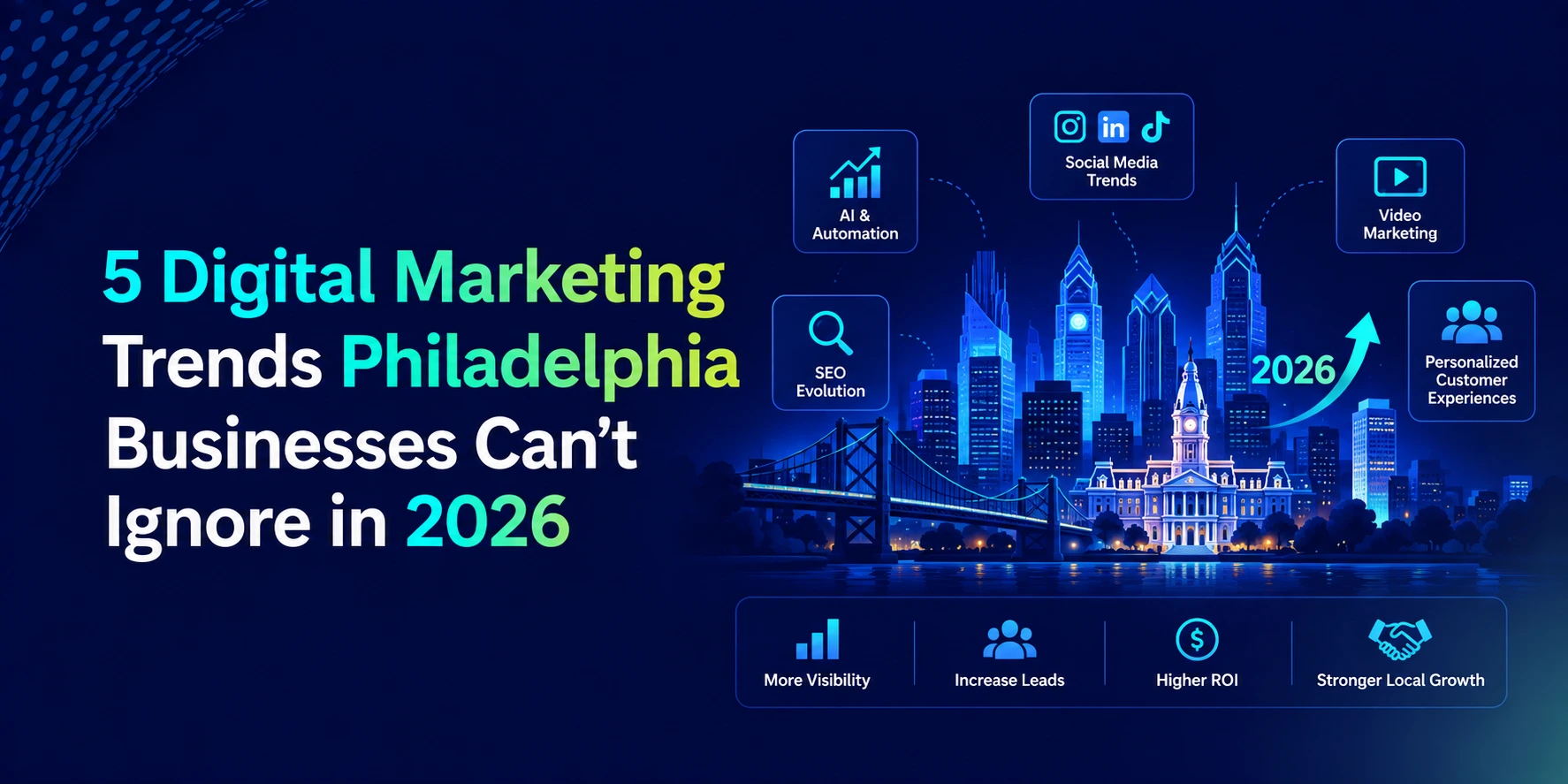
Five trends will define digital marketing for Philadelphia businesses in 2026: AI-driven search and Generative Engine Optimization, short-form video dominance, AI-assisted but human-led content, evolving local search behavior, and privacy-first data. Nearly half of Google searches carry local intent, short-form video delivers the highest ROI of any format, and AI Overviews now appear on a large and growing share of queries. Philadelphia businesses that adapt to these local search trends, invest in video, and use AI content responsibly will capture demand competitors miss. The blog closes with a quarterly plan to keep your strategy current all year.
Key Takeaways
- What is the biggest 2026 marketing trend? AI-driven search. Google AI Overviews now appear on a large share of queries, reshaping how customers find businesses.
- Does video still matter? Yes. Short-form video is the most-used format and delivers the highest ROI, making it essential for local reach.
- Is AI content safe to use? When human-led and edited, yes. Search now rewards authentic, expert content over generic AI output.
- Why do local search trends matter in Philadelphia? Nearly half of searches have local intent, and most near-me searches lead to a visit within a day.
- How do I keep up all year? Follow a quarterly update plan that reviews each trend and adjusts your strategy every three months.
Every year brings a new list of marketing trends, and most of them are noise. But 2026 is different. The way customers discover, evaluate, and choose businesses has shifted so sharply that tactics that worked eighteen months ago are actively losing ground. For a Philadelphia business competing block by block against local rivals and national brands alike, ignoring these changes is not a neutral choice. It is a slow, quiet loss of visibility to whoever adapts first.
This guide cuts through the hype and focuses on five trends in digital marketing that Philadelphia businesses genuinely cannot afford to overlook this year. Each comes with local context, the data behind it, and a concrete action item. At the end, you will find a simple quarterly plan to keep your Philadelphia marketing on track all year.
Trend 1: AI-Driven Search Is Rewriting Discovery
The single biggest shift in how Philadelphia businesses get found is how AI has changed search itself. Customers no longer just scroll through ten blue links. They read AI-generated summaries, ask conversational questions, and often get answers without clicking at all. Google AI Overviews expanded rapidly through 2025 and into 2026, appearing on roughly 6 to 8 percent of queries in early 2025 and climbing to nearly half of all tracked queries by early 2026, with some commercial and local-heavy categories, such as restaurants, jumping from around 10 percent to nearly 80 percent. In other words, the way your business gets found is fundamentally different than it was a year ago.
Sources: BrightEdge / Search Engine Journal, 2026; Semrush AI Overviews data
This has created a new discipline called Generative Engine Optimization, or GEO: optimizing not just to rank on a results page but to be cited inside AI answers. The upside is meaningful. AI search traffic has grown 527 percent year over year, and studies show the average AI search visitor converts at roughly 4.4 times the rate of a traditional organic visitor. For a Philadelphia business, appearing in an AI summary for “best accountant in Center City” is the new equivalent of ranking first.
Sources: Previsible AI Traffic Report, via Semrush; Semrush / Seer Interactive, June 2025
The practical difference between old SEO and GEO comes down to how you write and structure information. AI systems favor content that answers a question directly, backs it up with specifics, and is easy for a machine to parse. A page that buries its answer three paragraphs down loses to one that leads with a clear response. This is also why your Google Business Profile and consistent business information matter more than ever: AI assistants pull heavily from structured, verifiable sources when deciding which local business to mention.
Action item: Structure your content to answer specific questions clearly and concisely, add schema markup so machines can read your site, and keep your Google Business Profile complete and accurate. Create a short FAQ section on key pages using the exact phrasing customers use, since question-and-answer formats are among the most likely to be pulled into AI results.
Looking ahead, expect AI Overviews to keep expanding across local queries and click-through rates on classic results to drift down. That does not mean fewer customers; it means the businesses cited in AI answers capture a growing share of high-intent traffic.
Trend 2: Short-Form Video Is No Longer Optional
Video has moved from a nice-to-have to the center of attention. Short-form video is now the most-used media format, and 21 percent of marketers say it delivers the highest ROI of any content type, ranking it first among all formats. Global spending on short-form digital video advertising reached roughly $111 billion in 2025, up nearly 12 percent year over year, a clear signal of where audience attention and budget are heading.
Sources: HubSpot State of Marketing Report; Statista, via Wix video marketing statistics
For Philadelphia businesses, this is an opportunity that plays to local strengths. A short walkthrough of your South Philly restaurant, a quick tip from your Fishtown salon, or a behind-the-scenes clip from your Manayunk boutique builds trust in a way text never can. Local video also travels well on the platforms where your neighbors already spend their time, turning ordinary moments into discovery opportunities.
The businesses that struggle with video usually overthink it. You do not need a studio, a script, or expensive gear. What performs is authenticity: a real person, a real place, and a useful moment. A few formats work reliably and are easy to repeat: a quick how-to or tip, a behind-the-scenes look, a short customer story, an answer to a common question, and a simple tour of your space. Video also feeds Trend 1, since YouTube behaves like a search engine and clips increasingly appear inside search and AI results, so a single video can work across discovery channels at once.
Action item: Commit to a realistic cadence, such as one or two short vertical videos per week. Batch-record several at once to save time, focus on authenticity over production polish, feature real people and real locations, caption every video for silent viewing, and always include a clear next step for viewers.
Trend 3: AI Content, But Human-Led
AI writing tools have made it possible to produce more than ever, but the market has already corrected against generic output. Search engines and audiences alike now reward genuine expertise and first-hand experience over content that reads like it was generated in bulk. The winning approach in 2026 is not AI instead of humans, but AI as an accelerator behind human judgment.
This matters for Philadelphia businesses because authenticity is a competitive advantage a national brand cannot easily fake. Your team’s real knowledge of your industry, your customers, and your city is exactly the signal that both search algorithms and local buyers are looking for. AI can speed up research, outlining, and drafting, but the insight, voice, and accuracy have to come from you.
A useful way to think about it is a simple division of labor. AI is good at the mechanical parts: gathering background, suggesting structure, producing a first draft, and catching typos. Humans are essential for the parts that build trust: first-hand experience, accurate local detail, a genuine point of view, and the judgment to know when something is wrong or generic. Search engines increasingly reward this combination through what is often called experience, expertise, authoritativeness, and trust. Content with a named author, specific examples, and details only an insider would know consistently outperforms content that could have been written by anyone or anything.
Action item: Use AI to draft and research, then have a knowledgeable person edit every piece for accuracy, add real examples and local detail, and ensure it reflects genuine expertise. Attribute content to a real author, include specifics only your team would know, and never publish unedited AI output.
Trend 4: Local Search Behavior Keeps Evolving
Local search remains the front door for Philadelphia businesses, and the local search trends of 2026 make it more important, not less. Roughly 98 percent of consumers now search online before visiting a local business, and about 46 percent of all Google searches carry local intent. Intent is high too: 76 percent of near-me mobile searches lead to a store visit within 24 hours.
Sources: Google / Think with Google & BrightLocal, via Shopify local SEO stats; BiziQ local search statistics 2026
The behavior is also increasingly mobile and increasingly decisive. The majority of local searches now start on a mobile device, and most consumers look at only three or fewer businesses before deciding. In a city as dense and competitive as Philadelphia, that narrow consideration window means being visible and credible in those first few results is everything.
Reviews deserve special attention here, because they are one of the strongest factors in whether you make that short list. Consumers overwhelmingly read reviews before choosing a local business, and a rating below four stars removes many businesses from consideration entirely. Recency and responses matter too: a steady flow of recent reviews signals an active, trusted business, and thoughtful replies show prospects and search engines that you are engaged. A deliberate habit of asking satisfied customers for a review is one of the highest-return activities available to a Philadelphia business.
Action item: Keep your Google Business Profile fully optimized, ensure your site loads fast on mobile, ask every satisfied customer for a review and respond to all of them, and maintain accurate business details everywhere they appear online.
Trend 5: Privacy-First Data Becomes the Standard
As third-party tracking continues to erode and privacy expectations rise, 2026 belongs to businesses that collect and use data responsibly. The shift is toward zero-party and first-party data: information customers share directly and willingly through sign-ups, quizzes, preferences, and interactions you own. This data is more accurate, more durable, and more compliant than the third-party sources marketers relied on for years.
For a Philadelphia business, this is less of a burden than it sounds. A strong email list, a well-run loyalty program, and direct customer relationships are exactly the owned assets that privacy-first marketing depends on, and a local business is well positioned to build them. The businesses that invest now will have a data advantage precisely when others lose access to the shortcuts.
Action item: Build and nurture a first-party email list, offer genuine value in exchange for contact information, and make sure your data collection is transparent and compliant with current privacy expectations.
How These Trends Work Together
It is tempting to treat these five trends as a checklist of separate projects, but their real power comes from how they reinforce one another. A single piece of local expertise can feed every trend at once. A short video answering a common customer question builds trust (Trend 2), demonstrates genuine expertise (Trend 3), and can be turned into a question-and-answer page that AI systems cite (Trend 1) and that strengthens your local relevance (Trend 4). The email address you collect from a viewer who wants more (Trend 5) then lets you reach that person directly, without paying for access again.
This is why the businesses that win in 2026 are rarely the ones chasing every trend in isolation. They are the ones that build a simple, repeatable system where good local content is created once and put to work across search, video, and owned channels. For a Philadelphia small business with limited time, that compounding effect is the difference between marketing that feels like a treadmill and marketing that builds a lasting asset over the year.
What This Means for Philadelphia Businesses
These five trends are not abstract. How they land depends heavily on what industry you are in, and Philadelphia’s economy is concentrated in a few sectors where the stakes are especially high. Healthcare and social assistance alone account for roughly a third of city employment, tourism and hospitality are heading into a landmark 2026, and a dense base of professional services, local trades, and startups fills out the rest. Here is what the trends mean for the city’s three biggest opportunities.
Sources: Center City District / Philadelphia industry data; Philadelphia 2026 tourism outlook, Axios
1. Healthcare and Life Sciences
As Philadelphia’s largest employer, anchored by Penn Medicine, Jefferson Health, Temple Health, CHOP, and a fast-growing University City biotech cluster, this sector lives and dies on trust and findability. AI-driven search (Trend 1) matters most here: health queries trigger AI Overviews more than almost any other category, so a practice that structures clear, accurate answers to patient questions is far more likely to be cited than one that does not. Human-led content (Trend 3) is non-negotiable given compliance and accuracy demands, and reviews (Trend 4) carry outsized weight when patients are choosing a provider. Practical move: build a compliance-reviewed FAQ library around the conditions and services you offer, attribute it to named clinicians, and make review generation a routine part of patient follow-up.
2. Hospitality, Dining, and Tourism
Restaurants, hotels, and attractions are heading into an extraordinary 2026, with Philadelphia hosting six FIFA World Cup matches, the MLB All-Star Game, the PGA Championship, and America250 celebrations, drawing hundreds of thousands of high-intent visitors. Short-form video (Trend 2) is the single biggest lever here: a quick clip of your South Philly dining room or Fishtown bar travels exactly where visitors are looking. Local search (Trend 4) is decisive when a hungry visitor searches for “best cheesesteak near me,” and AI Overviews (Trend 1) increasingly answer restaurant queries directly. Practical move: post authentic vertical video weekly, keep your Google Business Profile flawless with current hours and photos, and aggressively gather recent reviews ahead of the 2026 event surge.
3. Professional Services, Local Trades, and Startups
From law firms and accountants to home-services businesses and the venture-backed startups clustered in the region’s growing ecosystem, this group competes on credibility and being chosen in a narrow consideration window. Human-led expertise (Trend 3) is the differentiator a national competitor cannot fake, GEO (Trend 1) puts your firm inside AI answers for high-value queries, and first-party data (Trend 5) turns one-time clients into a durable email and referral base. Practical move: publish genuine, author-attributed expertise on the questions your clients actually ask, then convert readers into an owned email list you control rather than renting access through ads.
Your Quarterly Update Plan for 2026
Trends move fast, and a strategy set in January is stale by summer. The most effective way to stay current is a simple quarterly rhythm that revisits each trend and adjusts as the year unfolds. Here is a practical plan any Philadelphia business can follow.
| Quarter | Focus | Key Actions |
| Q1 | Audit and foundation | Optimize your Google Business Profile, set up analytics, and launch a first-party email capture |
| Q2 | Content and video | Establish a weekly video cadence and start publishing human-led, AI-assisted content |
| Q3 | Search and AI visibility | Add schema, refine content for AI citation, and review local ranking and review performance |
| Q4 | Review and plan ahead | Analyze the full year, double down on what worked, and set the strategy for the next year |
The discipline matters more than the specifics. A business that checks in every quarter, measures results, and adjusts will always outperform one that sets a plan once and forgets it. Treat this as a living cycle, not a one-time setup.
How Shankom Can Help
Shankom solutions helps Philadelphia businesses turn these trends into results rather than headlines. From Generative Engine Optimization and short-form video to human-led AI content, local search optimization, and privacy-first data strategy, Shankom builds a digital marketing program tuned to how customers actually discover and choose businesses in Philadelphia in 2026. Whether you start with the fundamentals or run a full quarterly strategy across every trend above, Shankom keeps your Philadelphia digital marketing current, measurable, and focused on growth.
FAQs
Which trend should a small Philadelphia business start with?
Start with local search and your Google Business Profile, since it delivers the fastest, most reliable returns. From there, layer in short-form video and AI-assisted content as your capacity grows.
Do I need a big budget to keep up with these trends?
No. The highest-impact moves, such as optimizing your profile, posting authentic video, and building an email list, cost more in consistency than in cash. Budget helps you scale, but effort and focus drive the early wins.
Is traditional SEO dead in 2026?
No, but it has evolved. The fundamentals of quality content, technical health, and local relevance still matter. They now sit alongside optimizing for AI answers rather than only for the classic results page.
How is AI content different from spam?
The difference is human involvement. AI content becomes valuable when a knowledgeable person adds real expertise, accuracy, and local context. Unedited, generic AI output is exactly what search engines now filter out.