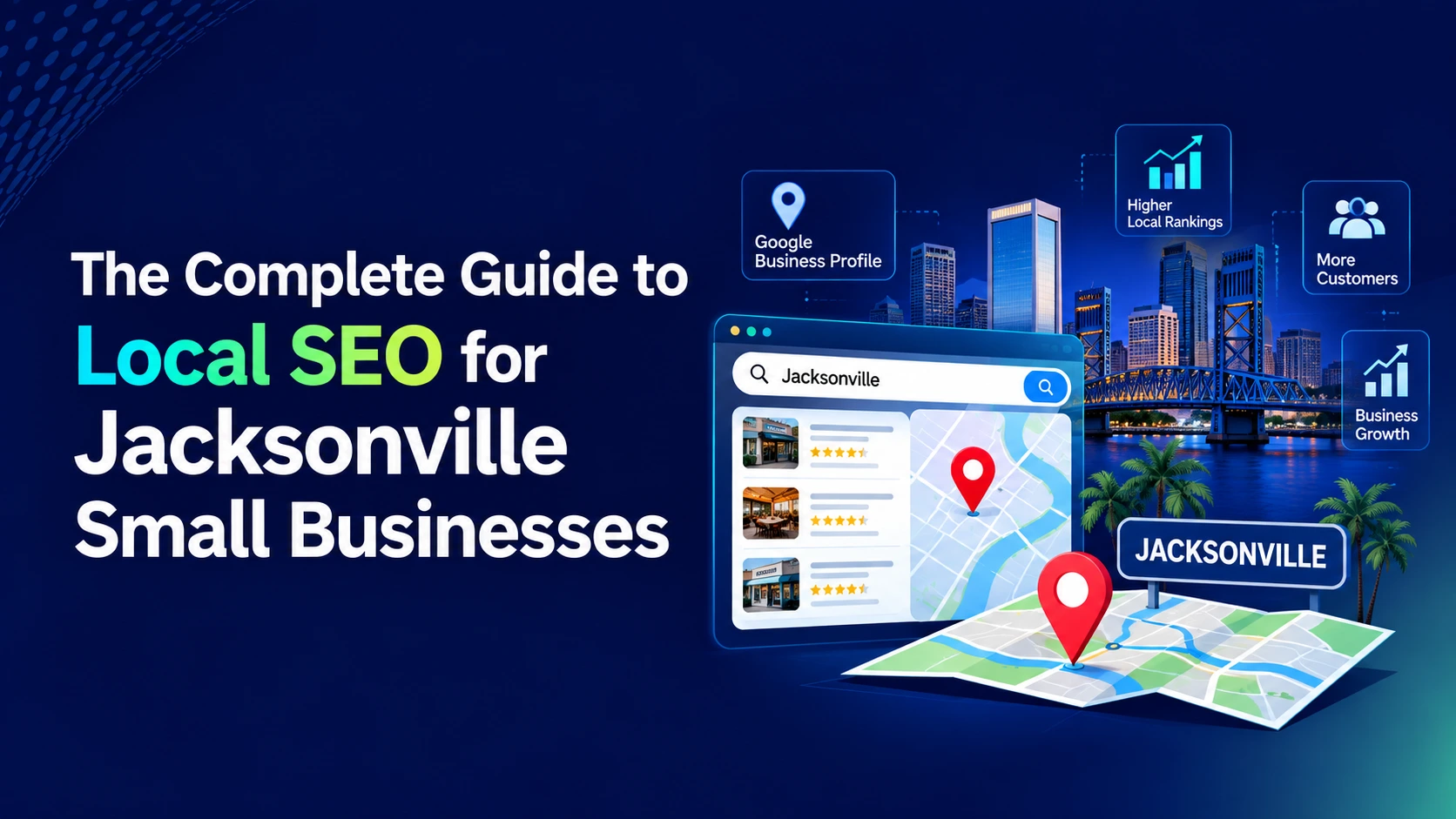
The Complete Guide to Local SEO for Jacksonville Small Businesses
Winning local SEO in Jacksonville starts with a clear audit of your Google Business Profile, website, citations, and reviews. Keep your name, address, and phone number identical everywhere to build trust with search engines. Generate a steady flow of genuine reviews, since they are one of the strongest drivers of map pack ranking. Build local links from Jacksonville businesses, publications, and community organizations to prove neighborhood relevance. Understand that the map pack and organic results are two different systems, and build dedicated service and location pages for the areas you serve. Done consistently, these steps make a small business visible to the high-intent customers already searching nearby across the First Coast.
Key Takeaways
- What is local SEO? The practice of optimizing a business to appear in geographic searches, including the map pack, for customers searching nearby.
- How do I rank in the Jacksonville map pack? Optimize your Google Business Profile, keep citations consistent, earn genuine reviews, and build local links.
- Why does NAP consistency matter? Identical name, address, and phone number across the web signal trust to Google and prevent ranking-diluting duplicates.
- Do reviews affect local rankings? Yes. Review quantity, quality, recency, and your responses are major map pack ranking factors.
- Is the map pack the same as organic results? No. They are two separate systems with different ranking signals, and a complete strategy targets both.
Jacksonville is dozens of stitched-together markets, from the Beaches to Mandarin to the Northside, spread across nearly 900 square miles and the largest city by land area in the country. That sprawl shapes how people find businesses here: a customer in Riverside, one in Ponte Vedra, and one in Orange Park are effectively searching three different local markets, each filtering a huge field down to whoever looks closest, most trusted, and easiest to reach. The businesses that show up at that moment win the customer. The ones that do not never enter the conversation, no matter how good they are.
There is a specific kind of frustration that Jacksonville business owners know well. You run a genuinely good business. Your customers are loyal, your work is solid, and word of mouth keeps a steady base coming back. Yet when a new customer across town searches for exactly what you offer, a competitor you have never heard of shows up first, and you are nowhere to be found. The gap is not your business. It is your visibility in local search, and it is costing you customers every single day without you ever seeing them.
Closing that gap is what local SEO does, and it is one of the most overlooked opportunities for Jacksonville small businesses. Unlike paid advertising, which vanishes the moment your budget runs out, local search visibility is an asset that compounds over time. This guide is a practical, start-to-finish walkthrough: a step-by-step audit to find your gaps, the NAP and citation work that earns search engines’ trust, review strategies that lift your rankings, how to build the service and location pages that win neighborhood searches, and local link-building that proves you belong to the Jacksonville community. Whether you tackle it yourself or bring in a digital marketing agency in Jacksonville, these are the fundamentals that decide who wins local search.
Why Local SEO Matters More in Jacksonville
Jacksonville is one of the largest cities by area in the country, and that geography changes how local search works. Because Duval County alone stretches from the coastal beach communities of Atlantic Beach, Neptune Beach, and Jacksonville Beach across to the Westside and up to the Northside, a single citywide ranking rarely exists. Buyers rely on the map pack to filter a wide field down to a few nearby options that are close, well-reviewed, and easy to find, and what ranks in San Marco may be invisible in Mandarin ten miles away. Appearing in those results, in the specific areas you actually serve, is what decides whether local customers find you.
The reach extends well beyond Duval, too. The Jacksonville market blends into the surrounding First Coast: St. Johns County communities like Ponte Vedra and St. Augustine, Clay County towns like Orange Park and Fleming Island, and Nassau County’s Fernandina Beach. For many Jacksonville businesses, customers cross those county lines every day, which makes appearing in local results across the whole 904 region a genuine growth opportunity rather than an afterthought.
The upside is that local SEO rewards effort in a way paid advertising does not. When you stop paying for ads, the visibility disappears instantly. A strong local presence, by contrast, compounds over time: the work you do this quarter keeps sending customers next quarter. For a Jacksonville small business competing against local rivals and national chains alike, that makes local SEO one of the highest-return investments available.
Step-by-Step Local SEO Audit
Before optimizing anything, you need an honest picture of where you stand. A local SEO audit is a systematic review of the signals Google uses to rank local businesses. Work through these steps in order.
- Audit your Google Business Profile. Confirm your Google Business Profile is claimed, verified, and complete. Check that the category, hours, service areas, photos, and description are accurate and current. An incomplete profile is the single most common reason Jacksonville businesses miss the map pack.
- Check your map pack ranking. Search your core terms from a Jacksonville location and note where you appear. Test several neighborhood variations, such as your service plus “Riverside,” “Southside,” or “Jacksonville Beach,” since rankings shift across the city’s many areas.
- Review NAP consistency. Search for your business name and confirm your name, address, and phone number match everywhere they appear. Inconsistencies are a hidden ranking killer, covered in detail below.
- Inventory your citations. List every directory and site where your business is listed. Flag duplicates, outdated entries, and missing major directories.
- Analyze your reviews. Look at review count, average rating, recency, and how many you have responded to. Compare against the top three competitors in your category and area.
- Assess on-page and local signals. Check that your website has location-specific pages, local keywords, embedded maps, and proper title tags and schema markup. If you serve multiple Jacksonville areas but have only one generic page, that is a major gap, and the section on building service and location pages below shows how to fix it.
- Evaluate your backlink profile. Identify how many local, relevant sites link to you, since local links are a strong signal of neighborhood authority.
The output of this audit is a prioritized list of gaps. Most small businesses find their biggest wins in the first four steps, so start there before moving to more advanced tactics.
NAP Consistency: The Foundation of Local Trust
NAP stands for name, address, and phone number. Inconsistent NAP information is one of the most common and damaging problems in local SEO. When Google finds different versions of your details across the web, it loses confidence that it knows the correct information, and that uncertainty drags down your map pack ranking. Consistency means the exact same format everywhere, down to abbreviations. Follow these tips:
- Pick one canonical format. Decide exactly how your name, address, and phone number will be written, down to abbreviations, and use it everywhere without exception.
- Match your Google Business Profile. Treat the details on your Google Business Profile as the master version and align every other listing to it.
- Use a local phone number. A 904 area code reads as unmistakably Jacksonville and reinforces geographic relevance far more than a toll-free number. Note that newer local numbers may carry the 324 overlay introduced in 2024; either is genuinely local to the First Coast.
- Audit regularly. Details drift over time as directories update automatically or old listings resurface, so recheck every few months.
- Fix duplicates first. Duplicate listings split your authority and confuse ranking signals. Claim or remove them before creating new citations.
Local Citations: Building Consistent Authority
Local citations are online mentions of your business details, whether on major directories, industry sites, or local Jacksonville listings. Each consistent citation reinforces to Google that your business is real, established, and located where you say it is. The goal is not volume for its own sake but accuracy and relevance.
Prioritize your citations in this order:
| Priority | Citation Source | Why It Matters |
| 1 | Google Business Profile | The single most important listing for map pack ranking |
| 2 | Major data aggregators | Feed business data to hundreds of downstream directories |
| 3 | Core directories | Yelp, Bing Places, Apple Maps, and similar high-traffic platforms |
| 4 | Industry-specific sites | Signal relevance within your particular category |
| 5 | Local Jacksonville sites | JAX Chamber, Visit Jacksonville, and neighborhood directories prove local ties |
Once your top-priority citations are accurate and consistent, additional listings deliver diminishing returns. Focus your energy on quality and consistency rather than chasing every possible directory, since a handful of accurate, authoritative citations will always outperform dozens of sloppy or duplicated ones.
Review Generation Strategies That Work
Reviews are among the strongest drivers of map pack ranking, and in a competitive market like Jacksonville, they also decide whether a searcher clicks you or a competitor. Google weighs review quantity, average rating, recency, and how you respond. A steady flow of recent, genuine reviews beats a large pile of old ones.
Here is how to build that flow the right way:
- Ask at the right moment. Request a review right after a positive experience, when satisfaction is highest, whether that is at checkout, after a completed job, or in a follow-up message.
- Make it effortless. Share a direct link to your Google Business Profile review form by text or email so customers can leave feedback in seconds.
- Respond to every review. Thank positive reviewers and address negative ones calmly and constructively. A local mention in a reply, like referencing the neighborhood you served, reinforces relevance while signaling an active, trustworthy business.
- Never buy or fake reviews. Fake reviews violate Google policy, risk removal or suspension, and erode the trust of local customers who can spot them.
- Build it into your routine. Consistency matters more than bursts, so make asking for reviews a standard part of every customer interaction.
Negative reviews are not the end of the world. A handful of thoughtful, professional responses to criticism often build more trust than a wall of flawless five-star ratings, because they show a real business that listens and cares. What matters is that you respond promptly and turn a complaint into a public demonstration of good service.
Map Pack vs. Organic SEO: Why the Difference Matters
One of the most common misunderstandings among Jacksonville business owners is treating the map pack and organic search results as the same thing. They are not. They are two separate systems, ranked by different signals, and a complete local strategy has to earn a place in both.
The map pack, also called the local pack, is the boxed set of three business listings with a map that appears at the top of local searches, pulled directly from Google Business Profiles. It is powered by local-specific signals: your Google Business Profile completeness, proximity to the searcher, review quantity and quality, and citation consistency. When someone in Southside searches “plumber near me,” the map pack is what decides which three businesses they see first. This is Google Maps SEO, and it is where proximity and profile strength matter most.
Organic results are the traditional blue-link listings below the map pack. They rank web pages, not profiles, using signals like content quality, backlinks, on-page optimization, and site authority. A well-written service page, a helpful neighborhood guide, or a blog post answering a local question competes here. Organic is where your website itself earns visibility, and where thorough content and links pay off.
The practical takeaway is that the two reinforce each other but require different work. Your Google Business Profile, reviews, and citations drive the map pack; your website’s pages, content, and links drive organic. A business that optimizes only its profile may win the map pack but vanish in the organic results right below it, while a business with great content but a thin profile may rank organically yet never crack the local pack. Winning local search in Jacksonville means covering both, which is exactly why the service and location pages described next matter so much.
| Dimension | Map Pack (Google Maps SEO) | Organic SEO |
| What ranks | Your Google Business Profile | Your website’s pages |
| Top signals | Proximity, profile, reviews, citations | Content, backlinks, on-page SEO, authority |
| Where it shows | The boxed map with three listings | The blue links below the map pack |
| Best levers | Profile completeness, reviews, NAP | Service and location pages, content, links |
Building Jacksonville Service and Location Pages
The audit flagged location-specific pages as a ranking signal, but most guides never explain how to actually build them. This is where many Jacksonville businesses leave organic visibility on the table. Service and location pages are dedicated pages on your website, each targeting one service or one area you serve, so you can rank for the specific searches customers actually type, like “water heater repair in Mandarin” rather than just a generic homepage.
There are two related page types, and larger businesses often combine them:
- Service pages. One page per core service you offer, each fully explaining that service, its benefits, pricing guidance where appropriate, and a clear call to action.
- Location pages. One page per distinct area you serve, such as Riverside, San Marco, the Beaches, or Orange Park, describing how you serve customers there specifically.
To build pages that actually rank rather than read as thin, duplicated filler, follow these principles:
- Make every page genuinely unique. The fastest way to fail is to copy one page and swap the neighborhood name. Google filters out near-duplicate pages, so each needs original content specific to that service or area.
- Add real local detail. Reference the actual neighborhoods, landmarks, and characteristics of the area. A page for the Beaches might mention Atlantic, Neptune, and Jacksonville Beach and the realities of serving coastal properties, details a generic template cannot fake.
- Include location-relevant proof. Add reviews, projects, or examples from customers in that specific area when you have them, which builds both trust and relevance.
- Optimize the on-page basics. Put the service and location in the page title, headings, and URL (for example, /water-heater-repair-mandarin), add a relevant meta description, and embed a map of the area served.
- Add local schema markup. Use LocalBusiness structured data so search engines can clearly read the service, area, and business details on each page.
- Link them together sensibly. Link service and location pages to each other and from your main navigation or footer, so both users and search engines can find them.
A word of caution: only build location pages for areas you genuinely serve, and only as many as you can make substantively different. Ten thin, near-identical pages for towns you barely cover will hurt you; four strong, distinct pages for your real service areas will help. Quality and honesty win here, exactly as they do everywhere else in local SEO.
Local Link-Building Tactics
Links from other local websites tell Google that your business is an established part of the Jacksonville community. Unlike broad national link-building, local link-building is about relevance and geography over sheer authority. A link from a Jacksonville neighborhood blog or a Riverside merchants association can carry more local weight than one from a large but unrelated national site.
Effective local link-building tactics include:
- Local sponsorships. Sponsor a neighborhood event, youth sports team, or nonprofit, which often earns a link from their website alongside genuine community goodwill.
- Chamber and association memberships. Join the JAX Chamber and relevant industry or neighborhood associations, which typically list members with a link.
- Local press and blogs. Pitch story angles to Jacksonville publications and neighborhood blogs, since coverage brings both links and visibility.
- Partnerships with nearby businesses. Cross-promote with complementary local businesses and link to each other where it genuinely helps customers.
- Community resources and guides. Create genuinely useful local content, such as a neighborhood guide, that other local sites naturally want to reference.
Quality and relevance always beat quantity. A few strong links from trusted Jacksonville sources will do more for your rankings than dozens of low-value links from unrelated directories, and most of these tactics build real community relationships that pay off beyond search.
Optimizing for AI and the Future of Local Search
Local search is changing fast, and Jacksonville businesses that prepare now will pull ahead. AI-generated answers increasingly appear at the top of local searches, summarizing options and sometimes recommending a business directly before a customer ever sees the traditional map pack. This does not replace local SEO fundamentals; it raises their importance.
The good news is that the work that wins the map pack is also the work that earns a mention in AI answers. A complete, accurate Google Business Profile, consistent citations, genuine reviews, and helpful, question-answering content, including the service and location pages above, are exactly the signals AI systems rely on to decide which local business to surface. To position your business, make sure your website clearly answers the questions customers ask, add structured data so machines can read your details, and keep every listing accurate. Businesses that treat local SEO as a living system rather than a one-time setup will be the ones AI recommends, and customers choose.
How Shankom Can Help
Shankom solutions designs and manages local SEO strategies built for the realities of the Jacksonville market. From a full audit and Google Business Profile optimization to citation cleanup, review generation systems, purpose-built service and location pages, and local link-building, Shankom handles the work that gets small businesses into the map pack and ranking organically, then keeps them there. As a digital marketing agency in Jacksonville focused on measurable results, Shankom builds a local search foundation that turns nearby demand into a dependable source of high-intent customers. Whether you are starting from scratch or reclaiming visibility you have lost to competitors, Shankom helps your business get found by the customers already searching for it across the First Coast.
FAQs
How long does local SEO take to show results in Jacksonville?
Most businesses see early movement within three to six months, though a competitive category or neighborhood can take longer. Google Business Profile optimization and review generation often produce the fastest visible gains, while link-building and authority build more gradually.
How do I know if my Jacksonville business is actually ranking in the map pack?
Do not rely on what you see in your own searches, since Google personalizes results based on your location and history. Search your core terms from different Jacksonville neighborhoods (or use a tool that checks rankings by location), because you may rank in the map pack in San Marco but not in the Northside. A local rank-tracking tool that maps results across the city gives the most accurate picture, and comparing against the top competitors in each area shows where your real gaps are.
Should I create a separate page for every Jacksonville neighborhood I serve?
Only for areas you genuinely serve and can write substantively unique content about. A distinct, detailed page for each real service area (Riverside, the Beaches, Orange Park, and so on) helps you rank for those local searches. But do not mass-produce thin, near-identical pages just to cover every neighborhood name, since Google filters out duplicate content and it can hurt more than help. Quality and honesty beat quantity.
What is the difference between Google Maps SEO and organic SEO?
Google Maps SEO (the map pack) ranks your Google Business Profile using signals like proximity, reviews, and citations, and shows up in the boxed map at the top. Organic SEO ranks your website’s pages using content, backlinks, and on-page optimization, and shows up in the blue links below. They are separate systems, and a complete strategy targets both, as explained in the section above.
Do I need a physical storefront to rank locally?
Not necessarily. Service-area businesses without a public storefront can still rank by configuring service areas in their Google Business Profile and following the same citation, review, and link-building practices as storefront businesses.
Can I do local SEO myself or should I hire help?
Owners can handle the fundamentals, including profile setup, citation cleanup, and review requests. Competitive categories, technical fixes, service and location page builds, and sustained link-building are where professional help usually pays for itself.