The Complete Guide to Local SEO for San Francisco Small Businesses
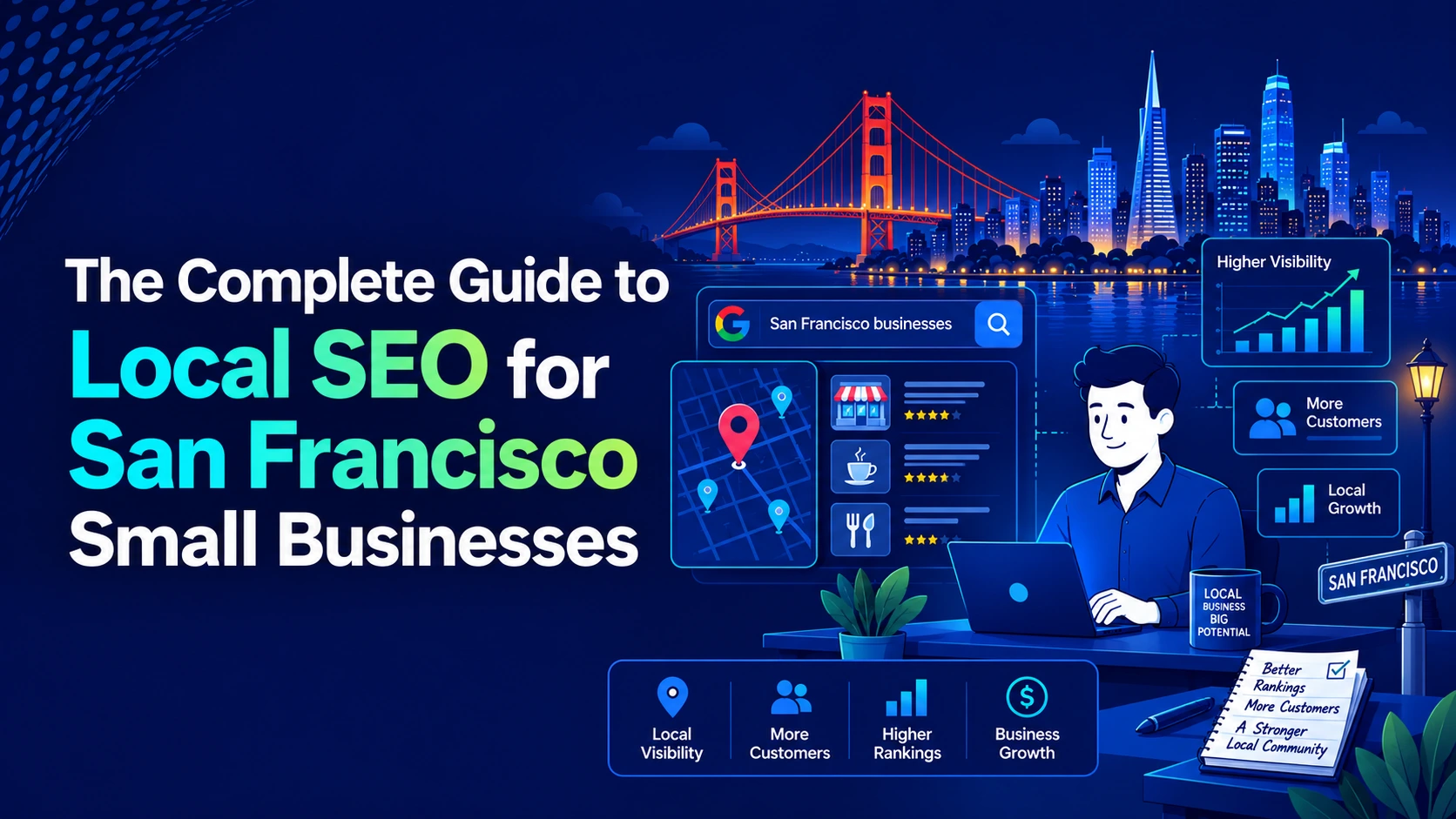
Winning local SEO in San Francisco means being the business that shows up when a nearby customer searches with intent. This guide is a start-to-finish playbook: what local SEO is and how Google ranks local results, a full audit, Google Business Profile optimization, local keyword research and mapping, on-page and technical SEO, NAP and citation management, reviews, local link building, neighborhood-level targeting, competitor analysis, content, schema, strategies by business type, measurement and reporting, a 90-day action plan, a complete checklist, and the Shankom Local SEO Framework. In one of the most expensive and competitive markets in the country, durable organic visibility is among the highest-return moves a small business can make.
Key Takeaways
- What is local SEO? Optimizing a business to appear in geographic searches, including the map pack, for customers searching nearby.
- How do I rank in the San Francisco map pack? Optimize your Google Business Profile, keep citations consistent, earn genuine reviews, and build local links.
- Why does it matter so much here? Acquisition is expensive in San Francisco, so free, compounding organic visibility delivers outsized value versus paid channels.
- What moves the needle fastest? A complete Google Business Profile and a steady flow of recent, genuine reviews usually produce the quickest gains.
- Is local SEO a one-time project? No. Rankings, listings, and reviews shift constantly, so local SEO is an ongoing system, not a setup.
What Actually Works in San Francisco Local SEO
Before the tactics, it helps to name what genuinely moves local rankings in a market this dense, because a lot of common advice is noise. In practice, a handful of things do most of the work: a complete and accurate Google Business Profile, proximity and relevance to the searcher, a steady stream of recent genuine reviews, consistent business information across the web, and a website that clearly signals what you do and where you do it. Everything else in this guide supports those fundamentals.
What does not work, especially in San Francisco, is chasing volume for its own sake: mass-buying citations, stuffing neighborhood names into thin pages, or gaming reviews. The city’s customers and Google’s systems are both sophisticated enough to see through it. The businesses that win are the ones that get the fundamentals right, consistently, over time, and treat local SEO as a living system rather than a launch-and-forget task.
What Is Local SEO?
Local SEO is the practice of optimizing a business so it appears in the geographic searches customers use to find nearby products and services. When someone searches “best tacos near me” or “emergency plumber in the Mission,” Google draws on a different set of signals than it does for a general web search, and local SEO is the work of aligning your business with those signals.
It shows up in two connected places. The first is the map pack, the boxed set of three business listings with a map that appears at the top of local searches, pulled from Google Business Profiles. The second is the local organic results, the traditional links below, where your website’s own pages compete. A complete local SEO strategy earns visibility in both, because they reinforce each other: a strong profile wins the map pack, while strong pages and content win the organic listings and feed the profile’s authority.
Why Local SEO Matters for San Francisco Small Businesses
San Francisco packs an enormous number of businesses into a small footprint. A single neighborhood may hold a dozen competitors for the same search term, so the margin between showing up and being buried is razor-thin. Local buyers here are mobile-first and decision-ready, often searching while walking or commuting, which means the businesses that appear first capture demand at the exact moment of intent.
The cost angle makes it matter even more. San Francisco is consistently the most expensive rental market in the country and one of the costliest places anywhere to operate, with elevated rent, labor, and overhead every month. That changes the math on marketing: when every customer acquired through paid ads erodes already-thin margins, organic local visibility, once earned, keeps delivering customers at effectively no marginal cost. In a high-cost market, the compounding nature of local SEO is one of the few acquisition channels whose economics improve over time.
How Google Local Search Rankings Work
Google has been explicit that local rankings come down to three core factors, and understanding them turns local SEO from guesswork into strategy.
- Relevance. How well your business matches what the searcher is looking for. A complete Google Business Profile with the right primary category, services, and descriptive content helps Google understand exactly what you offer.
- Distance. How close your business is to the searcher or the location implied by their search. You cannot move your storefront, but you can strengthen relevance and prominence so you surface across a wider area.
- Prominence. How well-known and trusted your business is. This is driven by reviews, citations, links, and your overall web presence, and it is the factor you have the most room to improve.
The practical implication is that you cannot change distance, so you win by maximizing relevance and prominence. Nearly every tactic in this guide, from profile optimization to reviews to local links, is really a lever on one of those two factors.
| Ranking Factor | What It Means | How You Influence It |
| Relevance | Match to the search query | Profile categories, services, on-page content, keywords |
| Distance | Proximity to the searcher | Fixed by location; offset with relevance and prominence |
| Prominence | Trust and authority | Reviews, citations, local links, overall web presence |
The Complete San Francisco Local SEO Audit
Before optimizing anything, you need an honest picture of where you stand. A local SEO audit is a systematic review of the signals Google uses to rank local businesses. Work through these steps in order, and the output will be a prioritized list of gaps.
- Audit your Google Business Profile. Confirm it is claimed, verified, and complete, with an accurate primary category, hours, service areas, photos, and description. An incomplete profile is the single most common reason San Francisco businesses miss the map pack.
- Check your map pack ranking by neighborhood. Search your core terms from different San Francisco locations, such as your service plus “Mission,” “Hayes Valley,” or “Marina,” since rankings shift block by block.
- Review NAP consistency. Confirm your name, address, and phone number match everywhere they appear online, down to abbreviations.
- Inventory your citations. List every directory and site where your business is listed, and flag duplicates, outdated entries, and missing major directories.
- Analyze your reviews. Look at count, average rating, recency, and response rate, and compare against the top three competitors in your category and corridor.
- Assess on-page and local signals. Check that your site has location-specific pages, local keywords, embedded maps, proper title tags, and schema markup.
- Evaluate your backlink profile. Identify how many local, relevant sites link to you, since local links strongly signal neighborhood authority.
- Audit technical health. Confirm the site loads fast on mobile, is crawlable and indexed, and has no errors blocking key pages.
Most small businesses find their biggest wins in the first four steps, so start there before moving to advanced tactics.
Google Business Profile Optimization
Your Google Business Profile is the single most important asset in local SEO, because it directly powers the map pack. Optimizing it thoroughly is the highest-leverage work you can do, and most competitors leave easy wins on the table.
- Choose the right primary category. Your primary category carries enormous weight. Pick the most specific one that matches your core business, then add relevant secondary categories.
- Complete every field. Fill in hours, services, attributes, and a keyword-aware description. Empty fields are missed relevance signals.
- Add real, high-quality photos. Genuine photos of your space, team, and work build trust and are associated with more views and clicks. Refresh them regularly.
- Use Google Posts. Publish updates, offers, and events. An active profile signals a live business to both customers and Google.
- Populate services and products. List your services with descriptions so the profile can match a wider range of searches.
- Answer questions and enable messaging. Seed the Q&A with common questions and respond quickly to messages, which both help conversion.
Treat the profile as a living asset. Businesses that update it regularly, add fresh photos, post, and respond consistently outrank those that set it up once and walk away.
Local Keyword Research for San Francisco
Local keyword research maps the exact phrases your customers use, so you can target the searches that actually drive local revenue rather than vanity terms. In San Francisco, that means layering geography onto intent.
- Start with core service terms. List the services and products you offer in the words customers use, not internal jargon.
- Add geographic modifiers. Combine services with the city, neighborhoods, and corridors you serve, such as “dry cleaner Hayes Valley” or “dentist Noe Valley.”
- Capture “near me” and implicit-local intent. Many local searches omit a location because Google infers it, so optimize for the intent behind “near me” searches, not just literal phrasing.
- Group by intent. Separate informational (“how to”), commercial (“best”), and transactional (“book,” “near me”) queries, since each maps to a different page type.
- Mine real sources. Pull terms from Google autocomplete, the “People also ask” box, competitor pages, and your own reviews and support questions.
Local Keyword Mapping and Website Architecture
Research is only useful once each keyword has a home. Keyword mapping assigns every target term to a specific page, which prevents two pages from competing for the same query and ensures every important search has a page built to win it.
A clean local architecture usually looks like this: your homepage targets your primary service plus the city; individual service pages target each core service; location or neighborhood pages target the specific areas you serve; and blog or resource content targets informational and long-tail queries. Each page should have one clear primary keyword and a set of related terms, all linked together sensibly so authority flows through the site.
| Page Type | Targets | Example |
| Homepage | Primary service + city | “Electrician San Francisco” |
| Service page | One core service | “Panel upgrades” |
| Location page | One area served | “Electrician in the Sunset” |
| Blog/resource | Informational, long-tail | “Cost to rewire an SF Victorian” |
On-Page SEO for Local Businesses
On-page SEO is how you tell Google, on your own website, what each page is about and where it applies. For local businesses, a few elements do most of the work.
- Title tags and meta descriptions. Include the service and location in the title of each key page, and write a compelling meta description that earns the click.
- Headings. Use a clear H1 with the primary keyword and logical subheadings that reflect how customers think about the topic.
- Localized body content. Reference the neighborhoods, landmarks, and specifics of the areas you serve, in a way that reads naturally rather than stuffed.
- NAP in the footer and contact page. Display your name, address, and phone consistently, and embed a Google Map on your contact page.
- Internal links. Link service, location, and content pages to one another so both users and search engines can navigate them.
- Image optimization. Use descriptive file names and alt text, and compress images so pages load fast.
NAP Consistency and Local Citation Management
NAP stands for name, address, and phone number. Inconsistent NAP information is one of the most common and damaging problems in local SEO, because when Google finds conflicting versions of your details, it loses confidence in which is correct, and that uncertainty drags down your ranking. Consistency means the exact same format everywhere, down to abbreviations.
- Pick one canonical format for your name, address, and phone, and use it everywhere without exception.
- Match your Google Business Profile as the master version, and align every other listing to it.
- Use a local 415 number, which reinforces San Francisco relevance more than a toll-free number.
- Fix duplicates first, since duplicate listings split authority and confuse ranking signals.
- Audit regularly, because details drift as directories auto-update or old listings resurface.
Local citations are online mentions of your business details on directories and sites. Each consistent citation reinforces that your business is real and located where you say. Prioritize them in this order rather than chasing volume:
| Priority | Citation Source | Why It Matters |
| 1 | Google Business Profile | The single most important listing for map pack ranking |
| 2 | Major data aggregators | Feed business data to hundreds of downstream directories |
| 3 | Core directories | Yelp, Bing Places, Apple Maps, and similar high-traffic platforms |
| 4 | Industry-specific sites | Signal relevance within your particular category |
| 5 | Local San Francisco sites | SF Chamber, merchant associations, and district directories prove local ties |
Reviews and Reputation Management
Reviews are among the strongest drivers of map pack ranking, and in a review-obsessed market like San Francisco they also decide whether a searcher clicks you or a competitor. Google weighs review quantity, average rating, recency, and how you respond, and a steady flow of recent, genuine reviews beats a large pile of old ones.
- Ask at the right moment, right after a positive experience when satisfaction is highest.
- Make it effortless by sharing a direct link to your review form via text or email.
- Respond to every review, thanking positive reviewers and addressing negative ones calmly and constructively.
- Never buy or fake reviews, which violate Google policy and erode trust with a discerning local audience.
- Build it into your routine, since consistency matters more than occasional bursts.
Negative reviews are not fatal. A handful of thoughtful, professional responses to criticism often build more trust than a wall of flawless five-star ratings, because they show a real business that listens and cares.
Local Link Building Strategies in San Francisco
Links from other local websites tell Google your business is an established part of the San Francisco community. Local link building is about relevance and geography over raw authority, so a link from a neighborhood blog or a corridor merchant association can outweigh one from a large but unrelated national site.
- Local sponsorships of neighborhood events, teams, or nonprofits, which often earn a link plus community goodwill.
- Chamber and association memberships, including the SF Chamber, your merchant association, or your Community Benefit District, which typically list members with a link.
- Local press and blogs, pitched with genuine story angles to San Francisco publications and neighborhood outlets.
- Partnerships with nearby businesses, cross-promoting and linking where it genuinely helps customers.
- Community resources and guides that other local sites naturally want to reference.
Quality and relevance always beat quantity. A few strong links from trusted San Francisco sources do more than dozens of low-value directory links.
Neighborhood-Level Local SEO
San Francisco is not one market but a patchwork of tight commercial corridors, each with its own character and competitive set. The boutiques of Valencia Street in the Mission behave differently in search than the design-and-food crowd on Hayes Street, the counterculture retail of Haight Street, the upscale shops on Union and Chestnut in the Marina and Cow Hollow, the neighborhood mainstays of West Portal and Polk Street, or the destination dining of North Beach and the Richmond’s Clement Street. Rankings shift block by block, so a business optimized for the Mission can be invisible a mile away in Noe Valley.
Winning at the neighborhood level means targeting the specific areas you actually serve. Build a genuinely distinct page for each real service neighborhood, reference local landmarks and specifics, seek reviews that mention the area, and earn links from that neighborhood’s organizations. Do this only for areas you truly serve and can describe uniquely; thin, near-identical neighborhood pages hurt more than they help.
Competitor Analysis: Find Your Local SEO Gaps
Your competitors’ rankings are a roadmap. Analyzing the businesses that outrank you in your corridor shows exactly where your gaps are and which fixes will move the needle fastest.
- Identify your real local competitors. Search your core terms from your neighborhood and note the three businesses in the map pack and the top organic results, which are your true competition, not national brands.
- Compare Google Business Profiles. Look at their categories, review counts and recency, photos, posts, and completeness against yours.
- Compare reviews. Note how many reviews they have, their average rating, and how actively they respond, then set a realistic target to match or beat.
- Analyze their backlinks and citations. See which local sites link to them and where they are listed, and pursue the relevant ones you are missing.
- Study their content. Identify the service, location, and blog pages they rank with, and find topics and neighborhoods they have covered that you have not.
The output is a prioritized gap list: the specific reviews, links, pages, and profile improvements that separate you from the businesses currently winning.
Local Content Strategy for San Francisco Businesses
Content is how you earn organic visibility beyond the map pack and build the topical authority that supports your whole local presence. For a San Francisco business, the most effective content is genuinely local and genuinely useful.
- Neighborhood guides that position you as a local expert and naturally earn links from other local sites.
- Service-plus-location pages that answer exactly what a searcher in a given area needs.
- Local FAQs answering the real questions customers ask, phrased the way they ask them, which also feeds AI answers.
- Local news and events tied to your industry and community, showing you are active and current.
- Case studies and local projects that demonstrate results and reference the neighborhoods you serve.
The goal is not volume but relevance: content that a real San Francisco customer would find useful is exactly what search engines and AI systems reward.
Local Business Schema and Structured Data
Schema markup is code that tells search engines exactly what your business is, in a language they read perfectly. For local businesses, LocalBusiness schema is the priority, and it helps you qualify for rich results and feed accurate data to both Google and AI systems.
- LocalBusiness schema with your name, address, phone, hours, geo-coordinates, and price range on your homepage and contact page.
- Service and product schema on the relevant pages so search engines understand your offerings.
- Review and aggregate-rating schema where appropriate and policy-compliant, which can surface star ratings in results.
- FAQ schema on pages with genuine question-and-answer content.
- Breadcrumb schema to clarify your site structure.
Keep the markup accurate and consistent with what appears on the page and across your listings, because mismatched structured data does more harm than good.
Technical SEO for Local Businesses
Technical SEO is the foundation that lets everything else rank. It does not need to be complicated for a small business, but a few essentials are non-negotiable.
- Mobile-first performance. Most local searches happen on phones, so the site must load fast and work flawlessly on mobile.
- Page speed. Compress images, minimize scripts, and use good hosting, since slow pages lose both rankings and customers.
- Crawlability and indexing. Ensure key pages are indexed, submit an XML sitemap, and fix crawl errors in Google Search Console.
- Secure HTTPS. A valid SSL certificate is a baseline trust and ranking signal.
- Clean URL structure. Use readable, descriptive URLs that include the service and location where relevant.
- No duplicate or thin pages. Consolidate or improve weak pages so every indexed page earns its place.
Local SEO Strategies by Business Type
Local SEO is not one-size-fits-all. The right emphasis depends on how your business reaches customers.
Storefront and retail businesses
For businesses customers visit, proximity and the map pack are everything. Prioritize a flawless Google Business Profile with great photos, accurate hours, steady reviews, and strong neighborhood citations, and lean into foot-traffic corridors.
Restaurants and hospitality
Reviews, photos, and up-to-date information dominate. Keep menus, hours, and attributes current, gather recent reviews relentlessly, and invest in appetizing imagery, since these searches are high-intent and often last-minute.
Professional and B2B services
Trust and authority matter most. Combine profile optimization with content that demonstrates expertise, case studies, and links from professional and local organizations, since consideration cycles are longer.
Local SEO for Service-Area Businesses
Service-area businesses, like plumbers, electricians, and cleaners, serve customers at their locations rather than at a storefront, which changes the playbook in specific ways.
- Configure service areas, not a public address. Set your service areas in the Google Business Profile and hide the address if you work from home, which is fully supported.
- Build location pages for each area served. Create genuinely distinct pages for the neighborhoods and nearby cities you cover, so you can rank across a wide service radius.
- Emphasize reviews that mention locations. Reviews referencing specific neighborhoods reinforce where you operate.
- Highlight responsiveness. For urgent services, fast response and clear availability drive both conversions and repeat visibility.
Local SEO for Multi-Location Businesses
Businesses with more than one location need a structured approach so each location ranks in its own area without cannibalizing the others.
- A separate Google Business Profile per location, each fully optimized with its own address, phone, hours, and reviews.
- A dedicated landing page per location, with unique content about that specific area rather than duplicated text.
- Consistent NAP per location across all citations, matched to each profile.
- Location-specific reviews, directing customers to review the profile for the location they visited.
- A logical site structure, such as a locations hub linking to each individual location page.
How to Measure Local SEO Performance
Local SEO only earns ongoing investment when you can see it working. Because it compounds, the meaningful signals appear in stages, so measure leading indicators early and business outcomes as the strategy matures.
- Map pack rankings by neighborhood, tracked from multiple locations since a single citywide rank rarely exists.
- Google Business Profile insights, including calls, direction requests, website clicks, and searches that surfaced you.
- Organic traffic and local landing-page performance, from Google Analytics and Search Console.
- Reviews over time, tracking volume, recency, rating, and response rate.
- Leads and revenue: the calls, form fills, and bookings that local search actually generates.
Local SEO Reporting: What to Track Every Month
A simple monthly report keeps the strategy honest and shows whether the investment is paying off. Focus on a consistent set of metrics rather than a sprawling dashboard.
| Metric | What It Tells You | Healthy Trend |
| Map pack rankings | Visibility by neighborhood and term | Rising or holding top 3 |
| Profile actions | Calls, directions, clicks from GBP | Steady month-over-month growth |
| Organic traffic | Website visibility beyond the map pack | Gradual, compounding increase |
| Reviews | Reputation and a ranking signal | Steady flow of recent 4–5 star reviews |
| Leads and calls | Actual business impact | Growing, at a stable or falling cost |
How Long Does Local SEO Take?
Local SEO is not instant, but it is faster than many owners expect for the fundamentals. Google Business Profile optimization and review generation often produce visible gains within the first one to three months, because they directly influence the map pack. Citation cleanup and on-page work compound over roughly three to six months, while link building and deeper authority build over six months and beyond.
Timelines depend on your starting point and how competitive your category and neighborhood are. A brand-new business in a crowded Mission corridor will take longer than an established business fixing obvious gaps. The key is consistency: local SEO rewards steady work, and the businesses that keep at it pull steadily ahead of those that stop after the initial setup.
Common Local SEO Mistakes
An incomplete Google Business Profile. Leaving categories, hours, photos, or the description blank is the fastest way to lose the map pack to a more thorough competitor.
Ignoring NAP consistency. Small mismatches in your business details across the web quietly undermine rankings, and most owners never notice them.
Neglecting reviews. Failing to ask for reviews, or never responding, leaves one of the strongest ranking levers untouched.
Chasing every directory. Volume for its own sake wastes time; a few accurate, high-priority citations matter far more than hundreds of low-quality ones.
Treating local SEO as one-and-done. Rankings, listings, and reviews shift constantly, so local SEO needs ongoing attention rather than a single setup.
Local SEO Shortcuts That Can Backfire
In a competitive market, the temptation to cut corners is real, but the shortcuts below routinely cause more harm than good and can trigger penalties or suspensions.
- Fake or incentivized reviews. They violate Google policy, risk profile suspension, and a savvy San Francisco audience often spots them.
- Keyword-stuffing your business name. Adding keywords to your Google Business Profile name that are not your real name violates guidelines and can get the listing suspended.
- Fake or lead-gen addresses. Creating listings at addresses you do not operate from is a serious violation.
- Mass-produced doorway pages. Dozens of thin, near-identical neighborhood pages get filtered or penalized.
- Buying spammy links. Low-quality bulk links can hurt rather than help, unlike genuine local links.
The through-line is that local SEO rewards authenticity. Every durable ranking gain comes from being a genuinely visible, trusted, and consistent business, which is exactly what these shortcuts fake and eventually undermine.
A 90-Day Local SEO Action Plan
To turn this guide into action, here is a realistic 90-day plan. Keep the order, since each phase makes the next work harder, and adjust the pace to your resources.
| Phase | Focus | Key Actions |
| Days 1 to 30 | Foundation and profile | Run the audit, fix tracking, fully optimize the Google Business Profile, and standardize NAP everywhere |
| Days 31 to 60 | Content and reviews | Build service and neighborhood pages, add schema, and launch a systematic review-generation routine |
| Days 61 to 90 | Authority and links | Clean up citations, pursue local links, publish local content, and stand up monthly reporting |
| Ongoing | Measure and refine | Track rankings, reviews, and leads monthly, double down on winners, and expand into new areas |
The Shankom Local SEO Framework
Shankom approaches San Francisco local SEO through a repeatable methodology we call the Shankom Local SEO Framework. Rather than a loose list of services, it is a defined sequence built for a dense, high-cost market, where each stage sets up the next. Here is what Shankom actually does, in order.
- Audit. A full local SEO audit of your Google Business Profile, website, citations, reviews, and local backlinks, benchmarked against the specific competitors in your corridor.
- Identify gaps. The audit becomes a prioritized action plan, focusing first on the fixes that will move rankings fastest for your neighborhood and category.
- Optimize the Google Business Profile. Complete and optimize categories, services, hours, photos, and description so the profile is fully eligible for the map pack.
- Clean up citations. Standardize NAP across the major aggregators and directories, removing duplicates and correcting mismatches that quietly suppress rankings.
- Build review systems. Set up a repeatable system for earning genuine, recent reviews and responding to them, turning reviews into an ongoing ranking and trust asset.
- Acquire relevant local links. Earn links from trusted San Francisco sources, such as neighborhood associations, Community Benefit Districts, and local press.
- Measure rankings and leads. Track map pack rankings by neighborhood, organic traffic, and the leads and calls the work generates, then refine based on the data.
Because the framework is a cycle rather than a one-time project, it compounds: each round of measurement feeds the next round of optimization.
San Francisco Local SEO Case Study and Practical Examples
To see how the framework plays out, here are two realistic examples. To protect client confidentiality the names are masked, and the figures are representative of the outcomes this approach produces rather than a guarantee, since results always depend on the starting point, category, and competition.
Case study: a Hayes Valley cafe (“Fog Hollow Coffee”)
Fog Hollow Coffee, a small independent cafe on a busy Hayes Valley block, was buried beneath larger chains whenever locals and visitors searched “coffee near me.” The audit found an unclaimed duplicate Google listing, hours that disagreed across three directories, and only nine reviews, most over a year old. Shankom claimed and removed the duplicate, standardized the cafe’s name, address, and phone everywhere, completed the profile with fresh photos and accurate hours, and set up a checkout QR code that made leaving a review effortless.
Over the following two quarters, the cafe climbed into the map pack’s top three for several neighborhood coffee searches, its review count roughly tripled with a steady flow of recent five-star ratings, and profile actions, including direction requests and calls, rose sharply. Because Hayes Valley draws heavy foot traffic, that visibility converted into daily walk-ins that paid ads could never have sustained profitably at local rents. The decisive move was not a clever trick but disciplined execution of the fundamentals.
Practical example: a citywide plumbing service (“Golden Gate Rooter”)
Golden Gate Rooter, a service-area plumbing business covering several San Francisco neighborhoods, ranked almost nowhere despite years in business, because its website was a single generic page and its citations were scattered and inconsistent. Shankom configured service areas in the Google Business Profile, cleaned up citations across the major aggregators, built genuinely distinct location pages for the neighborhoods actually served, and earned links from a neighborhood association and two local suppliers.
Because home-services searches are high-intent and often urgent, climbing into the map pack for terms like “emergency plumber” across several districts turned local search into a steady, lower-cost lead source, a decisive advantage in a market where every acquired customer is expensive. Both stories follow the same arc: audit first, fix the foundation, earn reviews and local links, then measure and refine. The specifics differ by industry, but the framework does not.
Complete Local SEO Checklist
Use this as a quick reference to track your progress through everything above.
Google Business Profile
- Claimed, verified, and 100% complete with the right primary category
- Accurate hours, services, attributes, and a keyword-aware description
- Fresh, genuine photos and regular Google Posts
Consistency and citations
- One canonical NAP format used everywhere, matched to the profile
- Duplicates removed and top-priority citations accurate
Website and content
- Service and location pages, each unique and locally specific
- On-page basics, LocalBusiness schema, and fast mobile performance
- Local content such as neighborhood guides and FAQs
Reviews and links
- A systematic review-generation routine and responses to every review
- Genuine local links from San Francisco sources
Measurement
- Monthly tracking of rankings, profile actions, reviews, and leads
How Shankom Can Help
Shankom solutions designs and manages local SEO strategies built for the realities of San Francisco’s dense, high-cost market. Through the Shankom Local SEO Framework, from a full audit and Google Business Profile optimization to citation cleanup, review systems, local link building, and neighborhood-level content, Shankom handles the work that gets small businesses into the map pack and keeps them there, then measures the rankings, calls, and leads it produces. Whether you are starting from scratch or reclaiming visibility lost to competitors, Shankom turns San Francisco’s expensive, high-intent demand into a dependable source of customers.
Conclusion
Local SEO is not a trick or a one-time project. It is the ongoing practice of being the most visible, trusted, and consistent option when a nearby customer searches with intent. In San Francisco, where competition is fierce and the cost of every customer is high, that visibility is one of the most valuable assets a small business can build, precisely because it compounds and cannot be switched off like a paid ad.
The path is clear: get the fundamentals right, target your real neighborhoods, earn genuine reviews and local links, measure what matters, and keep at it. Do that consistently and local search becomes a durable engine of growth rather than a channel you rent. Whether you build it yourself with this guide or partner with a team like Shankom, the businesses that treat local SEO as a long-term system are the ones that win their corner of the city, and keep winning it.
FAQs
How long does local SEO take to show results in San Francisco?
Most businesses see early movement within three to six months, though a competitive category or neighborhood can take longer. Profile optimization and reviews often produce the fastest gains, while links and authority build more gradually.
Is local SEO worth it for a very small business?
Yes. It targets customers actively searching nearby, and in an expensive market, free organic visibility that compounds is especially valuable. A small business can outrank far larger ones by being more thorough and consistent.
Do I need a physical storefront to rank locally?
No. Service-area businesses can rank by configuring service areas in their Google Business Profile and following the same citation, review, and link-building practices as storefront businesses.
What is the difference between the map pack and organic results?
The map pack ranks your Google Business Profile using proximity, reviews, and citations. Organic results rank your website’s pages using content, links, and on-page SEO. A complete strategy targets both.
How many reviews do I need to rank in the map pack?
There is no fixed number. What matters is having more genuine, recent, well-managed reviews than the competitors ranking above you, plus a healthy average rating and consistent responses.
Can I do local SEO myself or should I hire help?
Owners can handle the fundamentals. Competitive categories, technical fixes, and sustained link building are where professional help usually pays for itself.