How AI Is Reshaping Digital Marketing Services in San Francisco
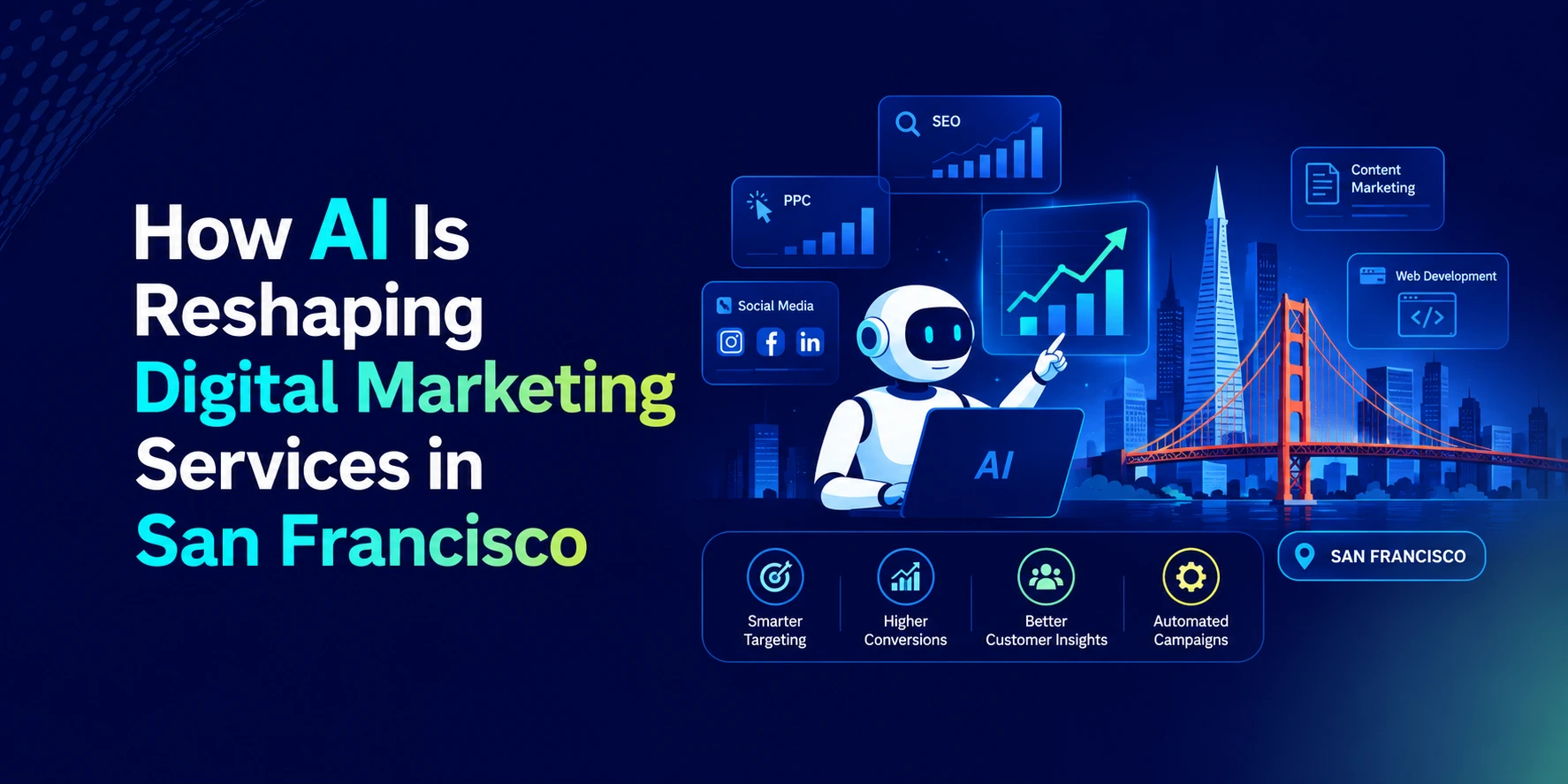
AI is transforming San Francisco online marketing by automating execution while human strategists focus on strategy and creativity. Agencies now rely on predictive analytics, generative content, automated bidding, conversational and voice AI, AI agents, and personalization tools. AI wins on scale and speed, while humans win on nuance and judgment, so the strongest results combine both. Automation for SMBs has closed much of the gap with enterprise budgets, delivering lower acquisition costs and faster testing. Independent data backs the shift: AI-driven optimization has been shown to cut cost per acquisition by roughly 15 to 40 percent when tools meet clean data and clear strategy. Businesses that adopt AI thoughtfully, rather than chasing hype, will lead the market over the coming years.
Key Takeaways
- How is AI changing digital marketing services in San Francisco? AI automates execution such as bidding, targeting, content, and reporting, freeing strategists to focus on strategy and creative direction.
- What AI marketing tools do agencies actually use? Predictive analytics, generative content engines, automated bidding, conversational and voice AI, AI-driven personalization, and autonomous AI agents, each solving a specific funnel problem.
- Is AI better than traditional marketing methods? Neither wins universally. AI excels at scale and speed; humans win on nuance and judgment. The best results combine both.
- Can small businesses benefit from AI marketing? Yes. Automation for SMBs delivers enterprise-grade targeting on lean budgets, closing the gap with far larger competitors.
- What is predictive analytics in marketing? It uses data to forecast which customers will convert or churn, directing budget toward the highest-probability outcomes before you spend.
San Francisco is not an average market. The concentration of technology talent, the sophistication of buyers, and the cost of acquisition mean inefficiency is punished quickly. A campaign that wastes budget in a smaller market can coast; in San Francisco, it fails, which is why AI adoption here has moved faster than almost anywhere else.
AI has not replaced the strategist. It has changed what the strategist spends their time on. San Francisco online marketing today is a partnership between human judgment and machine execution. This guide breaks down the AI tools reshaping the field, how they compare to traditional methods, what the ROI looks like, and where the industry is heading.
The AI Marketing Tools Reshaping San Francisco Campaigns
At Shankom, the shift toward AI has not been about chasing novelty. It has been about deploying the right AI marketing tools where they measurably outperform manual effort. Each tool solves a specific problem in the funnel, and none run unsupervised. Here is how the core stack breaks down.
Predictive Analytics Engines
Predictive analytics is the foundation of modern data-driven marketing. Rather than reacting to what already happened, these platforms forecast what is likely to happen, including which leads will convert and which customers are about to churn. Shankom uses predictive models to score leads before a dollar of ad spend is committed, so the budget flows toward the highest-probability outcomes instead of being spread evenly across an untested audience.
Generative Content Systems
AI content engines handle the volume problem that has always challenged content marketing. Producing dozens of ad variations, headlines, subject lines, and captions manually is slow and expensive. Generative tools produce those variations in minutes, but the strategist still selects, edits, and approves what ships. The efficiency gain is real, and the quality control stays human.
Automated Bid and Budget Management
The machine-learning bid systems inside Google and Meta adjust bids in real time across millions of auction signals, including device, location, time of day, and browsing behavior, at a speed no human can match. Shankom layers these systems onto campaigns with sufficient conversion data, while keeping manual oversight of creative, keyword strategy, and negative keywords so the algorithm does not optimize toward the wrong goal.
Conversational and Voice AI
AI chat assistants handle first-touch engagement around the clock, answering questions, qualifying leads, and booking appointments without a human on standby. Voice AI extends the same capability to the phone channel, fielding inbound calls, screening intent, and routing high-value callers to the right person in real time. For San Francisco businesses facing 24/7 support expectations across both chat and phone, this closes a gap that used to cost real revenue after hours.
Autonomous AI Agents
The newest layer of the stack is the autonomous AI agent: a system that does not just recommend changes but executes them within defined guardrails. Rather than a strategist manually pausing a fatigued ad or shifting budget between campaigns, an agent monitors performance signals continuously and acts on them, pausing underperformers, reallocating spend toward winning segments, and flagging anomalies for human review. At Shankom, agents run inside strict boundaries the strategist sets, so speed of response never comes at the cost of control.
AI-Driven Personalization
Personalization engines tailor what each visitor sees, including product, offer, and message, based on behavior and intent signals in real time. In a market as sophisticated as San Francisco, generic messaging is ignored. AI personalization lets campaigns speak to segments of one, at scale, in ways manual segmentation never could.
AI vs. Traditional Marketing Methods: A Detailed Comparison
The temptation is to frame AI as the obvious replacement for traditional methods, but the reality is more nuanced. Traditional digital marketing services in San Francisco, built on human research, manual targeting, and relationship-driven strategy, still hold advantages in specific situations. AI wins on scale and speed; humans win on judgment and nuance. Understanding the trade-off separates effective adoption from wasteful hype.
| Dimension | Traditional Methods | AI-Powered Methods |
| Speed of execution | Days to weeks per campaign build | Hours, with variations generated in minutes |
| Targeting precision | Segment-level, manually defined | Individual-level, behavior-driven |
| Data processing | Limited to human-reviewed samples | Millions of signals in real time |
| Cost efficiency at scale | Rises steeply with campaign volume | Marginal cost drops as scale grows |
| Brand nuance and creativity | Strong, with human judgment leading | Assistive, requiring human oversight |
| Performance with thin data | Reliable and experience-driven | Weak, as algorithms need volume to learn |
| Best suited for | Brand strategy, relationship sales, low-data launches | High-volume campaigns, personalization, optimization |
The takeaway is not that one approach replaces the other. The most effective San Francisco online marketing strategies use AI for scale, speed, and optimization, while keeping human strategists in control of positioning, creative direction, and decisions that need context a machine does not have.
How AI Actually Produces the Result
It is easy to say “AI optimizes campaigns,” but that phrasing hides the mechanism. Optimization is not a single button; it is a loop between data sources, algorithms, and human oversight. Understanding that loop is what separates a campaign that improves from one that quietly drifts.
Here is how the pieces work together in practice. First, conversion data flows from the ad platforms and the website into the CRM, where each lead is tagged as qualified, unqualified, or closed. Those CRM signals are fed back to Google and Meta, so the bidding algorithms learn what a genuinely valuable conversion looks like rather than optimizing toward raw form fills. As conversion volume accumulates, the algorithms gain enough signal to bid confidently, concentrating budget on the audiences, placements, and times of day that actually produce revenue. Audience data, including behavior on site and position in the funnel, sharpens targeting further. Throughout, a Shankom strategist reviews what the system is doing, checking that it is optimizing toward the right goal, catching tracking errors before they compound, and adjusting creative and keyword strategy the algorithm cannot judge on its own. The result comes from the combination, not from any single tool.
How Automation Levels the Field for San Francisco SMBs
For years, the gap between enterprise budgets and small-business reality was nearly impossible to close. Enterprises could afford dedicated analysts, expensive tooling, and large creative teams. Small businesses could not. Automation for SMBs has changed that more than any development in the past decade. Tools that once required a specialist are now self-serve, affordable, and capable of enterprise-grade targeting on a fraction of the budget. A local business can now run predictive lead scoring, automated bidding, and personalized email sequences that once required a five-figure monthly retainer.
For SMBs, the practical benefits show up in a few clear places:
- Time recovery: Automated reporting, scheduling, and optimization free small teams from hours of manual work each week. Marketers using AI tools report saving an average of roughly six hours per week.
- Lower acquisition costs: Predictive targeting concentrates spend on the audiences most likely to convert, reducing wasted budget.
- 24/7 responsiveness: AI chat, voice, and lead-qualification tools engage prospects instantly, even outside business hours.
- Faster testing: Generative tools produce ad and landing-page variations quickly, letting small teams test and learn at agency pace.
Sources: AI marketing time-savings and ROI data (2026)
The caveat applies everywhere. Automation amplifies whatever strategy it is given: pointed at a clear plan, it multiplies results; pointed at a vague one, it multiplies waste. SMBs that succeed pair the tools with a defined strategy, or a partner who provides one.
Real-World ROI: What AI Delivers for San Francisco Businesses
The case for AI in digital marketing services in San Francisco comes down to return. The gains are real but conditional, showing up when tools are applied to the right problems with sufficient data. The benchmarks below reflect both published industry data and the outcomes Shankom sees when AI is deployed correctly.
| Metric | Traditional Approach | AI-Powered Approach | Typical Gain |
| Cost per acquisition | Baseline | 15 to 30% lower at scale* | AI wins |
| Campaign build time | Days to weeks | Hours | AI wins |
| Lead qualification speed | Manual, business hours | Instant, 24/7 | AI wins |
| Conversion rate (personalized) | Baseline | 10 to 25% higher with targeting | AI wins |
| Ad spend efficiency | Even distribution | Concentrated on high-intent | AI wins |
| Wasted spend | Higher, from broad targeting | Lower, from predictive filtering | AI wins |
*Sources: McKinsey on personalization revenue lift
A note on the numbers: published case studies span a wide range. One documented Google Ads deployment cut CPA by 30 percent while lifting click-through rates by 41 percent, and aggregated 2026 industry data attributes CPA reductions of 29 to 40 percent to AI-driven bidding and creative testing. Results depend heavily on data quality and starting point, so Shankom treats these as ranges to validate, not guarantees.
Examples From the Field
B2B SaaS startup: winning expensive, high-intent search
- Problem: A Series A SaaS company selling into engineering teams was burning budget on broad paid search. In San Francisco, where dozens of well-funded startups bid on the same buyer keywords, cost per click was punishingly high, and most clicks came from job seekers and competitors rather than buyers.
- Shankom solution: Shankom connected the CRM to Google Ads so that only sales-qualified leads counted as conversions, then layered predictive lead scoring on top so bids concentrated on accounts resembling past closed-won customers. Automated bidding optimized toward that CRM-verified signal instead of raw demo requests.
- Result: Cost per qualified lead fell while total budget held flat, and the sales team spent less time filtering out unqualified inbound.
- Lesson learned: In a crowded, high-CPC market like San Francisco SaaS, the leverage is not louder bidding; it is teaching the algorithm what a real buyer looks like so every dollar chases the right account.
Home-services company: capturing after-hours demand across the Bay Area
- Problem: A Bay Area home-services business was losing leads that came in during evenings and weekends, when no one was available to answer. High local demand and premium pricing meant every missed call was a meaningful loss.
- Shankom solution: Shankom deployed an AI chat and voice assistant to qualify and book jobs around the clock, while automated bidding adjusted in real time for neighborhood-level proximity and demand across San Francisco and the surrounding Bay Area.
- Result: Qualified lead volume rose as cost per lead fell, with a growing share of bookings captured outside business hours that would previously have gone to a competitor.
- Lesson learned: For local service businesses, responsiveness is acquisition. Automating the first touch turns after-hours interest into booked revenue instead of a voicemail.
Boutique e-commerce retailer: competing on relevance, not budget
- Problem: A two-person e-commerce brand could not match the ad budgets of national competitors and was seeing flat return on ad spend from generic campaigns.
- Shankom solution: Shankom applied AI personalization to tailor on-site product and offer messaging by visitor behavior and funnel stage, and used generative testing to produce and iterate on ad variations quickly. Strategists reviewed and refined every variation before it shipped.
- Result: Return on ad spend improved, and the small team operated at a scale that previously required a much larger one.
- Lesson learned: A small brand cannot outspend enterprise competitors, but AI-driven relevance lets it out-target them, which is where the margin actually lives.
Each case shows the same pattern: AI closed the resource gap, but only because it was pointed at a clearly defined problem with clean data and human oversight.
Why San Francisco Businesses Face Different Acquisition Challenges
San Francisco does not just have more marketing than other cities; it has a harder version of it. Understanding the local dynamics is what makes AI adoption here a necessity rather than an experiment.
SaaS and startups compete for the same expensive clicks. The Bay Area’s density of venture-backed software companies means that for any given B2B buyer keyword, a dozen well-funded competitors are bidding simultaneously. That drives cost per click far above national averages and makes broad targeting ruinous. AI helps by narrowing spend to accounts that resemble real buyers, so a startup is not paying premium prices to reach job seekers, competitors, and researchers. For companies raising and deploying capital on tight runway timelines, that efficiency is the difference between hitting a growth milestone and missing it.
Buyers are sophisticated, and generic messaging is ignored. San Francisco audiences are steeped in technology marketing and screen out anything that reads as boilerplate. AI personalization lets campaigns adapt message and offer to a visitor’s behavior and funnel stage, which matters more here than in markets where a generic pitch still lands.
High-value local businesses operate in a premium-cost environment. From home services to professional practices, Bay Area businesses charge premium prices and face premium acquisition costs, so every wasted impression is expensive. Round-the-clock AI chat and voice, plus proximity-aware bidding, help capture high-intent local demand the moment it appears rather than losing it to a faster competitor.
Talent and tooling are costly. Hiring an in-house performance team in one of the most expensive labor markets in the country is out of reach for most SMBs. Automation, guided by an experienced partner, delivers much of that capability without the headcount, which is precisely why AI adoption has accelerated faster in San Francisco than in most other markets.
Where San Francisco Digital Marketing Is Heading Next
San Francisco has always been an early indicator of where the broader marketing industry is going. The trends taking shape here now will define digital marketing services in San Francisco, and eventually everywhere else. A few predictions stand out.
Prediction 1: Autonomous Campaign Management Becomes Standard
More of the execution layer will run autonomously. Within a few years, expect AI agents to handle end-to-end campaign management, from budget allocation to creative rotation to real-time optimization, with humans setting strategy and guardrails. The strategist’s role shifts from operator to director.
Prediction 2: Predictive Analytics Moves From Advantage to Baseline
Predictive analytics is currently a competitive edge, but it will soon be table stakes. As forecasting tools become cheaper and more accessible, businesses that fail to adopt them will operate at a structural disadvantage against competitors already allocating budget based on probability rather than guesswork.
Prediction 3: First-Party Data Becomes the Deciding Factor
As privacy regulations tighten and third-party tracking erodes, the quality of a business’s own first-party data will determine how effective its AI tools can be. Businesses that invest now in clean, well-structured customer data will get more from every system they deploy. Those that do not will find their algorithms starved of signal.
Prediction 4: Human Creativity Becomes More Valuable, Not Less
As AI commoditizes execution, the scarce resource becomes original thinking, including distinctive brand voice, creative insight, and strategic judgment. The teams that thrive will use AI to eliminate busywork and reinvest that time into the human work machines cannot replicate. AI raises the floor, but not the ceiling.
Common Mistakes San Francisco Businesses Make With AI Marketing
Mistake #1: Treating AI as a strategy rather than a tool. AI executes a plan; it does not create one. Adopting tools without a strategy simply automates existing inefficiencies.
Mistake #2: Deploying automation without clean data. Predictive analytics and automated bidding are only as good as the data feeding them. Inaccurate tracking causes AI to optimize confidently toward the wrong outcomes.
Mistake #3: Removing human oversight entirely. Full automation without review drifts toward wasted spend and off-brand output. AI needs a strategist checking creative quality, keyword relevance, and direction regularly.
Mistake #4: Chasing tools instead of outcomes. A fascination with new technology can lead businesses to adopt AI tools they do not need. The right question is not “what can this tool do?” but “what problem does this solve?”
Mistake #5: Underestimating the ramp-up period. AI systems need time and data to learn. Businesses expecting instant results often abandon a strategy weeks before it would have paid off.
How Shankom Can Help
Shankom Solutions designs and manages digital marketing services in San Francisco that apply the right blend of AI-powered execution and human strategy for your industry, data maturity, and growth goals. Rather than bolting on tools for their own sake, Shankom works through a repeatable framework. Every engagement moves through five stages, each pairing automation with human judgment:
- 1. Audit and data foundation. Before any automation, Shankom audits tracking, conversion definitions, and CRM hygiene, because AI is only as good as the data feeding it. This is where the wrong outcomes get prevented.
- 2. Model and score. Shankom builds predictive models against your historical data to score leads and identify high-value prospects, so budget targets the accounts most likely to convert.
- 3. Deploy and automate. Shankom connects CRM signals to automated bidding, stands up generative content pipelines, configures personalization, and, where it fits, sets AI agents to monitor and act within defined guardrails.
- 4. Human review. Strategists review creative, keyword strategy, agent actions, and optimization direction on a regular cadence, catching drift and refining what the algorithm cannot judge.
- 5. Measure and refine. Results are measured against business outcomes, not vanity metrics, and the loop repeats as the models learn.
How We Make AI Work
- Predictive analytics: Shankom feeds your historical CRM and conversion data into scoring models that rank incoming leads and flag high-value prospects, then predict churn risk so retention spend goes where it matters. Bids and budget follow those scores rather than treating every lead as equal.
- Automated bidding: Shankom pipes CRM-verified conversion and audience data back into Google and Meta so their algorithms bid toward genuinely valuable outcomes, continuously shifting budget away from weak placements and toward the segments, times, and creatives that are converting.
- Generative content: AI produces many ad and landing-page variations — headlines, body copy, captions — in minutes, and Shankom strategists then review, edit, and approve each one so only on-brand, high-quality variations ever go live.
- AI personalization: Shankom configures website and content experiences to adapt in real time to a visitor’s behavior, interests, and funnel stage, so a first-time visitor, a returning researcher, and a ready-to-buy prospect each see a different, more relevant message.
- AI automation and agents: Where it fits, Shankom deploys agents that continuously monitor campaign performance and automatically trigger actions within set guardrails, pausing fatigued or underperforming ads, reallocating budget toward winning segments, and flagging anomalies for strategist review so response time is measured in minutes, not days.
Whether you are a small business looking to unlock automation for SMBs on a lean budget, or an established brand aiming to scale San Francisco online marketing without losing precision, Shankom builds the strategy that puts measurable ROI ahead of technology for its own sake.
FAQs
How much does AI-powered digital marketing cost in San Francisco?
Costs vary by scope, but AI has lowered the entry point. Many AI marketing tools run on affordable subscriptions, and automation for SMBs lets a small business run sophisticated campaigns without an enterprise budget. The larger investment is usually strategy and setup, as the tools themselves are rarely the bottleneck.
How long does it take to see results from AI marketing?
Most AI systems need a learning period, typically four to six weeks, to optimize reliably. Chat, voice, and content generation deliver value almost immediately, while predictive bidding and personalization improve as they accumulate signal. Abandoning a strategy during the learning phase is a common and costly mistake.
Will AI replace my marketing team or agency?
No. AI replaces repetitive execution, not strategy, creativity, or judgment. The marketer’s role shifts from operating individual levers to directing the systems and agents that do the work, and demand for skilled strategists who can guide AI is rising, not falling.
What are AI agents in marketing?
AI agents are systems that not only recommend changes but execute them within defined limits, such as pausing underperforming ads or reallocating budget automatically. At Shankom, they run inside strict guardrails a strategist sets, so speed never comes at the cost of control.
Is my business data safe when using AI marketing tools?
It depends on the tools and how they are configured. Reputable platforms comply with privacy regulations and keep first-party data secure, but businesses should vet each tool’s data handling and prioritize solutions that keep customer data under their own control.
Do I need clean data before adopting AI marketing?
Yes, and this is non-negotiable. Predictive analytics and automated bidding are only as good as the data feeding them. Inaccurate tracking causes AI to optimize toward the wrong outcomes, so a data audit should always come before any automation rollout.
What industries in San Francisco benefit most from AI marketing?
High-volume, data-rich sectors such as SaaS, e-commerce, and home services see the strongest gains because AI has the conversion data it needs to learn. Compliance-sensitive fields like healthcare, legal, and financial services benefit too, but require tighter human oversight.