South Jersey Digital Marketing: Why Local Businesses Are Investing Now
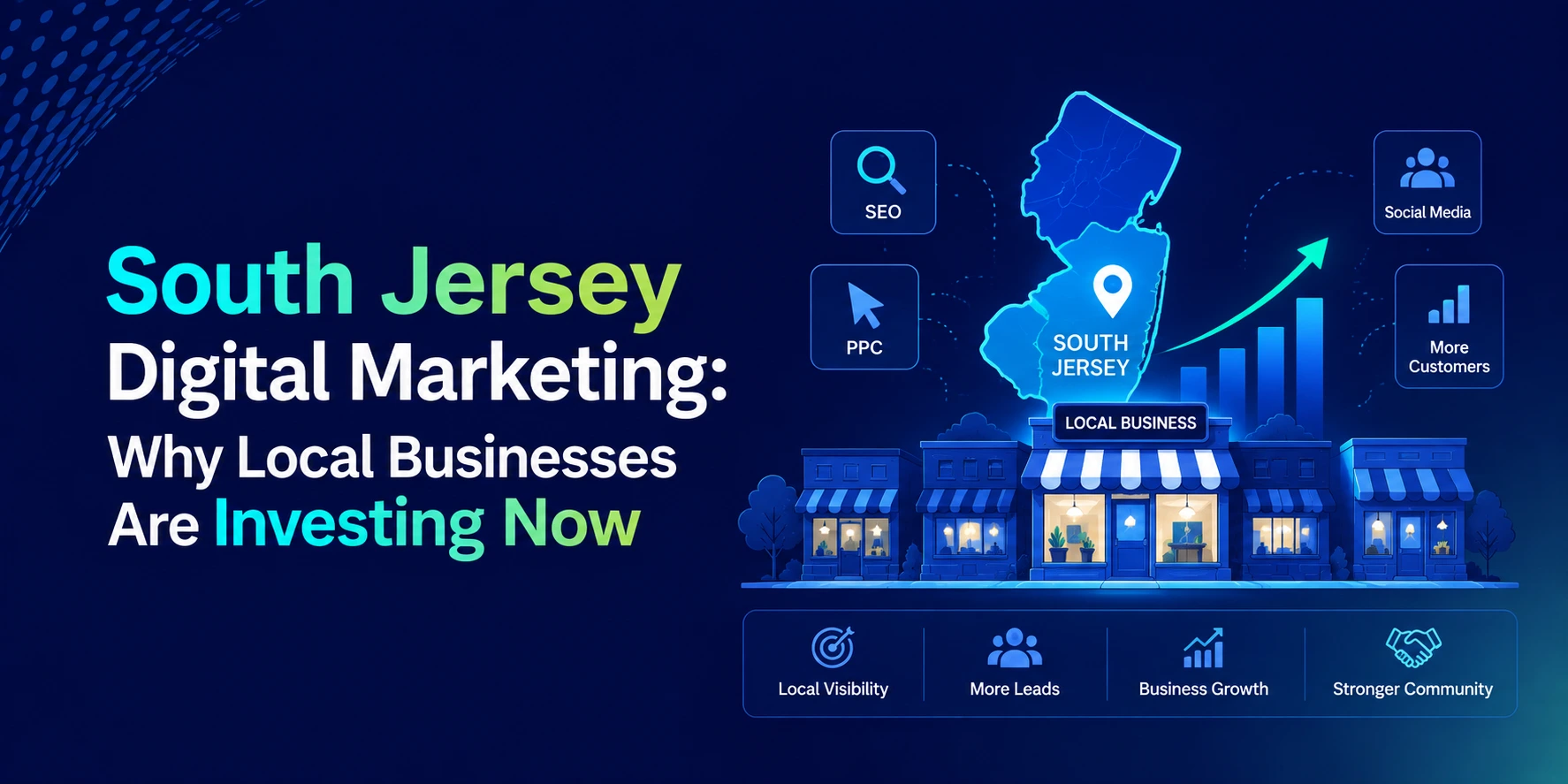
South Jersey businesses are investing in digital marketing because the ROI is now too clear to ignore. Across independent studies, email, SEO, and local search all return far more than they cost, and most businesses that increased their marketing spend saw revenue improve. As more customers research locally online, South Jersey small businesses are turning to local SEO and coordinated channel strategy to capture demand competitors miss. This guide covers the regional growth trends, the ROI data (with sources), how coordinated channel management works, a look at the local markets we serve, and a 90-day roadmap you can act on.
Key Takeaways
- Why are South Jersey businesses investing now? Customers research locally online first, and the ROI on digital channels is now clearly documented and hard to ignore.
- What is the ROI on digital marketing? It varies by channel: email and SEO return many times their cost over time, while paid search delivers faster but lower per-dollar returns. Full figures and sources are in the ROI table below.
- What matters most for local businesses? Local SEO and a coordinated channel strategy that connects search, content, email, and paid together.
- What is channel management? Coordinating your marketing channels so they reinforce each other instead of competing, maximizing total return.
- Do small businesses really see results? Yes. Most businesses that increased marketing spend reported stable or improved revenue, according to 2025 SMB survey data.
Something is shifting across South Jersey. Walk through Cherry Hill, Vineland, or the towns along the shore, and you will find local businesses that once relied on word of mouth and a phone book now pouring energy into their online presence. This is not trend-chasing hype. It is a calculated response to a simple reality: the customers these businesses depend on now make their decisions online, often before they ever pick up the phone or walk through a door.
The result is a wave of investment in South Jersey digital marketing that shows no sign of slowing. Local owners have watched competitors climb the rankings, fill their calendars from online leads, and build email lists that generate sales on demand. This guide explains why that investment is happening now, what the return actually looks like, and how South Jersey businesses are coordinating their marketing channels to grow in a market that rewards the prepared.
Regional Growth Trends Driving the Shift
The move toward digital marketing in South Jersey is being pushed by a few converging trends. First, customer behavior has fundamentally changed. Nearly every consumer now searches online before choosing a local business, and a large share of those searches carry local intent, meaning the customer is ready to act nearby. A business that is invisible in those searches is invisible at the exact moment of decision.
Second, the competitive bar has risen. As more South Jersey small businesses invest in their online presence, the businesses that wait fall behind not gradually but noticeably, losing visibility and leads to neighbors who moved first. Third, the tools have become both more powerful and more accessible, so a well-run local business can now compete with far larger companies on the searches that matter most to its market. Together, these trends have turned digital marketing from a nice-to-have into a requirement for staying competitive in the region.
A fourth trend is quietly reshaping the landscape: the rise of AI-driven search. More local searches now return AI-generated summaries that answer questions directly, which changes how customers discover businesses and raises the stakes for having an accurate, authoritative online presence. For South Jersey businesses, this means the fundamentals of local SEO- a complete profile, consistent information, genuine reviews, and helpful content- matter more than ever, because those are the signals both traditional search and AI systems rely on when deciding which local business to surface. The brands investing now are positioning themselves for how search works next, not just how it worked last year.
The ROI Data Behind the Investment
Local owners are practical people, and the reason they are investing is that the numbers now make the case for them. The return on well-executed digital marketing is documented across multiple independent studies. The table below shows typical returns by channel, and it is the one place in this guide where the full figures appear, so treat it as the reference.
| Channel | Typical Return | Character |
| Email marketing | About $36 per $1 spent | Highest raw ROI; owned audience |
| SEO and organic search | About $22 per $1 over time | Compounds; an appreciating asset |
| Local SEO | Strong return on high-intent local traffic | High-intent local customers |
| Paid search (PPC) | About $2 per $1 spent | Fast and scalable; stops when spend stops |
Sources: Litmus 2025 State of Email (email ROI); First Page Sage/marketing ROI benchmarks (SEO & PPC)
Beyond the per-channel figures, the broader pattern is striking. Among small businesses that increased marketing spend in 2025, 88 percent reported stable or improved sales and revenue, and organic search is regularly ranked among the top ROI channels by marketers. Just as telling is the confidence gap: nearly three-quarters of small business owners are unsure their marketing is working, largely because they under-invest or spread budget too thin rather than committing to proven channels. South Jersey businesses that avoid that trap and invest with focus are the ones seeing the returns above.
Source: Taradel 2025 SMB survey, via BiziQ
One nuance worth understanding is the difference between channels that rent attention and channels that build equity. Paid search delivers fast, predictable returns, but the traffic stops the moment the budget does, so you are effectively renting visibility. SEO and email are different: a page that ranks keeps paying you for months without ongoing spend, and an email list is an owned audience you can reach again and again at almost no cost. The highest-performing South Jersey businesses use a little paid spend to buy time and immediate results while the compounding channels mature, then let those owned assets carry more of the load over time. That balance is why the smartest investors think in years, not weeks.
Why Channel Management Is the Real Advantage
Investing in individual channels is a start, but the businesses seeing the strongest results are doing something more sophisticated: coordinating those channels so they reinforce one another. This is the heart of real channel management, and it is where many local businesses leave money on the table.
Here is the difference. A business running channels in isolation might have a website, an occasional email, and a paid ad campaign that never talk to each other. A business practicing real channel strategy uses local SEO to earn visibility, content to build trust, paid ads to accelerate reach, and email to capture and re-engage every visitor those channels bring in. Each channel feeds the next. The SEO traffic becomes email subscribers; the email list makes paid retargeting cheaper; the content gives paid campaigns something valuable to promote. Managed together, the channels produce far more than the sum of their parts, which is exactly why coordinated channel management delivers a better return than scattered spending.
Picture how this plays out for a typical South Jersey business. A customer in Mount Laurel searches for a service and finds the business through local SEO. They are not ready to buy yet, but a helpful piece of content and a well-timed offer convince them to join the email list. Over the next two weeks, an automated email sequence builds trust, while a low-cost retargeting ad keeps the brand visible. When the customer is ready, they convert, and a post-purchase email flow turns them into a repeat buyer who refers others. No single channel did that work alone. The coordination did. That compounding effect is what separates businesses that see a modest return from those that build a genuine growth engine.
Common Results Patterns We See
Because every business and contract is different, we do not publish named client quotes here. But across the South Jersey businesses that adopt a coordinated approach, a few results patterns come up again and again. The scenarios below describe those recurring outcomes rather than any specific customer:
- From referral-dependent to found by strangers. Businesses that had relied almost entirely on referrals often see their first steady stream of new inquiries once local SEO is in place, reaching people who had never heard of them before.
- Email flows that sell on autopilot. Owners are frequently surprised that automated email sequences, once set up, recover sales from customers they assumed were lost, with little ongoing effort.
- The shift from piecemeal to system. The biggest change owners describe is not any single tactic but the moment the channels start working together, so marketing feels like a repeatable system rather than a gamble.
The consistent theme is simple: the businesses that treat digital marketing as a coordinated, ongoing investment, rather than a one-off experiment, are the ones that see durable results.
The South Jersey Markets We Serve
South Jersey is a large and varied region, and effective local marketing means understanding the communities within it. Each market below has its own competitive dynamics, customer base, and search behavior, so the opportunity for a local business looks different in each one.
Camden County
Cherry Hill, Camden, Voorhees, Gloucester Township, and Collingswood form the region’s densest, most competitive commercial corridor. High search volume and affluent households in Cherry Hill and Voorhees mean strong demand but crowded results, so the advantage goes to businesses with the most complete profiles, freshest reviews, and sharpest local content. This is a market where ranking in the map pack directly drives foot traffic and calls.
Burlington County
Mount Laurel, Moorestown, Evesham, Willingboro, and Burlington combine established suburban spending power with strong professional-services and home-services demand. Buyers here research thoroughly before committing, which rewards businesses that pair local SEO with trust-building content and an email follow-up sequence for longer consideration cycles.
Gloucester County
Washington Township, Deptford, Glassboro, and Woodbury blend fast-growing residential areas with a college-town audience around Glassboro. That mix favors businesses that can speak to both settled families and a younger, mobile-first search audience, making mobile speed and up-to-date listings especially valuable here.
Atlantic County
Atlantic City, Hammonton, and Egg Harbor Township carry heavy seasonal and tourism-driven demand alongside steady local trade. Search interest spikes around the season, so businesses that plan content and paid campaigns around those peaks capture demand competitors leave on the table.
Cumberland County
Vineland, Millville, and Bridgeton are less saturated online than the northern counties, which is precisely the opportunity: businesses that invest early in local SEO and reviews can establish visibility before competitors catch up, often at a lower cost per lead than denser markets.
Cape May County
Cape May, Wildwood, Ocean City, and the shore communities are defined by sharp seasonal swings and a visitor audience searching on the go. Winning here means being unmistakably visible during the shoulder and peak seasons, with fast mobile pages, accurate hours, and content that captures both locals and tourists searching “near me.”
Because each of these markets behaves differently, local SEO and channel strategy in South Jersey work best when tailored to the specific community a business serves rather than applied generically.
How to Start Investing Wisely
For a South Jersey business ready to invest, the smart path is not to do everything at once. It is to sequence the investment so early wins fund later growth. This value-focused approach keeps risk low and momentum high.
- Start with your foundation. Ensure your website is fast, mobile-friendly, and set up to track results accurately before spending on traffic.
- Claim the local wins. Optimize your Google Business Profile and local SEO first, since local search delivers high-intent customers at a strong return.
- Set up email automation. Capture and re-engage the visitors your other channels bring in, since email consistently delivers the highest ROI.
- Layer in content and paid. Add content to build authority and paid campaigns to accelerate, once the foundation and owned channels are working.
- Coordinate and measure. Manage the channels together, track ROI, CAC, and lifetime value, and reinvest in what works.
Your 90-Day Roadmap
To turn that sequence into an executable plan, here is a realistic 90-day roadmap. Adjust the pace to your resources, but keep the order, since each phase makes the next one work harder.
| Phase | Focus | Key Actions |
| Days 1 to 30 | Foundation and local visibility | Audit the site for speed and mobile, fix conversion tracking, fully optimize your Google Business Profile, and standardize your name, address, and phone across directories |
| Days 31 to 60 | Owned channels | Launch local SEO content for your top services and towns, set up core email flows (welcome, follow-up, win-back), and start collecting reviews systematically |
| Days 61 to 90 | Accelerate and coordinate | Add targeted paid search or retargeting, connect the channels so they feed each other, and stand up a simple ROI dashboard |
| Ongoing | Measure and reinvest | Review results monthly, double down on the highest-ROI channels, and expand content and automation into new towns and services |
Sequenced this way, the investment tends to pay for itself as it grows. The early, high-ROI moves generate returns that fund the longer-term channels, so the business is rarely betting more than the results can justify. That is the essence of wise channel strategy: invest where the return is clearest first, then expand from a position of strength.
How Shankom Can Help
Shankom solutions helps South Jersey businesses invest in growth with confidence. From local SEO and content to email automation and coordinated channel strategy, Shankom builds complete digital marketing programs designed around how customers in the region actually search and buy. Rather than running channels in isolation, Shankom connects them into a system where each reinforces the next, so your investment compounds over time. Whether you are a growing business making its first move online or an established one ready to scale, Shankom delivers South Jersey digital marketing that puts measurable ROI first.
FAQs
How much should a South Jersey small business spend on marketing?
A common guideline is 7 to 8 percent of gross revenue, with newer businesses in competitive markets often investing more. What matters most is investing enough in proven channels rather than spreading a thin budget across too many.
How long before I see a return?
Paid search and email can show returns within weeks, while SEO compounds over several months. A useful rule is to give any channel around 90 days before judging it, and to track results consistently throughout.
What is the difference between digital marketing and channel management?
Digital marketing is the individual channels, such as SEO, email, and paid ads. Channel management is coordinating those channels so they reinforce each other, which produces a higher combined return than running them separately.
Can a small local business really compete online?
Yes. Local focus is an advantage. A business that deeply serves its South Jersey community can outrank larger, less focused competitors on the local searches that drive real revenue.