Human Writer vs. AI Tools: What Brand Voice, Accuracy, and Trust Actually Cost You
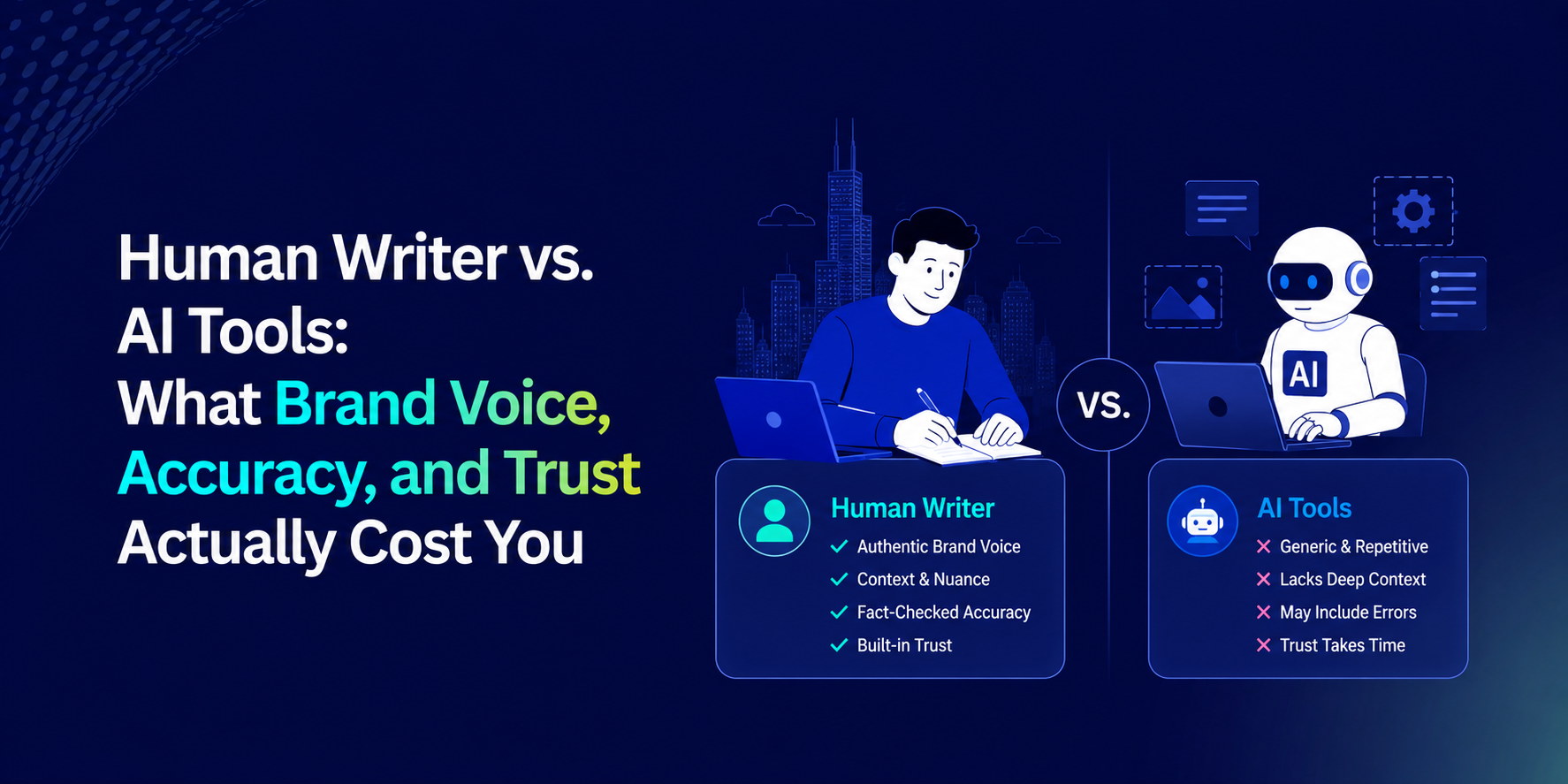
The human writer vs. AI tools debate is rarely framed around the costs that actually matter most. Production cost and speed dominate the conversation, and both favor AI convincingly. What gets left out of the calculation is what brand voice erosion, factual inaccuracy, and audience trust damage actually cost a business when they compound over 6, 12, and 24 months.
Key Takeaways
- What is the real cost difference between human writers and AI tools? AI tools reduce per-word production costs by 80–90% compared to skilled human writers. That cost advantage is real, but it is the starting point of the calculation, not the conclusion.
- How does brand voice differ between human writers and AI tools? Human writers produce content that reflects a brand's specific perspective, personality, values, and audience relationship. AI tools produce content that reflects statistical patterns across the internet.
- Does factual accuracy differ between human writers and AI tools? Significantly, in high-stakes content categories. AI language models generate factually plausible content that contains errors a non-specialist reviewer may not catch. In healthcare, legal, and financial services, these errors carry liability exposure that dwarfs any production cost savings.
- How does content trust affect conversion rates? Directly and measurably. Human-written product copy achieves a 30% higher conversion rate than AI-generated alternatives for equivalent products. In B2B, thought leadership content that reflects genuine expertise shortens sales cycles and improves close rates in ways that generic AI content cannot replicate.
- What is the right framework for deciding between human writers and AI tools? Content purpose, not content category. AI tools belong in the production workflow for efficiency tasks, briefs, metadata, repurposing, and structural drafting. Human writers belong in the workflow for anything where brand voice, factual accountability, audience trust, or professional credibility is the primary value signal.
Imagine two businesses in the same industry, targeting the same keywords, with similar domain authority and comparable backlink profiles. One has invested in skilled human writers who understand the brand, the audience, and the subject matter. The other has invested in AI content tools and a streamlined publishing workflow. At month one, the second business has published three times as many pieces at one-fifth the cost. At month six, the first business has more organic traffic, higher conversion rates, stronger backlink acquisition, and a brand that audiences recognize as distinctively credible.
This is not a hypothetical. It is the pattern documented consistently across content performance research in 2025 and 2026, and it is the pattern that makes the human writer vs. AI tools' decisions more consequential than the production cost comparison suggests.
This guide is designed to make those costs explicit: where they come from, how they accumulate, what they actually represent in business terms, and how to build a content approach that captures the genuine efficiency advantages of AI tools without the liabilities that erode them.
Brand Voice: What AI Tools Cannot Manufacture
Brand voice is the accumulated expression of a business's personality, values, perspective, and relationship with its audience, built through consistent, authentic communication over time. It is what makes one brand's content immediately recognizable as theirs, and what makes audiences feel they are in a relationship with a company rather than consuming a content commodity.
What makes brand voice distinctive
A skilled human writer working with a brand develops voice through genuine immersion: understanding the company's history, its founding perspective, the specific problems it solves and why, the audience it serves and how they talk about their challenges, the competitors it differentiates from and on what grounds. This understanding produces content that reflects a point of view, a specific angle, a characteristic tone, a way of framing problems that is distinctively the brand's.
AI tools produce content that reflects statistical patterns across vast training data. They can be prompted to adopt a tone- formal, conversational, authoritative- and they execute that prompt competently. What they cannot produce is the specific, accumulated perspective that makes a brand's voice genuinely distinctive rather than generically professional. The difference is the difference between a voice and a style, and audiences, particularly sophisticated B2B buyers and high-value B2C consumers, recognize it.
The business cost of generic voice
Brand voice erosion is not an abstract creative concern; it has direct business consequences. Businesses with distinctive, recognizable brand voices command premium pricing, generate higher customer loyalty, earn stronger word-of-mouth referral rates, and build the kind of audience trust that shortens sales cycles and improves conversion rates across every channel.
When AI tools replace human writers without strategic oversight, the brand voice that generates these outcomes is gradually replaced by competent genericism, content that covers the topic correctly but sounds like it could have been written by anyone, for anyone. Over 12 to 24 months, this erosion shows up in declining direct traffic (audiences no longer seeking out the brand's content specifically), lower email open rates (subscribers less engaged with content that no longer reflects a relationship), and weakening conversion rates on content-driven campaigns.
The cost of brand voice erosion cannot be invoiced, which is why it is consistently excluded from AI tools adoption calculations. It is, however, one of the highest long-term costs a content program can incur.
Factual Accuracy: Where AI Errors Become Business Liabilities
Factual accuracy is the dimension of the human writer vs. AI tools comparison where the stakes are most unevenly distributed across industries, and where the cost of AI errors can be catastrophically disproportionate to the production savings that motivated the choice.
How AI content generates factual errors
AI language models generate content by predicting statistically likely word sequences, not by retrieving verified facts from authoritative sources. This production mechanism creates several categories of factual risk:
- Outdated information: AI training data has a knowledge cutoff; information that has changed since training will be stated as current with the same confidence as accurate information
- Hallucinated specifics: statistics, citations, case names, regulatory figures, and specific data points that AI tools generate may not exist in the sources the model implies
- Jurisdiction conflation: legal and regulatory content that varies by state, country, or market is frequently generalized in ways that are accurate in some contexts and wrong in others
- Clinical oversimplification: medical content that is directionally accurate at a general level may be dangerously imprecise for specific patient populations, conditions, or treatment contexts
The liability distribution by industry
| Industry | AI Accuracy Risk | Potential Consequence |
| Healthcare | Clinical misinformation, outdated treatment guidelines, incorrect dosages, contraindication errors | Patient harm, regulatory action, reputational damage |
| Legal Services | Jurisdiction errors, superseded statute citations, implied guarantees | Professional liability, bar association complaints, client harm |
| Financial Services | Outdated rates, unauthorized investment advice, disclosure omissions | Regulatory scrutiny, FTC/SEC exposure, client financial harm |
| E-Commerce | Incorrect product specifications, false claims, inaccurate pricing | FTC compliance risk, returns, customer trust damage |
| SaaS / B2B | Technical inaccuracies, capability misrepresentation | Sales cycle damage, customer service escalations, churn |
| Home Services | Incorrect regulatory requirements, safety misinformation | Liability exposure, compliance violations |
A human writer with subject expertise produces content that is accountable; it can be traced to a specific professional who made a specific judgment based on specific knowledge. When errors occur, they are identifiable and correctable. AI tool errors are diffuse, confident, and often not identified until a reader, regulator, or legal counsel points them out.
The review cost that eliminates AI savings in YMYL industries
For healthcare, legal, and financial services, expert review of content before publication is not optional; it is professionally obligatory. This review process takes approximately the same amount of time regardless of whether the underlying draft was AI-generated or human-written.
In YMYL industries, the production cost savings from AI tools are largely illusory: the expert review cost, which is the expensive component of the production process, remains constant. What changes is the input to the review process, not the process itself. And because AI-generated drafts in these categories require more substantive correction than well-briefed human-written drafts, the total review time can actually increase when AI tools replace human writers.
Trust: The Revenue Variable That Content Decisions Build or Erode
Trust is the conversion infrastructure that every piece of content either builds or erodes, and it is the dimension of the human writer vs. AI tools comparison most consistently underweighted in production cost discussions.
How human-written content builds trust
Human writers build content trust through three mechanisms that AI tools cannot replicate: attribution (a named, credentialed author who can be verified and held accountable), specificity (detail that reflects genuine firsthand knowledge rather than general research), and consistency (a voice and perspective that audiences recognize as belonging to a real entity with a real stake in being accurate and helpful).
These mechanisms work together to create the kind of audience relationship that drives return visits, newsletter subscriptions, social shares, backlink acquisition, and the word-of-mouth referral patterns that are the most cost-efficient customer acquisition channel most businesses have. 79% of consumers trust online reviews as much as personal recommendations, and the trust that drives those reviews is built by the same authentic content signals that human writers deliver and AI tools consistently approximate but never quite reach.
How AI tool content erodes trust
Trust erosion from AI content at scale is gradual, cumulative, and self-reinforcing. It does not typically produce a single catastrophic trust failure; it produces a slow, steady decline in the engagement signals that indicate an audience values and trusts a content source. Open rates trend downward, return visit rates plateau, and time-on-page metrics decline as readers recognize a generic AI voice and disengage before completing the content.
Each of these engagement signal declines has both a direct revenue impact (lower conversion rates on content-driven campaigns) and an indirect SEO impact (weaker user engagement signals feeding into Google's quality assessment). Without effective AI content optimisation, the compounding nature of trust erosion means that the cost is small and invisible early in an AI content program, and large and difficult to reverse after 12 to 18 months of consistent publishing.
The conversion rate evidence
The trust differential between human-written content and AI content shows up most directly in conversion rate data. Human-written product copy achieves a 30% higher conversion rate than AI-generated alternatives for equivalent products in A/B testing. In B2B, thought leadership content authored by recognized practitioners shortens the consideration phase of the buying cycle, because it builds the trust required for a purchase decision faster than generic content can.
For a business generating $500,000 annually from content-driven conversions, a 30% conversion rate improvement from investing in skilled human writing represents $150,000 in additional revenue, a figure that almost never appears in a human writer vs. AI tools cost comparison, because it requires looking at revenue performance rather than production invoices.
Where Human Writers and AI Tools Each Belong
The practical conclusion from the brand voice, accuracy, and trust evidence is not that AI tools are without value; it is that their value is concentrated in specific parts of the content production workflow, and their costs are concentrated in other parts.
Where AI tools deliver genuine value
- Content brief and research generation, 70–80% time reduction on high-frequency, formulaic tasks with consistent quality output
- Metadata and SEO element production, title tags, meta descriptions, alt text, and schema at scale without quality risk
- First-draft scaffolding for non-YMYL content, structural acceleration for content that will receive substantive human editing
- Content repurposing, reformatting existing human-written content into new formats efficiently and accurately
- Performance monitoring and reporting, identifying patterns in content data that inform human strategic decisions
Where human writers are non-negotiable
- YMYL content, healthcare, legal, financial services, and safety content requiring expert authorship and professional accountability
- Brand voice and thought leadership, content where distinctive perspective and recognizable authority are the primary conversion drivers
- Local and community content, hyperlocal knowledge that AI tools cannot credibly manufacture
- Long-cycle B2B content, technical depth and practitioner credibility that sustains engagement across 3-to-6-month sales cycles
- Original research and proprietary insight, content that earns citations and backlinks precisely because it reflects knowledge unavailable elsewhere
Common Mistakes in the Human Writer vs. AI Tools Decision
Mistake #1: Comparing production cost without comparing revenue per piece. Production cost is the input. Revenue per piece over 12 months is the output. Human-written content's higher production cost is frequently recovered within 3 to 6 months through superior traffic, higher conversion rates, and stronger backlink acquisition, making the 12-month revenue-per-piece comparison the only meaningful cost analysis.
Mistake #2: Using AI tools for brand voice content to reduce cost on the highest-value assets. The content most responsible for brand authority, audience trust, and premium pricing power is precisely the content that should never be delegated to AI tools without substantive human rewriting. Saving money on these pieces is saving money on the foundation of the business's marketing effectiveness.
Mistake #3: Treating AI accuracy risk as a quality control problem rather than a liability problem. In YMYL industries, AI factual errors are not editorial problems; they are legal, regulatory, and professional liability problems. Organizations that treat AI accuracy review as a light editing pass rather than a substantive expert review are carrying unquantified liability on every piece of AI-generated content they publish.
Mistake #4: Measuring trust impact at the campaign level rather than the brand level. Trust erosion from cumulative AI content publishing does not appear in individual campaign metrics; it appears in brand-level trends over 12 to 24 months. Businesses that evaluate content performance campaign-by-campaign miss the accumulated trust signal damage until it has become expensive to reverse.
Mistake #5: Removing author attribution from AI-assisted content to scale faster. Author attribution is the primary mechanism by which content earns the E-E-A-T content quality signals that sustain rankings and the credibility signals that build audience trust. Eliminating it to accelerate AI content publishing removes the asset that makes the content worth publishing.
How Shankom Can Help
Shankom solutions helps businesses make the human writer vs. AI tools decision with the full cost picture in front of them, not just the production invoice. From content strategy audits that identify where AI tools are creating brand voice, accuracy, and trust liabilities, to hybrid content program design that allocates human writing investment to the content categories where it delivers the strongest measurable return, Shankom builds content operations that compound in business value rather than eroding it.
Whether you are evaluating your first AI content investment or recalibrating a program whose performance has not matched its production cost savings, Shankom provides the strategic framework and editorial execution that makes every content decision a deliberate one.