How a Dallas HVAC Contractor Generated Consistent Leads Without Relying Solely on Paid Ads
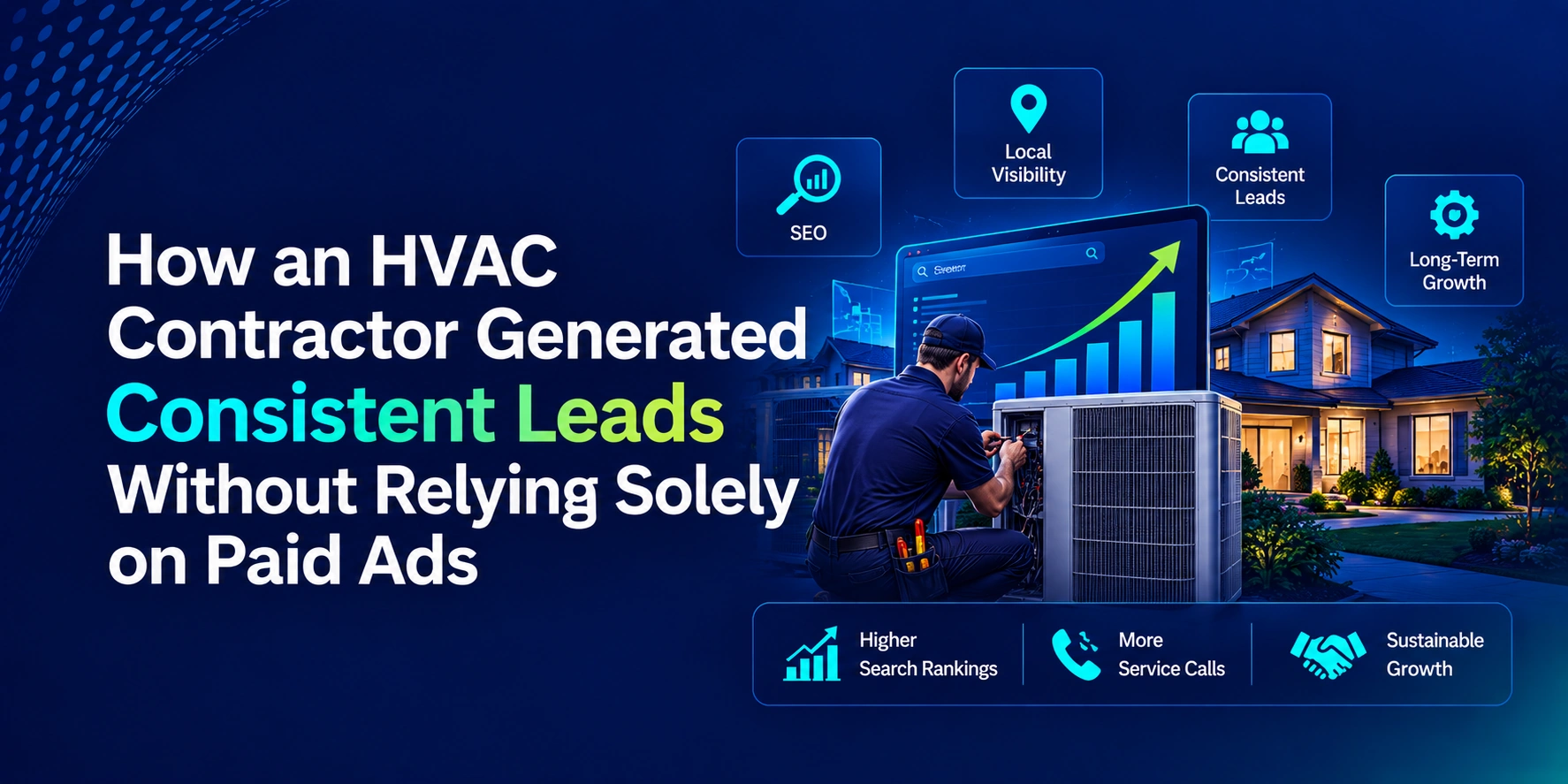
A Dallas-Fort Worth home services contractor offering HVAC, plumbing, and roofing relied heavily on paid ads. 62% of leads came from Google Ads, Local Services Ads, and Angi/HomeAdvisor, with organic search under 15%. Cost per lead averaged $89 to $143 across services, with 12 to 18% close rates. The website had no service-area pages, no structured review system, and no emergency-intent content. Over seven months, Shankom rebuilt the company's local presence using the same local SEO for HVAC companies playbook: service-area pages, Google Business Profile optimization, review velocity, emergency-keyword targeting, call tracking, and AEO for "near me" queries. The result was that organic call volume tripled, blended cost per lead dropped 54%, and the company moved from Map Pack position 5 to 7 up to position 1 across all three services. This HVAC SEO Dallas case study breaks down exactly how.
Key Takeaways
- Why do contractors stay dependent on paid ads even with strong reviews? Most treat GBP and reviews as reputation tools, not ranking signals. Stagnant review velocity and incomplete GBP data signal inactivity to Google and AI, so newer, more active competitors rank higher.
- Can organic search replace paid lead volume for home services? Yes, when targeting emergency-intent and suburb-specific queries. Organic leads run $18 to $47 versus $75 to $150 or more for paid, with 14 to 18% close rates compared to 3 to 7% for shared aggregators. That gap is a big part of why HVAC lead generation is shifting away from paid channels and toward owned organic assets.
- What's the biggest local SEO mistake contractors make? A single "Service Area" page instead of dedicated suburb landing pages. Homeowners searching "AC repair in Plano" want proof you work in their area, not a generic metro map.
- How fast does call-volume growth show up? First measurable increases appear in 8 to 10 weeks at prioritized suburbs. Network-wide compounding, including AI visibility, builds over 6 to 9 months.
The Starting Point: A Contractor Stuck in Paid-Ad Dependence
The company operated out of a single office in the Dallas-Fort Worth metro, offering HVAC, plumbing, and roofing services across 22 suburbs and zip codes spanning Plano, Frisco, McKinney, Arlington, Irving, Garland, Mesquite, and Grapevine. It had been in business for 18 years, with a website last redesigned in 2019 and built primarily around service descriptions and a contact form. The Google Business Profile existed but was rarely updated, with 58 total reviews (most over two years old) and no structured response process.
Internal call-tracking data showed that paid channels (Google Ads, Local Services Ads, Angi/HomeAdvisor) generated the majority of inbound calls, but those leads were expensive and often low-intent. Organic search contributed roughly 12% of total call volume, with most of those calls coming from branded searches (company name plus "near me") rather than non-branded emergency queries.
The business was profitable but vulnerable. Any increase in ad costs or drop in ad quality score immediately pressured margins, and there was no scalable organic channel to offset that risk.
The Problem: Three Gaps That Kept the Phone Quiet
Three structural gaps kept the company dependent on paid advertising.
No service-area pages. The website had a single "Service Area" page with a map and a list of cities, but no dedicated pages for individual suburbs. A homeowner searching "AC repair in Frisco" or "emergency plumber Arlington" found nothing on the company's site that spoke directly to that area.
Stagnant review base and weak GBP signals. The Google Business Profile had 58 reviews, but only 4 had been posted in the last six months. Service categories, attributes, and service lists were incomplete, and there was no systematic review request process tied to job completion.
No emergency-intent content or AEO structure. The website targeted generic terms like "HVAC services" and "plumbing repair," but had no pages built for high-intent emergency queries like "emergency AC repair near me," "burst pipe plumber Dallas," or "emergency roof leak repair McKinney." Content wasn't structured for AI extraction, so ChatGPT, Perplexity, and Google AI Overviews never surfaced the company when someone asked who fixes a broken AC near me. That's the kind of gap that separates real SEO for HVAC contractors from a website that just lists its services.
None of these were new problems. The company had simply relied on paid ads and word of mouth for so long that organic search had atrophied.
The Approach: Building an HVAC Local SEO Dallas Strategy Around Four Levers
Shankom's approach started from a simple constraint: the company did not need to eliminate paid ads overnight. It needed to build an organic channel that could replace at least half of paid lead volume within 12 months, at a fraction of the cost. That shifted the strategy away from "more keywords everywhere" and toward a focused, emergency-intent model of SEO for HVAC contractors designed to intercept homeowners already searching for urgent repairs in the suburbs where the company already had the most job history. In practice, this meant meeting homeowners at the moment of an urgent repair rather than competing for broad, low-intent terms, and working out how to generate HVAC leads from Google without paying for every click.
The work was organized around four levers that ran in parallel. The four levers below only pay off when they run together, which is the real argument for treating SEO for Dallas HVAC companies as one coordinated system rather than four separate tasks.
Lever 1: Service-area page architecture. Instead of trying to rank for broad terms like "HVAC Dallas" or "plumber DFW metro," the strategy leaned on targeted HVAC service area SEO, prioritizing 14 suburbs where the company already had the most completed jobs, strongest review density, and highest close rates. Each suburb became its own landing page, with localized content, suburb-specific emergency keywords, and clear calls to book same-day service. This avoided the common mistake of spreading effort thin across 40 or more low-volume towns, and instead concentrated authority where it could compound fastest. This is the core rule for SEO for multiple service areas: depth in a few markets beats a thin spread across many.
Lever 2: Google Business Profile as a lead engine. The GBP was rebuilt as a primary conversion channel, not just a map pin, since GBP visibility is where Google Maps SEO for HVAC companies and Map Pack rankings are actually won or lost. Service categories, attributes, and service lists were fully populated. Weekly posts were scheduled around seasonal demand (AC tune-ups in March, heater inspections in August, roof storm checks after severe weather). A structured review request system was implemented, triggering SMS requests 90 minutes after job completion with suburb-specific messaging ("Thanks for choosing us for your AC repair in McKinney, mind leaving a quick review?").
Lever 3: Emergency-intent keyword targeting. Content was restructured around the actual queries homeowners type when they have an urgent problem: "emergency AC repair near me," "water heater leak plumber Dallas," "emergency roof repair after storm Garland." This emergency HVAC SEO strategy gave each page a direct-answer opener, clear service steps, pricing context, and FAQ schema, so both Google and AI systems could confidently surface the company for high-intent searches.
Lever 4: Call tracking and attribution. A call-tracking system was implemented to distinguish organic, paid, and AI-sourced calls, with unique phone numbers for each service-area page and each GBP listing. This let the company see exactly which suburbs and which keywords were driving calls, and adjust content and ad spend accordingly.
The 14 suburbs with the highest job volume and lowest organic visibility were prioritized first, so results could be validated quickly before expanding to the remaining eight.
What We Did: Local SEO for HVAC Contractors in Dallas, in Three Phases Over Seven Months
Execution ran across three phases over twenty-eight weeks.
Phase 1: Foundation and GBP Optimization (Weeks 1 to 6). Every digital asset was audited and corrected.
| Issue Found | Fix Implemented |
| Incomplete GBP service categories and attributes | All categories, attributes, and service lists fully populated |
| 58 reviews, only 4 in last 6 months | Automated SMS review request system launched |
| No call tracking | CallRail integration with unique numbers per page and per GBP |
| Generic "Service Area" page only | 14 priority suburbs identified for dedicated pages |
NAP corrections were pushed across 20 directories, including Google, Bing, Yelp, Angi, HomeAdvisor, Better Business Bureau, and local chamber listings.
Phase 2: Service-Area Pages and Emergency Content (Weeks 7 to 20). Each of the 14 priority suburbs received a dedicated landing page. Every page included the suburb name in the H1, title, and URL, a service summary with emergency call-out availability, pricing context ("same-day service, no extra charge for evenings or weekends"), and a "Why choose us in [suburb name]" section referencing local landmarks, common issues (older homes with aging ductwork, frequent AC failures in specific neighborhoods), and the technicians who most frequently work there.
Content used an answer-first structure, with a two-to-three sentence direct answer opening every section before supporting detail, so both featured snippets and AI engines could extract clean responses. Each service-area page ran 1,200 to 1,500 words, incorporating original data from job history and suburb-specific insights that generic competitor pages could not replicate.
Emergency-intent pages were also created for each service category: "emergency AC repair Dallas," "emergency plumbing Dallas," and "emergency roof repair Dallas," each restructured with direct-answer openers, clear service steps, pricing transparency, and FAQ schema.
Phase 3: Review Velocity and AI Monitoring (Weeks 21 to 28). The automated review request system was refined based on response rates by service type and suburb. SMS messages were adjusted for emergency versus scheduled jobs, with emergency requests sent 2 hours after completion and scheduled requests sent 24 hours after.
A monthly monitoring process tested 20 realistic emergency and non-emergency queries across ChatGPT, Perplexity, Google AI Overviews, and Copilot, logging citation rate, source, and accuracy to guide ongoing content adjustments. GBP posts were scheduled weekly, with seasonal content timed 60 to 90 days before peak demand (AC content in March, heating content in August, roof storm content before spring severe-weather season).
What Moved and By How Much
| Metric | Before | After (Month 7) | Change |
| Total monthly calls (all channels) | 340 | 612 | +80% |
| Organic calls per month | 51 | 168 | +229% (3.3x) |
| Blended cost per lead | $89 (HVAC avg.) | $41 | -54% |
| Map Pack position (primary keywords) | 5 to 7 | 1 | +4 to 6 positions |
| Total Google reviews | 58 | 147 | +153% |
| New reviews per month (avg.) | 2 to 3 | 18 to 22 | +700% |
| AI citation rate (20 monitored queries) | 0 of 20 | 14 of 20 | +14 queries |
The 14 prioritized suburbs saw organic call increases within eight weeks, driven by long-tail, suburb-specific emergency queries. Network-wide gains, especially AI referral visibility, compounded over seven months as review velocity increased and service-area content accumulated citation history.
What Changed: From Paid-Ads-First to Organic-First
Before this engagement, the company was functionally invisible to search engines and AI systems beyond its paid ads and a generic service-area map. Afterward, 12 of 14 priority suburbs had independently ranking pages with their own local signals, and the company's AI query citation rate rose from zero to 14 of 20 monitored queries.
The core shift was moving from a paid-ads-first model to an emergency-intent organic model. Once Google and AI engines could clearly tie specific services, specific suburbs, and specific emergency availability to specific areas, the company began surfacing for the granular, high-intent queries that drive immediate calls. Lead quality improved too: organic calls closed at 22% compared to 12 to 18% for paid leads, a 1.5 to 1.8 times advantage in overall close rate.
Internally, the company also changed how it tracks and responds to calls. Every call is now tagged by source (organic, paid, AI-referral), by suburb, and by service type, letting the owner see exactly which channels and which suburbs are driving the most valuable calls. Ad spend was reduced by 35% in months 6 and 7 as organic volume replaced paid volume, lowering the blended cost per lead without sacrificing total call volume.
Why It Worked
Rebuilding each suburb as a fully described entity, with consistent NAP, suburb-specific emergency content, structured schema, and active GBP signals, gave every layer of the search and AI ecosystem a clear, citable source of truth. That's what earns Map Pack and Google Maps ranking for an HVAC contractor across a whole service area rather than at a single address. AEO ensured that once a system had a clear entity to point to, it also had answer-first content it could confidently extract for "near me" and emergency queries. GEO extended that consistency into the third-party directories generative engines cross-reference before naming a contractor.
Running these disciplines together, instead of as separate uncoordinated efforts, is what let gains compound. A service-area page with strong content but broken NAP underperforms. Strong reviews without suburb-specific content stay invisible to emergency-intent searches. Results came from closing every gap simultaneously across all 14 priority suburbs, rather than polishing the main service pages further.
How Shankom Can Help
Shankom provides local SEO for HVAC companies and AI visibility services for roofing, plumbing, and other home services contractors in Dallas-Fort Worth and beyond, facing exactly this problem: strong job volume but heavy dependence on paid ads and lead aggregators. From a full entity and NAP audit across every directory, to service-area page development, Google Business Profile optimization, automated review generation, emergency-intent keyword targeting, call tracking, and ongoing AI visibility monitoring across ChatGPT, Perplexity, Google AI Overviews, and Copilot, Shankom builds the complete program that turns every suburb in a service area into an independently discoverable, independently calling source of qualified leads.
If you're researching SEO services in Dallas for an HVAC company, or simply trying to figure out how to generate HVAC leads from Google without leaning entirely on paid ads, Shankom provides the strategy and execution that makes every service line and every service area in your business work as hard as your best-performing channel.
People Also Ask
Q: Why do only some contractors rank in the Map Pack?
A: Ranking is evaluated per location and service category based on GBP completeness, review recency, NAP consistency, and suburb-specific content. Generic content and inconsistent data suppress visibility.
Q: How does AEO differ from traditional SEO for home services?
A: Traditional SEO ranks pages. AEO structures content so AI systems extract and cite the contractor, which requires answer-first structure, emergency content, and explicit schema.
Q: How long until call volume improves?
A: Initial gains appear in 8 to 10 weeks. Network-wide compounding, including AI referrals, builds over 6 to 9 months.
Q: What's the biggest local SEO risk for contractors?
A: Treating new service areas as extensions of the main site. Generic templated content and inconsistent NAP suppress suburb-level ranking.
Recent Case Studies
How an Austin Residential Real Estate Agency Generated 3X More Local Leads Through Search Visibility
Know More
How a Chicago B2B Professional Services Firm Turned SEO into a Lead-Generation Engine
Know More