How a Chicago B2B Professional Services Firm Turned SEO into a Lead-Generation Engine
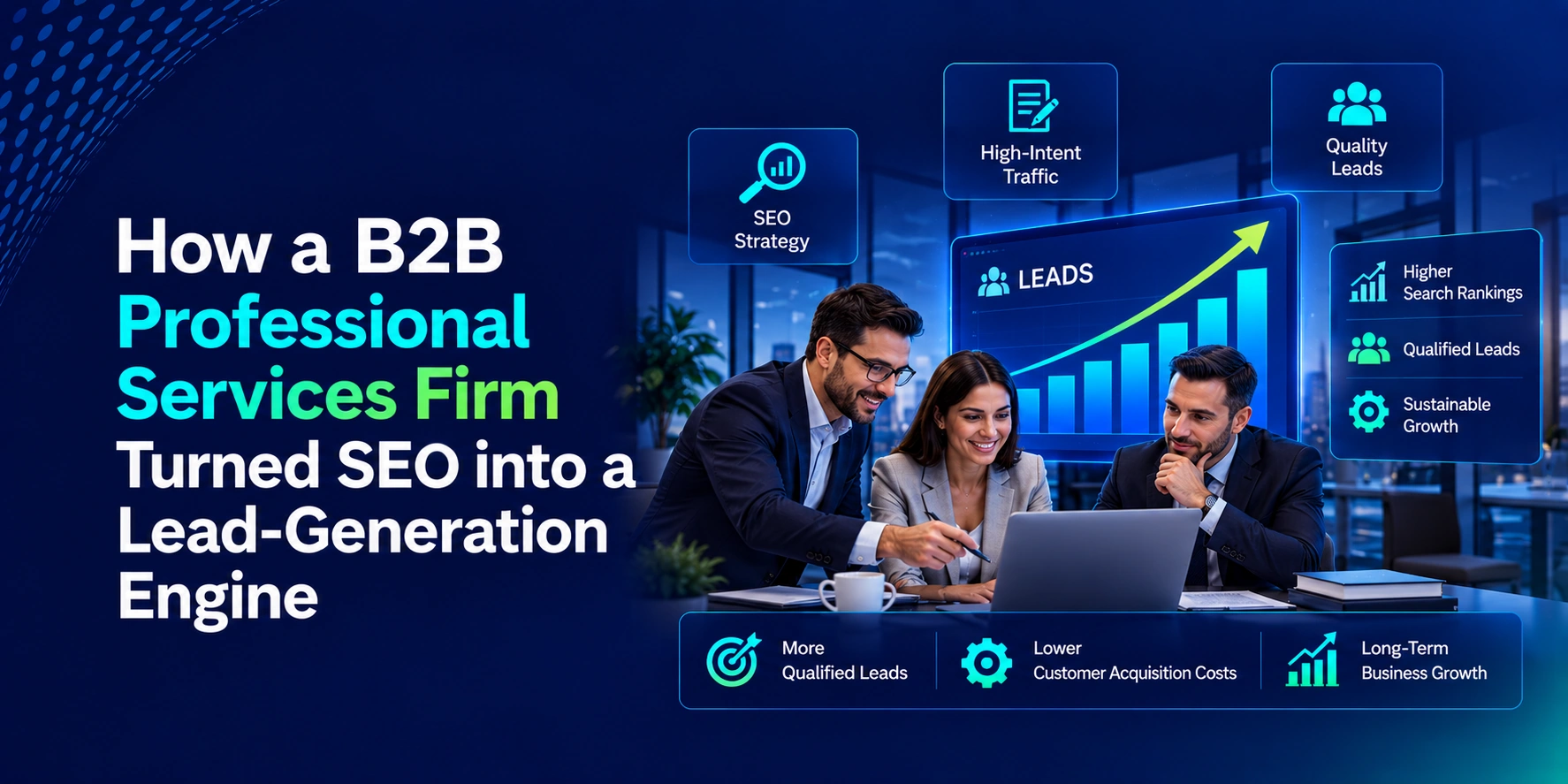
A professional services firm with 15 partners was winning good deals but struggling to fill the top of the funnel. Seventy-three percent of new opportunities came from LinkedIn ads, paid referrals, and existing client networks. Organic search contributed less than 9%. Cost per qualified lead averaged $210 to $280 across services. The website had 80+ blog posts but no commercial service pages, no quantified case studies, and no proof structure. Over eight months, Shankom rebuilt the firm's digital presence around 12 service and solution pages, 6 case studies with specific ROI figures, proof points embedded on commercial pages, conversion-focused copy, and LinkedIn content aligned to rank for buyer-intent queries. Qualified organic leads increased 285%. Blended cost per lead dropped 68%. SEO became the firm's largest source of new pipeline.
Key Takeaways
- Why do B2B firms stay dependent on LinkedIn ads and referrals? Most publish thought leadership content instead of bottom-funnel service pages. Buyers searching for specific services find nothing commercial to convert on.
- Can organic search outperform paid for B2B professional services? Yes, this is the core promise of B2B lead generation SEO: after month 6 to 8, organic CPL averages $147 to $164 versus $250 to $310 for paid. Bottom-funnel pages generate qualified leads within 8 to 16 weeks.
- What's the biggest SEO mistake B2B services firms make? Publishing 60+ top-of-funnel blog posts while service pages, case studies, and comparison pages remain thin or missing. Intent matters more than volume.
- How fast does pipeline growth show up? First increases in organic leads appear in 8 to 12 weeks. Full compounding, including AI visibility, builds over 6 to 9 months.
The Firm: Strong Delivery, Weak Discovery
The practice operated as a 15-person advisory firm based in Chicago, serving mid-market companies across the metro and the broader Midwest in strategy, operations, digital transformation, and M&A integration. Fifteen years in business. The website was last redesigned in 2019, built around an "About Us," "Services" dropdown, and an "Insights" blog with 80+ thought leadership posts. Google Business Profile existed but was rarely updated, with 23 total reviews and only 2 posted in the last year.
Internal data showed LinkedIn ads and referrals generated most new opportunities, but leads were expensive and inconsistent. LinkedIn Ad CPL averaged $210 to $280. Organic search contributed roughly 8% of total qualified leads, mostly from branded searches. The firm was profitable but vulnerable. Any decrease in ad performance or referral flow immediately pressured the pipeline, and there was no scalable organic channel to offset that risk.
The Gap: Three Reasons Buyers Could Not Find the Firm
Three structural issues kept the firm dependent on paid and referral channels.
No service-specific landing pages. The website had a single services dropdown with brief descriptions, but no dedicated pages for individual services. A buyer searching "digital transformation consulting firm Chicago" or "M&A integration advisors Chicago" found nothing on the firm's site that spoke directly to that service, showed proof of results, or answered commercial questions.
Case studies without quantified results. The firm had 4 case studies, but they were written as narrative stories without specific metrics, ROI figures, or client names (even with permission). There was no systematic process to capture and publish quantified results from completed engagements.
No commercial-intent content or AEO structure. The website targeted generic terms like "management consulting" and "business advisory," but had no pages built for high-intent commercial queries like "boutique consulting vs. Big Four," "top digital transformation firms for manufacturing," or "how much does M&A integration consulting cost." Content was not structured for AI extraction, so ChatGPT, Perplexity, and Google AI Overviews never surfaced the firm when buyers asked "who does post-merger integration for mid-market companies."
None of these were new problems. The firm had simply relied on LinkedIn ads and referrals for so long that organic search had atrophied.
The Strategy: Five Priorities That Drive Commercial Intent
Shankom's approach started from a simple constraint. The firm did not need to eliminate LinkedIn ads overnight. It needed to build an organic channel that could replace at least half of paid lead volume within 12 months, at a fraction of the cost. That shifted the strategy away from "more blog posts" and toward a focused, commercial-intent model designed to intercept buyers already searching for specific services across the Chicago metro and the industries where the firm already had the most experience.
The work was organized around five priorities that ran in parallel.
Priority 1: Service and solution page architecture. Instead of trying to rank for broad "management consulting" queries, the strategy prioritized 6 core services where the firm already had the most engagement volume, strongest case studies, and highest close rates. Each service became its own landing page, with localized content, industry-specific applications, proof points, and clear calls to request a consultation. This avoided spreading effort thin across 15+ low-intent services and instead concentrated authority where it could compound fastest.
Priority 2: Case studies with quantified results. Six detailed case studies were produced, each with specific metrics (revenue impact, cost savings, timeline, team size), client names (with permission), and industry context. Each case study followed a problem-solution-results structure, with ROI figures prominently displayed and downloadable PDF versions available for sales team use.
Priority 3: Proof points and conversion copy. Proof points (client logos, testimonial quotes, specific results) were embedded directly on service pages, with recent wins visible next to the consultation request form. Conversion copy was rewritten throughout to focus on buyer outcomes ("reduce integration risk by 40%") rather than firm capabilities ("we offer M&A integration services").
Priority 4: Commercial-intent content and AEO. Content was restructured around the actual questions buyers ask before hiring: "boutique consulting vs. Big Four," "how much does strategy consulting cost," "what to look for in an M&A integration firm." Each page was written with a direct-answer opener, clear service steps, pricing context, and FAQ schema, so both Google and AI systems could confidently surface the firm for high-intent searches.
Priority 5: LinkedIn support and distribution. LinkedIn posts were aligned to support the new service pages and case studies, with weekly posts driving traffic to commercial pages rather than thought leadership blog posts. Partner and employee profiles were optimized with consistent service messaging and links to priority service pages.
The 6 services with the highest engagement volume and lowest organic visibility were prioritized first, so results could be validated quickly before expanding to secondary services.
Execution: Building Commercial Assets Over Eight Months
The work unfolded across eight months, with assets launching as they were ready rather than all at once. This allowed the firm to start ranking and converting from high-intent pages early while the rest of the build-out continued.
Months 1 and 2: Foundation and First Two Service Pages
The first two months focused on fixing the foundation and getting the first two service pages live. The GBP was audited end to end. All service categories were populated. Attributes like "women-owned," "veteran-owned," and "free consultation" were enabled where applicable. The review system was set up with automated email triggers tied to the firm's CRM. Messages went out 24 hours after engagement completion, with personalized requests referencing the specific project.
The first service page, Digital Transformation Consulting Chicago, went live at the end of month 2 with 2,000+ words of content, 3 to 4 proof points, 2 case study callouts, pricing context ("engagements typically start at $75,000"), and FAQ schema. M&A Integration Consulting Chicago page was launched the same week, built to the same structure. NAP corrections were pushed across 28 B2B directories, including Clutch, UpCity, Better Business Bureau, Chamber of Commerce, and industry-specific associations.
Months 3 and 4: Two More Services and First Case Studies
Strategy Consulting Chicago page went live in month 3, following the same structure as the first two pages: direct-answer opener, service steps, pricing context, proof points, embedded case studies, and FAQ schema. Operations Consulting Chicago page was launched in month 4, built the same way. The first two case studies were also published in month 4, each with specific metrics ("reduced integration timeline by 40%," "delivered $3.2M in cost savings over 18 months"), client names, and industry context.
LinkedIn posts were scheduled weekly, with content timed to support the new service pages. Partner profiles were updated with consistent service messaging and links to priority pages. Q&A seeding was done manually on the GBP, with 12 common buyer questions added and answered with service-specific responses.
Months 5 and 6: Final Two Services and Comparison Content
The remaining two services (Post-Merger Integration and Digital Operating Model Design) launched in months 5 and 6, along with three comparison pages ("Boutique Advisory vs. Big Four," "Boutique vs. Enterprise Consulting," "When to Hire a Post-Merger Integration Firm"). These comparison pages targeted high-intent buyers actively evaluating options and positioned the firm against larger competitors on speed, cost, and senior-level attention.
A monthly AI monitoring process was launched at the start of month 6, testing 25 realistic commercial and pricing queries across ChatGPT, Perplexity, Google AI Overviews, and industry-specific AI tools. Citation rate, source, and accuracy were logged to guide ongoing content adjustments. The review request system was refined based on response rates by service type, with strategy engagements requested 24 hours after completion and longer transformation projects requested at key milestones.
Months 7 and 8: Final Case Studies and Conversion Optimization
The final two case studies launched in month 7, along with a full conversion audit of all service pages. Form fields were reduced from 8 to 4. Trust signals (client logos, testimonial quotes, specific results) were moved above the fold. A "Request a Consultation" CTA was added to the top right navigation on all commercial pages.
By the end of month 8, all 6 service pages, 6 case studies, and 3 comparison pages were indexed and ranked for long-tail commercial queries. The AI monitoring showed the firm being cited in 18 of 25 tested queries, up from 2 of 25 at the start. Review velocity held steady at 8 to 12 new reviews per month, keeping the local pack position stable at 1 to 2 for core service queries.
The Numbers: What Moved and By How Much
The table below summarizes the core metrics from this B2B SEO case study.
| Metric | Before | After (Month 8) | Change |
| Total monthly qualified leads | 34 | 131 | +285% |
| Organic leads per month | 4 | 53 | +1,225% |
| Blended cost per lead | $210 | $68 | -68% |
| Map Pack position (core service queries) | 6 to 8 | 1 to 2 | +5 to 6 positions |
| Total Google reviews | 23 | 98 | +326% |
| New reviews per month (avg.) | 1 to 2 | 8 to 12 | +500% |
| AI citation rate (25 monitored queries) | 2 of 25 | 18 of 25 | +16 queries |
| Case study downloads per month | 12 | 87 | +625% |
The 6 prioritized services saw organic lead increases within eight to twelve weeks, driven by long-tail, commercial-intent queries. Network-wide gains, especially AI referral visibility, compounded over eight months as review velocity increased and commercial content accumulated citation history.
The Shift: From LinkedIn-First to Organic-First
Before this engagement, the firm was functionally invisible to search engines and AI systems beyond its LinkedIn ads and a generic services menu. Afterward, 6 of 6 priority services had independently ranking pages with their own local signals, and the firm's AI query citation rate rose from 2 of 25 to 18 of 25 monitored queries.
The core shift was moving from a LinkedIn-first model to a commercial-intent B2B SEO Chicago strategy. Once Google and AI engines could clearly tie specific services, specific industries, and specific quantified results to specific queries, the firm began surfacing for the granular, high-intent searches that drive consultation requests. Lead quality improved as well. Organic leads showed at 34% compared to 12 to 18% for LinkedIn leads, delivering a 2 to 3x advantage in overall close rate.
Internally, the firm also changed how it tracks and responds to leads. Every consultation is now tagged by source, by service interest, and by industry, allowing the partners to see exactly which channels and which services are driving the most valuable opportunities. LinkedIn ad spend was reduced by 45% in months 7 and 8 as organic volume replaced paid volume, lowering the blended cost per lead without sacrificing total pipeline.
Why It Worked: How B2B Buyers Actually Decide
This worked because it aligned with how B2B buyers actually make hiring decisions, not how marketing teams think they should. It's a familiar pattern in Professional Services SEO: firms that win on delivery often lose on discovery, and the fix is proof, not more thought leadership.
B2B services purchases are high-stakes, multi-stakeholder decisions. Even a $75,000 consulting engagement involves procurement, finance, operations, and executive approval. Buyers do not hire the first LinkedIn ad they see. They search, they compare, they read case studies, they look for proof of results in their industry, and they want signals that the firm has done this before. The old website gave them none of that. It was a services menu and thought leadership blog posts. The new service pages gave them everything: quantified results, industry-specific applications, comparison content, and clear pricing context.
The case study piece tapped into a simple truth about B2B services. Specificity beats storytelling. A case study that says "we helped a manufacturing client improve operations" is forgettable. A case study that says "we reduced changeover time by 47% and delivered $2.1M in annual savings for a $150M manufacturing client" is memorable and citable. The six new case studies, each with specific metrics and client names, gave buyers the proof they needed to move forward and gave AI systems the structured data they needed to cite the firm.
The LinkedIn support and distribution changed how the firm used the platform, not just what it posted. For the first time, LinkedIn posts were driving traffic to commercial pages instead of thought leadership blog posts. Partner profiles were optimized with consistent service messaging and links to priority service pages. That visibility let the firm cut LinkedIn ad spend in low-value services and double down on the services and industries that mattered most. The organic growth did not replace LinkedIn ads by accident. It replaced them because the data made it obvious where to shift focus.
In short, the firm stopped trying to look like a thought leader and started showing up like the proven, results-driven, industry-specific advisor it already was. That shift, from thought leadership to proof, is what turned searches into pipelines.
How Shankom Can Help
Shankom provides SEO for professional services firms in Chicago and beyond, facing exactly this problem: strong engagement volume but heavy dependence on LinkedIn ads and referrals. From a full entity and NAP audit across every directory, to service page development, case study production with quantified results, proof point integration, commercial-intent content, local pack optimization, and ongoing AI visibility monitoring across ChatGPT, Perplexity, Google AI Overviews, and industry-specific AI tools, Shankom builds the complete program that turns every service in a practice menu into an independently discoverable, independently converting source of qualified pipeline.
Whether you are expanding your service menu faster than your digital presence can keep up, or watching buyers near your own service area get routed to AI-recommended competitors instead, Shankom's Professional Services SEO Chicago program provides the strategy and execution that makes every service and every partner in your firm work as hard as your best-performing channel.
Frequently Asked Questions
How long before a B2B professional services firm sees organic leads from SEO?
The first lift in organic qualified leads usually appears within 8 to 12 weeks, once the initial commercial service pages are indexed. The larger, compounding gains, including leads sourced through AI tools, tend to build over the following 6 to 9 months as case studies accumulate and pages earn citation history.
Why do commercial service pages outperform thought leadership blogs for lead generation?
Blog posts capture readers early in their thinking, while commercial service and comparison pages meet buyers who are ready to evaluate and hire. Because those pages answer pricing, fit, and proof questions directly, they convert far better and are the pages Google and AI assistants cite when a buyer searches for a specific service.
Does local SEO matter for a firm that serves clients well beyond its home city?
Yes. Local SEO for professional services matters even when engagements are national — most start with a location-qualified search such as "M&A integration advisors Chicago," and a complete, consistent local presence is one of the strongest signals Google and AI systems use to decide which firm to surface. Ranking locally in Chicago gave this firm credibility that extended to its broader Midwest and national searches.
What makes a case study strong enough for AI tools to cite it?
Specificity. A case study with named clients (where permitted), concrete metrics, and a clear problem-solution-results structure gives AI systems the structured, verifiable data they need to name a firm, whereas a narrative story with no numbers gives them nothing to extract.
How much of a firm's paid lead spend can organic realistically replace?
It varies by market and service mix, but a focused commercial-intent build can typically replace at least half of paid lead volume within 9 to 12 months at a fraction of the cost. In this engagement, organic became the largest single source of new pipeline and let the firm cut LinkedIn ad spend by 45% without losing total lead volume.
Recent Case Studies
How an Austin Residential Real Estate Agency Generated 3X More Local Leads Through Search Visibility
Know More
How a Miami Med Spa Increased Appointment Bookings by 82% and Became a Top-Ranked Local Provider
Know More