
How a Miami Med Spa Increased Appointment Bookings by 82% and Became a Top-Ranked Local Provider
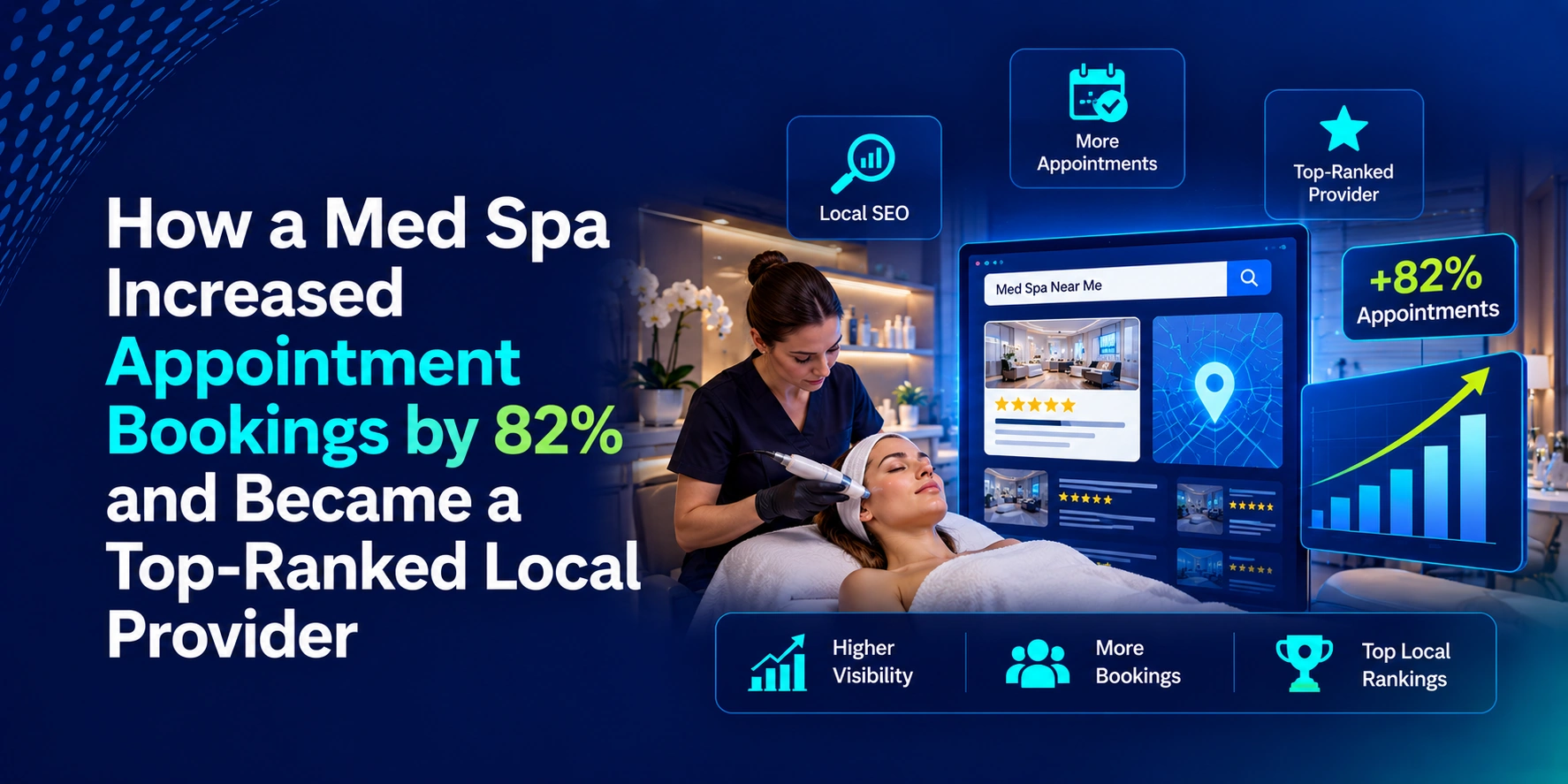
Most med spas chase the next Instagram ad or RealSelf promotion. This one did the opposite. Over five months, Shankom shifted a nine-year-old Miami practice away from paid-social dependence and toward organic search and AI visibility. The team built eight treatment-specific landing pages, rebuilt the before/after gallery as a conversion tool, launched an automated review system, and structured content so AI assistants would actually recommend the spa. By month five, appointment bookings were up 82%. Organic search had become the largest single source of new consultations. Cost per booking dropped from $185 to $72. The spa cut paid ad spend by 40% and let organic search and reviews do the rest of the work of filling the calendar. This Med Spa Miami case study breaks down exactly how.
Key Takeaways
Why do med spas stay dependent on paid social?
Most treat their website as a brochure, not a booking tool. No treatment pages, no structured before/afters, and stagnant reviews mean Google and AI cannot surface them for high-intent queries.
Can organic search outperform paid social for bookings?
Yes, after month 5 to 6 of consistent work. Organic search becomes the largest source of new consultations in established markets, with cost per booking 60 to 70% lower than paid.
What's the biggest local SEO mistake med spas make?
A single services dropdown instead of dedicated treatment pages. Patients want proof of expertise, before/afters, and FAQs, not a generic menu.
How fast does booking growth show up?
First increases in organic consultation requests appear in 4 to 6 weeks. Full compounding, including AI visibility, builds over 4 to 6 months.
The Practice: Strong Treatments, Weak Digital Presence
The spa operated from a single location in Miami, offering Botox, dermal fillers, laser hair removal, CoolSculpting, microneedling, and IV therapy. Nine years in business. Website last redesigned in 2020, built around a services menu, provider bios, and a contact form. Google Business Profile existed but was rarely updated, with 94 total reviews and only 6 posted in the last six months.
Internal data showed paid channels generated most new consultations, but leads were expensive and often low-intent. Organic search contributed roughly 11% of total consultation requests, mostly from branded searches. The business was profitable but vulnerable in one of the most competitive med spa markets in the country. In a market this competitive, stronger visibility for high-intent searches like ‘med spa Miami’ was essential to building a reliable organic acquisition channel.
The Gap: Why the Booking Calendar Stayed Light
Three structural issues kept the spa dependent on paid advertising.
No treatment-specific landing pages. The website had a single services dropdown with brief descriptions, but no dedicated pages for individual treatments. A patient searching "Botox injector Miami" or "CoolSculpting near me" found nothing on the spa's site that spoke directly to that treatment, showed before/afters, or answered common questions.
Stagnant review base and weak GBP signals. The Google Business Profile had 94 reviews, but only 6 in the last six months. Service categories, treatment lists, and before/after photos were incomplete, and there was no systematic review request process tied to appointment completion, a real liability in a city where a dozen other injectors sit within a ten-minute walk.
No treatment-FAQ content or AEO structure. The website targeted generic terms like "med spa Miami" and "aesthetic treatments," but had no pages built for high-intent treatment queries like "how much does Botox cost in Miami," "CoolSculpting vs. liposuction," or "best filler injector for lips near me." Content was not structured for AI extraction, so ChatGPT, Perplexity, and Google AI Overviews never surfaced the spa when users asked "who does microneedling near me."
None of these were new problems. The spa had simply relied on paid social and word of mouth for so long that organic search had atrophied.
The Plan: Four Moves That Fill the Calendar
Shankom's approach started from a simple constraint. The spa did not need to eliminate paid ads overnight. It needed to build an organic channel that could replace at least half of paid lead volume within 9 months, at a fraction of the cost. That shifted the strategy away from "more content everywhere" and toward a focused, treatment-first model designed to intercept patients already searching for specific procedures across Miami, where the spa already had the most experience. For any Miami Med Spa competing in this market, that kind of focus is what separates steady bookings from getting lost in the noise.
The work was organized around four moves that ran in parallel.
Move 1: Treatment page architecture. Instead of trying to rank for broad "med spa Miami" queries, the strategy prioritized 8 core treatments where the spa already had the most volume, strongest before/after portfolio, and highest close rates. Each treatment became its own landing page, with localized content, treatment-specific FAQs, before/after galleries, and clear calls to book a consultation. This avoided spreading effort thin across 20+ low-volume services and instead concentrated authority where it could compound fastest.
Move 2: Before/after content and trust signals. The before/after gallery was rebuilt as a primary conversion tool, not just a portfolio. Each treatment page featured 10 to 15 HIPAA-compliant before/after photos with patient consent, treatment details (units of Botox, mL of filler, number of CoolSculpting cycles), and provider notes. Reviews were embedded directly on treatment pages, with recent Google and RealSelf reviews visible next to the booking button.
Move 3: Treatment-FAQ and AEO content. Content was restructured around the actual questions patients ask before booking: "how much does Botox cost," "how long do fillers last," "CoolSculpting vs. liposuction," "laser hair removal for dark skin." Each page was written with a direct-answer opener, clear treatment steps, pricing context, and FAQ schema, so both Google and AI systems could confidently surface the spa for high-intent searches.
Move 4: Review velocity and local pack optimization. A structured review request system was implemented, triggering SMS requests 2 hours after appointment completion with treatment-specific messaging. Google Business Profile was optimized with full service categories, treatment lists, weekly posts, and Q&A seeding. The goal: move from position 5 to 7 in the local pack to position 1 to 2 for core treatment queries, a much harder climb in Miami's dense provider landscape than in a smaller market.
The 8 treatments with the highest booking volume and lowest organic visibility were prioritized first, so results could be validated quickly before expanding to secondary services.
Execution: Rolling Sprints Over Five Months
Instead of rigid phases, the work ran in overlapping two-week sprints across five months, with each sprint focused on a specific treatment and its associated assets. This allowed the team to launch treatment pages as soon as they were ready, rather than waiting for all eight to be complete.
Sprint 1 and 2 (Weeks 1 to 4): Foundation and First Two Treatments
The first month focused on fixing the foundation and getting the first two treatment pages live. The GBP was audited end to end. All service categories were populated. Treatment lists were added. Attributes like "women-owned," "LGBTQ+ friendly," and "accepts credit cards" were enabled. The review system was set up with automated SMS triggers tied to the spa's booking software. Messages went out 2 hours after injectable appointments and 24 hours after body contouring sessions.
The before/after gallery was rebuilt from scratch. Photos were organized by treatment type, tagged with provider names, and annotated with treatment details (Botox units, filler mL, number of CoolSculpting cycles). HIPAA consent forms were digitized and linked to each photo set. By the end of week 4, the Botox and Dermal Fillers landing pages were live, each with 1,500+ words of content, 12 to 15 before/afters, pricing context, and FAQ schema. NAP corrections were pushed across 22 directories.
Sprint 3 and 4 (Weeks 5 to 10): Next Four Treatments
CoolSculpting, Laser Hair Removal, Microneedling, and IV Therapy pages went live over weeks 5 to 10. Each page followed the same structure: direct-answer opener, treatment steps, pricing context ("CoolSculpting packages from $750," "Laser Hair Removal from $99/session"), before/after gallery, provider credentials, and embedded reviews. Treatment-FAQ pages were created for each service, with 8 to 12 questions pulled from actual consultation logs.
GBP posts were scheduled weekly, with content timed around seasonal demand. Botox and filler content ran in Q4 ahead of the holidays. CoolSculpting content launched in Q1 for New Year resolution seekers. Laser hair removal content went live in Q2 ahead of summer. Q&A seeding was done manually, with 15 common questions added to the GBP and answered with treatment-specific responses.
Sprint 5 and 6 (Weeks 11 to 20): Final Two Treatments and AI Monitoring
The remaining two treatments (Chemical Peels and PRP Facials) launched in weeks 11 to 14, along with a monthly AI monitoring process testing 20 realistic treatment and pricing queries across ChatGPT, Perplexity, Google AI Overviews, and RealSelf AI. Citation rate, source, and accuracy were logged to guide ongoing content adjustments. The review request system was refined based on response rates by treatment type, tightening the send windows and message wording that were converting best rather than changing the underlying cadence set up in the first sprint.
By week 20, all 8 treatment pages were indexed and ranked for long-tail queries, while collectively strengthening the site’s relevance for broader searches such as ‘med spa Miami.’ The AI monitoring showed the spa being cited in 15 of 20 tested queries, up from 1 of 20 at the start. Review velocity held steady at 22 to 28 new reviews per month, keeping the local pack position stable at 1 to 2 for core treatment queries.
The Numbers: What Moved and By How Much
| Metric | Before | After (Month 5) | Change |
| Total monthly consultation bookings | 187 | 340 | +82% |
| Organic bookings per month | 21 | 118 | +462% |
| Blended cost per booking | $185 | $72 | -61% |
| Map Pack position (core treatment queries) | 5 to 7 | 1 to 2 | +4 to 5 positions |
| Total Google reviews | 94 | 217 | +131% |
| New reviews per month (avg.) | 3 to 4 | 22 to 28 | +650% |
| AI citation rate (20 monitored queries) | 1 of 20 | 15 of 20 | +14 queries |
| Before/after gallery views per month | 340 | 1,240 | +265% |
The 8 prioritized treatments saw organic booking increases within four to six weeks, driven by long-tail, treatment-specific queries. Network-wide gains, especially AI referral visibility, compounded over five months as review velocity increased and treatment content accumulated citation history.
The Shift: From Paid-Social-First to Organic-First
Before this engagement, the spa was functionally invisible to search engines and AI systems beyond its paid ads and a generic services menu. Afterward, 7 of 8 priority treatments had independently ranking pages with their own local signals, and the spa's AI query citation rate rose from 1 of 20 to 15 of 20 monitored queries.
The core shift was moving from a paid-social-first model to a treatment-intent organic model. Once Google and AI engines could clearly tie specific treatments, specific providers, and specific before/after portfolios to specific queries, the spa began surfacing for the granular, high-intent searches that drive consultation bookings. Lead quality improved as well. Organic bookings showed at 28% compared to 8 to 14% for paid leads, delivering a 2 to 3x advantage in overall show rate.
Internally, the spa also changed how it tracks and responds to bookings. Every consultation is now tagged by source, by treatment interest, and by provider, allowing the owner to see exactly which channels and which treatments are driving the most valuable bookings. Ad spend was reduced by 40% in months 4 to 5 as organic volume replaced paid volume, lowering the blended cost per booking without sacrificing total consultation volume. Paid social still runs, just at a fraction of its old share, with organic search and reviews carrying most of the load.
Why It Worked: The Psychology Behind the Booking Decision
Med spa bookings are high-consideration purchases. Even a $300 Botox appointment involves trust, risk assessment, and social proof. Someone searching ‘med spa Miami’ is likely to compare several providers before choosing one, which makes trust signals just as important as search visibility. They search, they compare, they read reviews, they scrutinize before/afters, and they look for signals that the injector knows what they are doing. The old website gave them none of that. It was a services menu and a contact form. The new treatment pages gave them everything: real before/afters with treatment details, answers to their exact questions, reviews from patients who had the same treatment, and clear pricing context.
The review velocity piece tapped into a simple truth about local services, one that matters even more in a market as crowded as Miami's. Momentum matters more than total count. A med spa with 200 reviews and 20 new ones this month feels active and in demand. A med spa with 100 reviews and none in six months feels like it might be struggling, even if the quality is better. The automated SMS review requests, timed by treatment type, created a steady stream of fresh social proof that kept the spa moving up in the local pack and kept patients confident enough to book.
The booking tracking and attribution changed the business itself, not just the marketing. For the first time, the owner could see which treatments were actually booking, which queries were driving high-intent consultations, and which channels produced the highest show rates. That visibility let her cut ad spend in low-value treatments and double down on the services and providers that mattered most. The organic growth did not replace paid ads by accident. It replaced a large share of them because the data made it obvious where to shift focus.
In short, the spa stopped trying to look like a brand and started showing up like the trusted, experienced, treatment-specific provider it already was. That shift, from aspiration to authenticity, is what turned searches into bookings.
How Shankom Can Help
Shankom provides local SEO, reputation management, and AEO services for practices competing for high-intent searches like ‘med spa Miami,’ as well as treatment-specific queries across Miami and beyond, facing exactly this problem: strong treatment volume but heavy dependence on paid social, RealSelf, and referrals. From a full entity and NAP audit across every directory, to treatment page development, before/after gallery optimization, automated review generation, treatment-FAQ content, local pack optimization, and ongoing AI visibility monitoring across ChatGPT, Perplexity, Google AI Overviews, and RealSelf AI, Shankom builds the complete program that turns every treatment in a service menu into an independently discoverable, independently booking source of qualified consultations.
The same principle applies to any Miami Med Spa practice already trusted by patients for one or two treatments: give each service its own page, its own proof, and its own path to a booking. Whether you are expanding your treatment menu faster than your digital presence can keep up, or watching patients near your own service area get routed to AI-recommended competitors instead, Shankom provides the strategy and execution that makes every treatment and every provider in your spa work as hard as your best-performing channel.
People Also Ask
Q: Two med spas offer the same treatments nearby, why does only one show up in the map results?
A: Google scores each spa treatment by treatment, weighing how complete the Business Profile is, how fresh the reviews are, how consistent the name-address-phone details are across directories, and whether a page actually covers that specific procedure. A spa with recent before/afters and steady reviews for Botox will outrank a neighbor whose site only lists it in a dropdown.
Q: Do I still need AEO if my med spa already ranks well in Google search?
A: Yes. Ranking a page and being named by an AI assistant are different jobs. Patients increasingly ask ChatGPT, Perplexity, or Google AI Overviews who does a treatment nearby, and those tools only cite spas whose content answers the question directly and is backed by treatment FAQs, before/afters, and schema. Strong traditional rankings do not guarantee that AI systems can extract and recommend you.
Q: How soon should a med spa expect more consultations from this kind of work?
A: The earliest lift in organic consultation requests usually shows up within four to six weeks, once the first treatment pages are indexed. The larger, compounding gains, including bookings sourced through AI tools, tend to build over the following four to six months as reviews accumulate and content earns citation history.
Q: What most often holds a med spa back when it adds new treatments?
A: Bolting a new procedure onto the main services page instead of giving it a page of its own. Without its own before/afters, FAQs, and consistent listing details, a new treatment inherits none of the ranking signals it needs, so it stays invisible for the exact searches patients use when they are ready to book it.
Recent Case Studies

How an Austin Residential Real Estate Agency Generated 3X More Local Leads Through Search Visibility
Know More
How a Chicago B2B Professional Services Firm Turned SEO into a Lead-Generation Engine
Know More