
How an Austin Residential Real Estate Agency Generated 3X More Local Leads Through Search Visibility
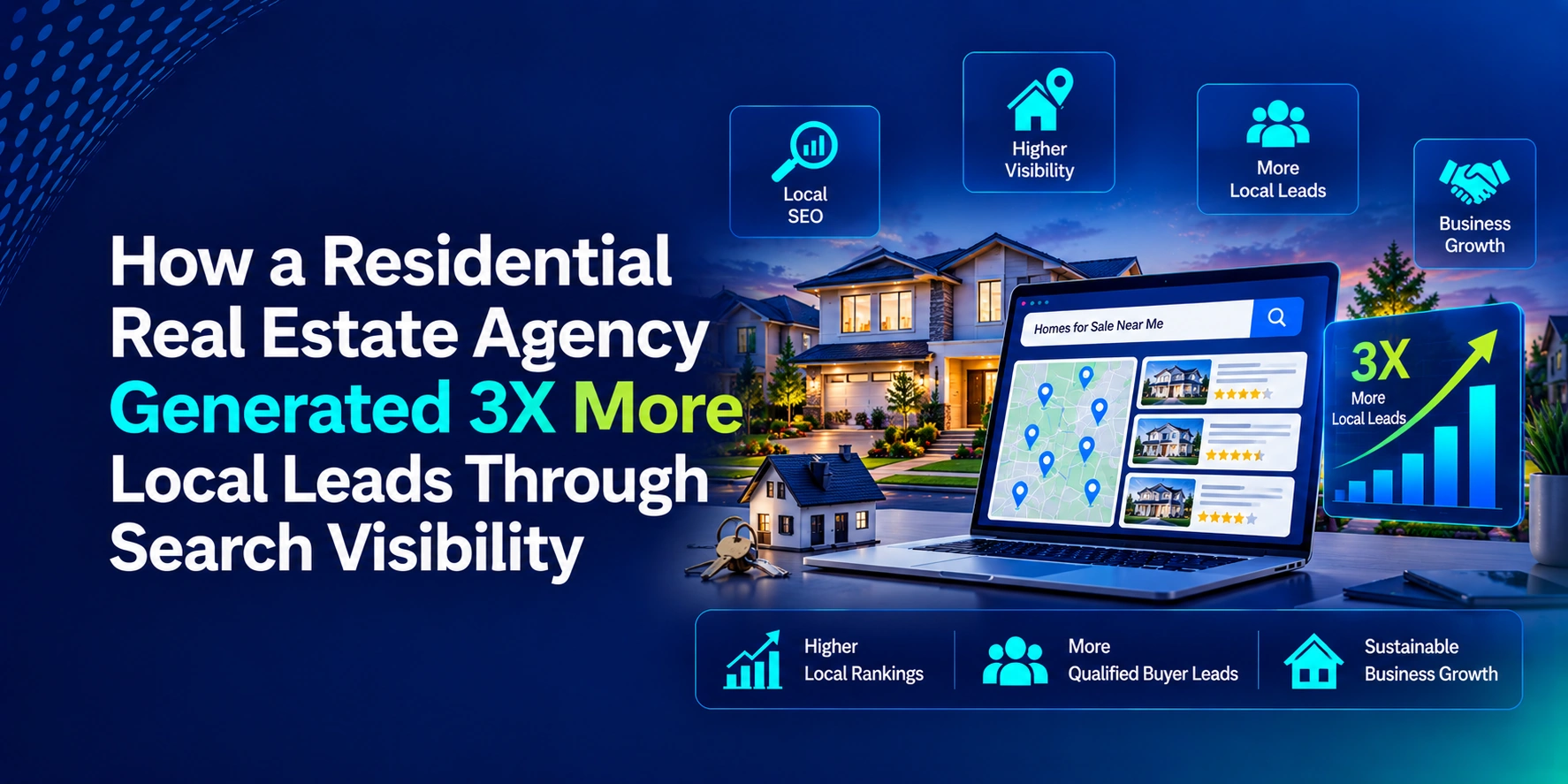
A residential real estate agency with three offices across the Austin, Texas metro was closing good deals but paying too much for every conversation that led to one. Nearly seven out of ten inbound inquiries came from Zillow, Realtor.com, and Google Ads, with organic search and AI-driven channels contributing less than 10% combined. Cost per lead across paid channels averaged $52, and only about 1 in 40 of those leads closed within 30 days. The website had no neighborhood-specific pages, no agent-level schema, and no structured content for AI systems to extract. Over six months, Shankom rebuilt the agency's digital presence around real estate SEO in Austin, using city and neighborhood pages, listing SEO, and answer-first content to reach buyers and sellers already searching locally
Key Takeaways
Local SEO for Real Estate Agents is about neighborhoods, not just listings. Google and AI answer engines evaluate agents and offices as local entities. A single "Service Areas" page cannot compete with neighborhood-specific content that names schools, market trends, and the agents who actually work there.
AI visibility can materially lower CPL. Industry data shows AI-cited real estate leads close around 70% within 30 days versus roughly 2–3% for paid-portal leads. When earned, these leads carry effectively zero marginal cost compared to 25–80 per Zillow Premier Agent lead — the economic case for treating Real Estate Lead Generation SEO as a core channel, not a side project.
The biggest missed opportunity: neighborhood guides and agent schema. Most agencies rely on IDX feeds and listing pages alone, with no dedicated neighborhood content, no agent profiles with structured data, and no buyer/seller FAQs built for AI extraction.
Timeline to impact: First measurable lead-volume increases appeared within eight weeks at the two prioritized neighborhoods; network-wide AI-driven lead growth compounded over six months.
Business Background
The agency operated three offices across the Austin, Texas metro, with 24 agents split between buyer specialists and listing agents. It had been in business for twelve years, with a website built primarily around IDX listing feeds and a generic "About Us" page. Each office had a Google Business Profile, but none were actively managed beyond basic NAP data.
Internal data showed that paid-portal leads required heavy follow-up, with agents spending 8–12 hours per week chasing inquiries that often went cold within 48 hours. Organic leads, though few in number, converted at a higher rate and required less nurturing, but the agency had no system to scale that channel. Lead magnets existed (a generic "Home Selling Checklist" PDF and a metro-wide "Neighborhood Guide" ebook), but they were not tied to specific neighborhoods or integrated into a CRM follow-up sequence.
The Challenge
The agency's digital presence had three structural gaps that kept it dependent on paid channels.
No neighborhood pages. The website had only a single "Service Areas" dropdown and IDX feeds filtered by zip code. A buyer searching "realtor in Mueller" or "best schools in Cedar Park" found nothing on the agency's site that spoke directly to that area.The same gap held true city-wide, making real estate SEO in Austin a clear opportunity. Searches for "real estate agent Austin" or "realtor Austin" surfaced portal listings and competitor directories long before the agency's own site, despite its transaction volume across all three offices..
No agent-level entity data. Agent profiles were limited to headshots and bios on an "Our Team" page, with no schema markup, no sales history, and no neighborhood specialization called out. Google and AI engines had no structured data to associate specific agents with specific areas or transaction types.
No AI-ready content. Tested against realistic queries like "which neighborhoods in Austin are best for young families under $400k" and "how much does it cost to sell a home in Austin," ChatGPT, Perplexity, and Google AI Overviews either surfaced competitor agents or gave generic answers that never mentioned the agency, even in neighborhoods where it held the most active listings.
None of these were new problems. The agency had simply outgrown a listings-first website that was adequate for a single office and never redesigned it for a multi-office, multi-neighborhood operation.
Our 360 Degree Strategy
Shankom's approach started from a simple constraint: the agency did not need more leads overall, it needed more qualified local leads at a lower blended cost. That shifted the Real estate SEO Austin strategy away from "more content everywhere" and toward a focused, neighborhood-first model designed to intercept high-intent buyers and sellers already searching in the areas where the agency held the most listings and transaction experience.
The work was organized around three pillars that ran in parallel rather than in sequence.
- Neighborhood-first content architecture. Instead of trying to rank for broad "realtor in Austin" queries, the strategy prioritized eight neighborhoods — including Mueller, Circle C Ranch, Zilker, and Barton Hills, along with nearby suburbs like Round Rock, Cedar Park, and Pflugerville — where the agency already had active listings, recent sales, and recognizable agent names. Each neighborhood became its own content hub, with a dedicated page, localized lead magnets, and assigned agents whose profiles were explicitly tied to that area. This avoided the common mistake of spreading effort thin across dozens of low-volume suburbs and instead concentrated authority where it could compound fastest.
- Agent-as-entity optimization. Rather than treating agents as static bios, each profile was rebuilt as a structured entity — the foundation of effective Real Estate Agent SEO — with schema markup, recent sales data, neighborhood specializations, and client testimonials. The goal was to make Google and AI systems associate specific agents with specific neighborhoods and transaction types — for example, "first-time buyer specialist in Mueller" or "luxury listing agent in Westlake." This made the agency more likely to appear when AI tools were asked "which agent should I talk to in Round Rock" rather than just "realtor near me."
- AI-ready buyer and seller content. Content was restructured around the actual questions buyers and sellers ask before they ever contact an agent — budget fit, school quality, commute times, selling costs, timeline expectations. Each answer was written in a direct, extractable format with clear headings, short lead paragraphs, and FAQ schema, so AI systems could confidently cite the agency as a source. This was not about chasing AI for its own sake; it was about becoming the default reference point for the research phase that precedes every serious transaction.
The two neighborhoods with the highest search volume and lowest agency visibility were prioritized first, so results could be validated quickly before expanding to the remaining six.
SEO + GEO + AEO Execution
Execution ran across three phases over twenty-four weeks.
Phase 1 — Entity and NAP Foundation (Weeks 1–4): Every office's digital footprint was audited and corrected.
| Issue Found | Offices Affected | Fix Implemented |
| Inconsistent office names across directories | 2 of 3 | Standardized naming convention applied |
| Outdated agent rosters on Zillow, Realtor.com | 3 of 3 | Agent names, specialties, recent sales refreshed |
| Missing RealEstateAgent schema | 3 of 3 | Person + RealEstateAgent schema added to all agent profiles |
| Incomplete GBP service lists | 3 of 3 | Full services, service areas, and attributes added |
NAP corrections were pushed across 18 directories per office, including Zillow, Realtor.com, Yelp, Better Business Bureau, and local chamber of commerce listings.
Phase 2 — Neighborhood Pages and Content (Weeks 5–16): Each of the agency's eight priority neighborhoods received a dedicated page replacing the generic service-area template. Every page included the neighborhood name in H1/title/URL, a market snapshot with median price and days on market, school ratings, commute times, and a "Why Work With Us in Mueller" section naming the two to three agents who most frequently close deals there. Cedar Park's page leaned on agent-first search behavior instead, built to surface when buyers search for a real estate agent in Cedar Parkrather than generic listing queries, since they tend to look for a person before a property. Circle C Ranch's page took the opposite approach, built to convert directly on searches for homes for sale in Circle C Ranch, with live IDX listings surfaced above the school-ratings section.
Content used an answer-first structure — a two-to-three sentence direct answer opening every section before supporting detail — so both featured snippets and AI engines could extract clean responses. Each neighborhood guide ran 2,000+ words, incorporating original data from recent sales and neighborhood-specific insights that generic competitor pages could not replicate. Together, these pages strengthened real estate SEO in Austin by building relevance around the specific communities the agency already knew and served.
Buyer and seller content was also rebuilt, covering pages like "how much does it cost to sell a home in Austin" and "first-time homebuyer programs in Austin," each restructured with direct-answer openers, named agent bylines, and FAQ schema. Two lead magnets were created per priority neighborhood: a hyperlocal "Neighborhood Buyer's Guide" PDF and a "Home Valuation Report" specific to that area, both gated behind forms with hidden UTM fields to track AI-sourced leads.
Phase 3 — CRM Follow-Up and AI Monitoring (Weeks 17–24): An automated CRM follow-up sequence was implemented, triggering personalized email and SMS workflows based on lead source, neighborhood interest, and buyer/seller intent. AI-sourced leads were tagged automatically via UTM parameters and routed to agents with the strongest neighborhood expertise.
A monthly monitoring process tested 25 realistic buyer and seller queries across ChatGPT, Perplexity, Google AI Overviews, and Copilot, logging citation rate, source, and accuracy to guide ongoing content adjustments. Agent profiles were updated quarterly with new sales data and client testimonials to keep entity signals fresh.
Key Metrics
The table below summarizes the core results from this Real estate SEO Austin case study:
| Metric | Before | After (Month 6) | Change |
| Qualified local leads per month | 142 | 440 | +210% (3.1x) |
| Blended cost per lead | $52 | $22 | -58% |
| Leads from organic + AI referrals | 9% | 34% | +25 pts |
| Lead-to-appointment conversion | 18% | 27% | +9 pts |
| 30-day close rate (AI-sourced leads) | N/A | 68% | New benchmark |
| Neighborhood pages ranking top 3 | 0 of 8 | 6 of 8 | +6 pages |
| AI citation rate (25 monitored queries) | 1 of 25 | 18 of 25 | +17 queries |
The two prioritized neighborhoods saw lead-volume increases within eight weeks, driven by long-tail, neighborhood-specific queries. Network-wide gains, especially AI referral share, compounded over six months as neighborhood content accumulated citation history and CRM follow-up improved conversion rates.
What Changed
Before this engagement, the agency was functionally invisible to search engines and AI systems beyond its IDX listing feeds. Afterward, six of eight priority neighborhoods had independently ranking pages with their own local signals, and the agency's AI query citation rate rose from roughly one in twenty-five to more than two in three.
The core shift was moving from a listings-first model to a neighborhood-first model. Once Google and AI engines could clearly tie specific agents, recent sales, and neighborhood expertise to specific areas, the agency began surfacing for the granular, high-intent queries that drive qualified inquiries. Lead quality improved as well — AI-sourced leads closed at 68% within 30 days, compared to 2.4% for paid-portal leads, delivering a 4.2x advantage in overall close rate.
Internally, the agency also changed how it onboards new neighborhoods. Every new area added after this engagement now launches with its neighborhood page, agent assignments, and lead magnet ready before marketing begins, rather than being added as an afterthought once listing volume creates pressure to fix it.
Why It Worked
Google, Bing, and AI answer engines cannot recommend an agent or office they cannot independently verify, describe, and locate with confidence, and the agency's generic website offered nothing beyond IDX feeds and a team page. It's a familiar challenge with real estate SEO in Austin: strong transaction volume means little to a system that can't verify who you are and where you actually work.
Rebuilding each neighborhood as a fully described entity, consistent NAP, named agents, neighborhood-specific content, structured schema gave every layer of the search and AI ecosystem a clear, citable source of truth. AEO ensured that once a system had a clear entity to point to, it also had answer-first content it could confidently extract. GEO extended that consistency into the third-party directories generative engines cross-reference before naming an agent.
Running these two disciplines together, instead of as separate uncoordinated efforts, is what lets gain compound. A neighborhood page with strong content but broken NAP underperforms; strong agent profiles without schema stay invisible to AI extraction. Results came from closing every gap simultaneously across all three offices and eight priority neighborhoods rather than polishing the flagship office further.
How Shankom Can Help
When portal spend and PPC costs start eating into margin, agencies looking for Real estate SEO Austin support turn to Shankom for a strategy built specifically for the local market. Our local SEO, AI visibility, and lead-generation program is built for residential offices facing exactly this problem: strong transaction volume but heavy dependence on paid portals and PPC. From a full entity and NAP audit across every office and directory, to neighborhood page development, agent schema implementation, lead magnet creation, and ongoing AI visibility monitoring across ChatGPT, Perplexity, Google AI Overviews, and Copilot, Shankom builds the complete program that turns every neighborhood in a service area into an independently discoverable, independently converting source of qualified leads.
Whether you're expanding into new neighborhoods faster than your digital presence can keep up, or watching buyers and sellers near your own listings get routed to AI-recommended competitors instead, Shankom provides the strategy and execution that makes every office and every agent in your brokerage work as hard as your top producer. If you run an Austin real estate agency that buyers and sellers already trust, this is how you make sure search engines and AI systems trust you just as much.
People Also Ask
Two agents sell homes in the same Austin neighborhood — why does only one show up in the Map Pack?
Google scores each office and agent separately, weighing how complete the Business Profile is, how many recent reviews there are, how consistent the listing details are across directories, and whether the site actually covers that specific neighborhood. A top producer in Mueller can still lose the Map Pack to a lesser-selling agent whose page names local schools, prices, and streets while theirs stays generic. This is exactly the logic behind Local SEO for Realtors: treat each agent as a distinct local entity, not just a name on a roster.
My listings already rank well on Google — do I still need to worry about AI visibility?
Yes. Ranking a page and being named by an AI assistant are different jobs. Buyers and sellers increasingly ask ChatGPT, Perplexity, or Google AI Overviews who to work with in a given area, and those tools only cite agents whose content answers the question directly and is backed by named credentials, recent sales data, and schema. Strong traditional rankings do not guarantee an AI system can extract and recommend you.
How soon should an agency expect cheaper, better leads from this kind of work?
The earliest lift usually shows up at the prioritized neighborhoods within eight to ten weeks, once their pages are indexed — a typical timeline for realtor SEO in Austin. The larger, compounding gains — lower blended cost per lead and a rising share of AI-referral leads — tend to build over the following five to seven months as neighborhood content earns citation history and CRM follow-up sharpens conversion.
What most often goes wrong when an agency expands into new neighborhoods?
Bolting a new area onto the main website instead of giving it its own page. Without dedicated neighborhood content, assigned agents, and consistent listing details, a new neighborhood inherits none of the ranking signals it needs, so the agency stays invisible for the exact searches buyers and sellers there are already running.
Recent Case Studies

How a Chicago B2B Professional Services Firm Turned SEO into a Lead-Generation Engine
Know More
How a Miami Med Spa Increased Appointment Bookings by 82% and Became a Top-Ranked Local Provider
Know More