From Invisible to Fully Booked: A Multi-Location Healthcare SEO Success Story in Atlanta
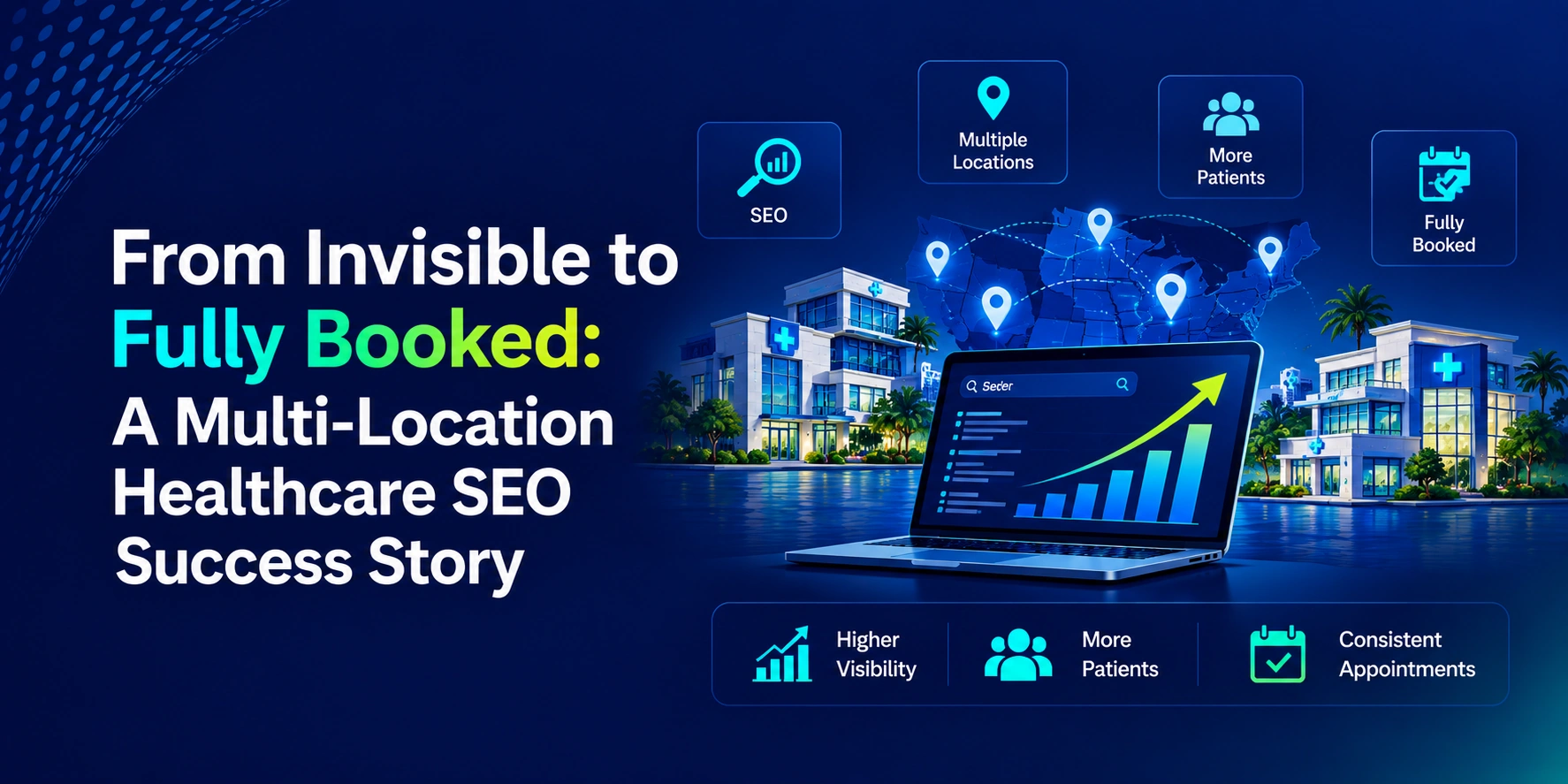
Patients no longer search the way they did two years ago. They ask Google AI Overviews which urgent care is open now, ask ChatGPT which pediatrician near them takes their insurance, and still check the Map Pack before calling anyone. A multi-location medical practice with seven family medicine and urgent care clinics across the Atlanta metro area was capturing almost none of this traffic outside its original flagship location. The website and location structure gave Google, Google Business Profile, and AI answer engines no reason to associate six of the seven clinics in suburbs like Alpharetta, Marietta, Decatur, Sandy Springs, and Johns Creek with local, credible, bookable care. Fixing this required a combined multi-location healthcare SEO strategy spanning local SEO, AEO, and GEO, executed over five months, rebuilt around each clinic as its own entity rather than the practice as a single brand. The result was a 162% increase in online-booked appointments and Map Pack presence in five new Atlanta-area service zones within four months.
Key Takeaways
- Why do multi-location practices struggle with local SEO even when the flagship ranks well? Google, Bing, and AI answer engines treat each clinic as a distinct local entity. A shared "Locations" dropdown gives no individual clinic the location-specific content or citation consistency needed to rank for "urgent care near me" searches tied to that clinic's actual Atlanta neighborhood.
- Can AEO and GEO meaningfully increase appointments? Yes, when content is structured and entity data is consistent. Appointments from AI Overview clicks and answer-engine referrals grew from near-zero to 9.4% of all new online bookings within five months.
- What's the biggest local SEO mistake multi-location healthcare groups make? Building one generic "Find a Location" page instead of a full page per clinic with its own NAP data, provider bios, and FAQs. Google and AI engines cannot recommend a location they cannot independently verify.
- How fast does growth show up? The first measurable booking increase appeared within six weeks at the two clinics prioritized first; network-wide AI-driven growth compounded over five months.
In early 2026, a seven-clinic family medicine and urgent care practice serving the Atlanta metro came to Shankom with a familiar problem in unfamiliar clothing. Its flagship clinic in Buckhead, open over a decade, ranked well and generated steady appointments. The six clinics opened over the following eight years across Alpharetta, Marietta, Decatur, Sandy Springs, Johns Creek, and Roswell were functionally invisible in local search, with call volume plateaued and two locations losing new-patient share to competitors that had opened more recently and were already outranking them across metro Atlanta.
Business Background
Our client's practice grew mainly through acquisition and organic expansion across the Atlanta suburbs rather than deliberate digital strategy. Each new clinic was added to the corporate website as a pin on a map, with no dedicated content, no independent Google Business Profile strategy, and no location-specific service pages.
The flagship, with fifteen years of accumulated reviews and search history, absorbed nearly all organic visibility. Internal data showed 68% of online appointment requests were tied to that one clinic, despite it representing only 14% of total patient capacity. The other six clinics relied on walk-ins, insurance directory referrals, and word of mouth rather than search, and their digital patient acquisition cost ran nearly three times higher than the flagship's.
Main Challenge
Three compounding issues explained the gap. First, service pages described "Family Medicine," "Urgent Care," and "Pediatrics" for the practice as a whole, with no location-specific versions, so a parent searching "pediatrician near Alpharetta" found nothing naming that suburb, those providers, or that clinic's hours.
Second, NAP (name, address, phone) data was inconsistent across directories. Four of seven clinics had duplicate or outdated Google Business Profile listings, two routed calls to a centralized call center instead of the clinic's real line, and Healthgrades, Zocdoc, and Vitals showed provider rosters over a year stale, actively suppressing Map Pack confidence in a metro area where patients have no shortage of other options to choose from instead.
Third, the practice had no structured content for AI answer engines. Tested against realistic queries like "which urgent care near Marietta, Georgia is open weekends," ChatGPT, Perplexity, and Google AI Overviews either surfaced competitors or gave generic answers that never mentioned the practice, even for clinics directly in the queried area.
Our 360-Degree Strategic Approach
Shankom treated each of the seven Atlanta-area clinics as an independent local entity requiring its own optimization plan, coordinated under a single brand governance structure to keep provider credentials and NAP data consistent. The approach layered three disciplines together: local SEO to rebuild foundational visibility, AEO to make clinic-specific content extractable by AI systems, and GEO to strengthen the entity and third-party citation signals generative engines cross-reference before recommending a provider.
Local SEO for multi-location medical practices comes down to one guiding principle: a patient searching near a specific clinic in Decatur or Johns Creek should find a page built for that clinic, its providers, its hours, and its neighborhood's actual questions, not diluted practice-wide content. The two clinics with the largest visibility gap, in Decatur and Johns Creek, were prioritized first to validate results quickly.
SEO + GEO + AEO Execution Across the Atlanta Network
Execution ran across three phases over twenty weeks.
Phase 1: Entity and NAP Foundation (Weeks 1 to 4). Every clinic's digital footprint was audited and corrected.
| Issue Found | Locations Affected | Fix Implemented |
| Duplicate GBP listings | 4 of 7 | Merged or removed via Google support |
| Call-center number on GBP/directories | 3 of 7 | Direct clinic line restored |
| Stale provider rosters (Healthgrades, Zocdoc, Vitals) | 6 of 7 | Names, specialties, credentials refreshed |
| Inconsistent clinic naming | 5 of 7 | Standardized naming convention applied |
| Incomplete GBP service/attribute lists | 7 of 7 | Full services, insurance, accessibility added |
NAP corrections were pushed across 22 directories per clinic, plus payer directories for the three largest regional health plans accepted in Georgia.
Phase 2: Location-Specific Content and Schema (Weeks 5 to 13). Each clinic received a fully independent page replacing the shared template, including the suburb name in H1/title/URL (for example, "Urgent Care in Alpharetta, GA"), a named provider roster with credentials, a clinic-specific service list, real current hours, and an FAQ section built from actual front-desk call logs. MedicalClinic, LocalBusiness, Physician, and FAQPage schema were deployed, with each provider tagged individually including specialty and accepted insurance.
Content used an answer-first structure, with a two-to-three sentence direct answer opening every section before supporting detail, so both featured snippets and AI engines could extract clean responses. Symptom and condition pages (such as "urgent care vs. ER" and "strep throat symptoms in kids") were rebuilt the same way, with physician bylines and FAQ schema.
Phase 3: Review Velocity and AI Monitoring (Weeks 14 to 20). The flagship had 340 reviews; three newer clinics had fewer than 20 each. An automated SMS review request, triggered 90 minutes post-checkout, was deployed network-wide. Local citation work targeted the metro Atlanta health system directory, two Atlanta-area parenting blogs, youth sports sponsorships in Alpharetta and Marietta, and the Medical Association of Georgia directory.
A monthly monitoring process tested 30 realistic patient queries across ChatGPT, Perplexity, Google AI Overviews, and Copilot, logging citation rate, source, and accuracy to guide ongoing adjustments.
Key Metrics
| Metric | Before | After (Month 5) | Change |
| Online-booked appointments/month | 410 | 1,074 | +162% |
| Clinics in Map Pack top 3 | 1 of 7 | 6 of 7 | +5 clinics |
| Total Google reviews (network) | 512 | 891 | +74% |
| Average GBP rating | 4.2 | 4.7 | +0.5 |
| New bookings from AI referrals | ~0% | 9.4% | New channel |
| Organic sessions to location pages | 3,100/mo | 11,600/mo | +274% |
| AI citation rate (30 monitored queries) | 2 of 30 | 21 of 30 | +19 queries |
The two prioritized clinics in Decatur and Johns Creek saw booking growth within six weeks, driven by long-tail, neighborhood-specific queries and demonstrating how to rank multiple medical locations independently rather than under a single brand. Network-wide gains, especially AI referral share, compounded over five months as review velocity rose and AI monitoring showed climbing citation frequency across the Atlanta network.
What Changed
Before this engagement, every clinic besides the Buckhead flagship was anonymous to search engines and AI systems alike. Afterward, six of seven had an independently ranking page with its own local signals, and the practice's AI query citation rate rose from roughly one in fifteen to more than two in three.
The core shift was moving from a single-brand content model to a per-clinic entity model. Once Google and AI engines could clearly tie a specific provider, hours, and services to a specific Atlanta neighborhood, each clinic began surfacing for the granular, high-intent queries that drive bookings. Review velocity also became compounding rather than static: the three clinics under 20 reviews each crossed 60 within five months, and the network-wide rating jump from 4.2 to 4.7 correlated directly with Map Pack gains at four of five newly ranking clinics.
Why It Worked
Effective healthcare local SEO starts from a simple constraint: Google, Bing, and AI answer engines cannot recommend a clinic they cannot independently verify, describe, and locate with confidence, and six of seven Atlanta clinics offered nothing beyond an address on a map. Rebuilding each clinic as a fully described entity, with consistent NAP, named providers, clinic-specific content, and structured schema, gave every layer of the search and AI ecosystem a clear, citable source of truth, which is what wins Map Pack ranking for a medical practice across a network rather than at a single flagship. AEO ensured that once a system had a clear entity to point to, it also had answer-first content it could confidently extract. GEO extended that consistency into the third-party directories generative engines cross-reference before naming a provider.
Running these three disciplines together, instead of as separate uncoordinated efforts, is what lets gains compound. A page with strong content but broken NAP underperforms. Strong reviews without schema stay invisible to AI extraction. Results came from closing every gap simultaneously across all seven Atlanta-area locations rather than polishing the flagship further.
How Shankom Can Help
Shankom provides local SEO, AEO, and GEO services for multi-location medical practices in Atlanta and beyond facing exactly this problem: strong reputation at one flagship, near-total invisibility everywhere else. From a full entity and NAP audit across every clinic and directory, to location-specific page development, provider schema, automated review generation, and ongoing AI visibility monitoring across ChatGPT, Perplexity, Google AI Overviews, and Copilot, Shankom builds the complete program that turns every clinic in an Atlanta-area network into an independently discoverable, independently bookable source of new patients.
Whether you're opening locations across metro Atlanta faster than your digital presence can keep up, or watching patients near your own clinics get routed to AI-recommended competitors instead, Shankom provides the strategy and execution that makes every location in your network work as hard as your best one.
People Also Ask
Q: Why do only some locations in a multi-location practice rank in the Map Pack?
A: Ranking is evaluated per location based on that clinic's GBP completeness, review count and recency, NAP consistency, and content relevance to its actual address. A strong flagship with generic shared content for other clinics means only the flagship ranks.
Q: How does AEO differ from traditional SEO for healthcare?
A: Traditional SEO ranks pages in search results. AEO structures content so AI systems can extract a standalone answer and cite the practice, requiring answer-first structure, real-question FAQs, named credentials, and explicit schema.
Q: How long until appointment growth shows up?
A: Initial gains at prioritized clinics can appear in six to eight weeks; network-wide compounding growth, including AI referral bookings, typically builds over four to six months.
Q: What's the biggest local SEO risk for a growing practice?
A: Treating new locations as extensions of the main website instead of independent local entities. Shared templated content and inconsistent NAP data suppress a new clinic's ranking regardless of the parent brand's reputation.
Recent Case Studies
How an Austin Residential Real Estate Agency Generated 3X More Local Leads Through Search Visibility
Know More
How a Chicago B2B Professional Services Firm Turned SEO into a Lead-Generation Engine
Know More