What to Expect from a Content Marketing Service in Philadelphia (2026 Buyer’s Guide)
A strong content marketing partner in Philadelphia delivers strategy, content, SEO, distribution, and reporting, not just a stack of blog posts. In 2026, most retainers fall between $3,000 and $15,000 a month, with the price reflecting how much strategy and distribution are bundled in. Before signing, vet any agency against a clear checklist: proven results, transparent pricing, relevant case studies, and defined deliverables. Ask to see case studies tied to revenue, not vanity metrics. The right partner matches your investment to a content strategy built for your goals, from brand awareness to B2B lead generation.
Key Takeaways
- What does a content marketing service include? Strategy, content creation, SEO, distribution, and reporting, ideally bundled rather than sold as writing alone.
- How much do content marketing services cost in 2026? Most Philadelphia retainers run $3,000 to $15,000 per month, depending on scope and strategy depth.
- How do I vet a content marketing agency? Check proven results, transparent pricing, relevant case studies, clear deliverables, and a defined reporting cadence.
- Why choose a local Philadelphia partner? A local agency understands the regional market, local audience, and competitive landscape more deeply than a distant vendor.
- What separates a cheap vendor from a real partner? Strategy and distribution. Low-cost vendors produce content; real partners produce results tied to business goals.
Hiring a content marketing partner should feel like a straightforward decision. In practice, it rarely does. You call three agencies, get three wildly different quotes, and hear the same promises from each. One says $3,000 a month, another says $12,000, and both claim they will grow your traffic and generate leads. Without a clear picture of what you are actually buying, it is nearly impossible to tell which quote is a fair deal and which is a costly mistake.
It helps to start with the market itself. Philadelphia’s economy runs on what locals call “eds and meds”: healthcare and social assistance alone now account for roughly a third of city employment, anchored by Penn Medicine, Jefferson Health, Temple Health, and CHOP. In 2025, the metro posted the strongest job growth among the nation’s largest metropolitan areas, and the region cracked the top 15 global startup ecosystems, driven by a fast-growing life sciences and biotech base around University City. That mix, dominant healthcare and higher-education institutions alongside a rising startup and professional-services sector, shapes what content marketing has to accomplish here: a Philadelphia buyer’s guide is really a guide to reaching a market where regulated, relationship-driven industries sit next to venture-backed challengers.
Source: Center City District / Philadelphia Employment Report 2025; Philadelphia Inquirer, Feb 2026
This guide is built to help you navigate that. If you are evaluating a content marketing partner in Philadelphia, the following pages set clear expectations for deliverables, break down real 2026 pricing ranges, and give you a vetting checklist to separate genuine partners from expensive vendors. By the end, you will know what questions to ask and what a fair investment looks like.
What a Content Marketing Service Actually Delivers
The biggest source of confusion when buying content marketing services in Philadelphia is that different agencies use the same labels for very different work. A “content retainer” at one shop means four blog posts written offshore with no strategy. At another, it means research, production, optimization, distribution, and analysis. Knowing the difference protects you from overpaying for underdelivery.
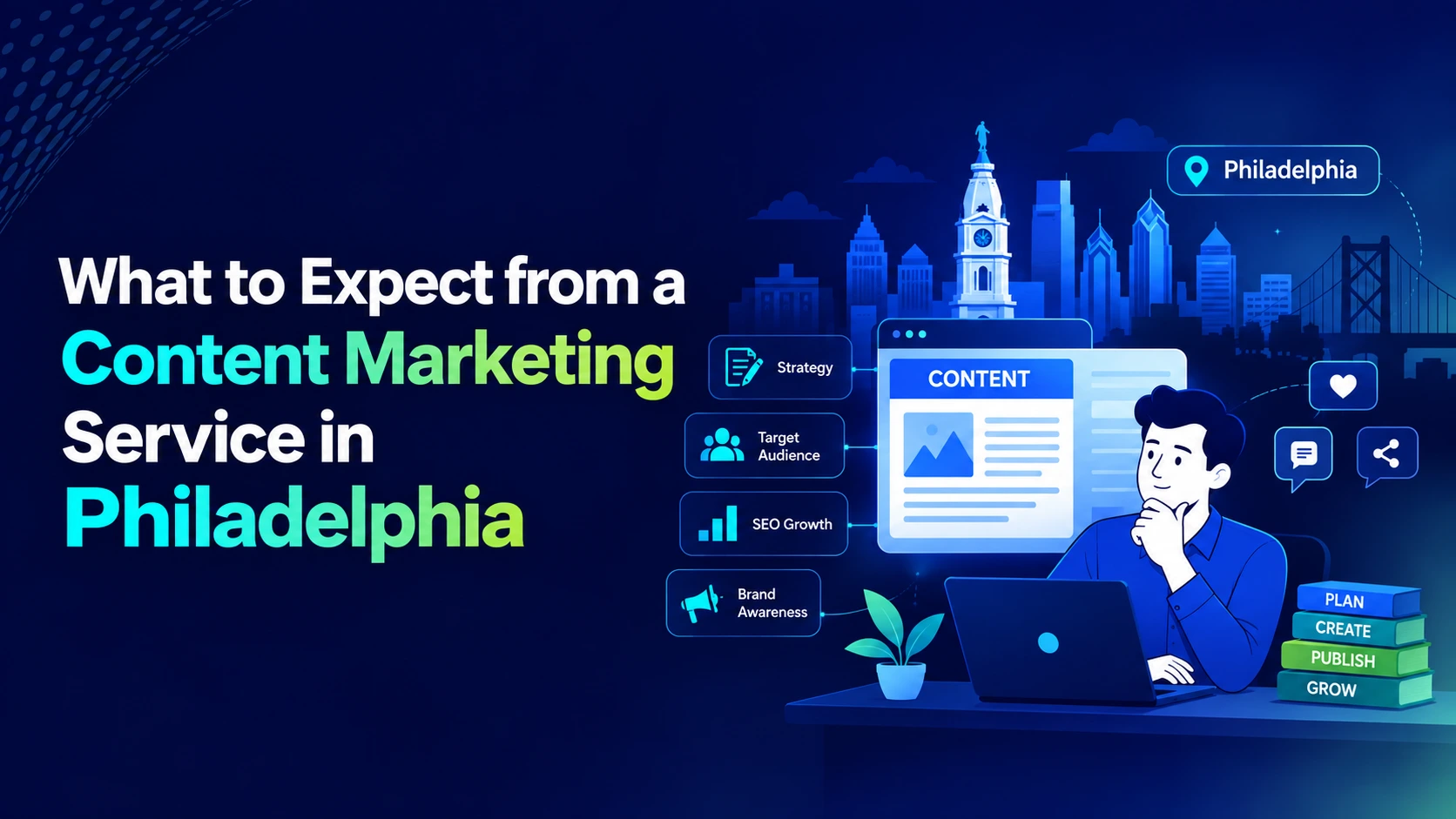
A complete content marketing service should include five deliverables. Understanding what each really involves is the difference between judging a proposal by its price and judging it by its value.
- Strategy and planning. This is the foundation everything rests on. A documented Philadelphia content strategy defines who you are reaching, what they search for, which topics build authority, and how success is measured, including personas, a keyword and topic map, a content calendar, and clear goals. Without this layer, content is guesswork with a deadline.
- Content production. The visible output: articles, landing pages, guides, and email copy. What matters is not just volume but who is writing and how well they know your industry. A subject-aware writer who interviews your team produces work that reads very differently from templated copy, and search engines increasingly reward the former.
- SEO integration. Good content no one can find is wasted. This means keyword research feeds the topics, on-page elements are optimized, internal linking is deliberate, and the site is technically sound. The best agencies bake SEO into the writing rather than bolting it on afterward.
- Distribution and promotion. Publishing is the halfway point, not the finish line. Distribution means actively getting content seen through email, social, outreach, and sometimes paid amplification. An agency that only publishes and hopes leaves most of your investment on the table.
- Reporting and analysis. You should never wonder whether the program is working. Strong reporting ties results to metrics that matter, such as organic traffic, rankings, leads, and conversions, and turns the data into a clear recommendation for what to do next.
What these five deliverables look like in practice depends heavily on your industry, and Philadelphia’s sector mix makes that concrete:
- Healthcare and life sciences. With hospital systems and a booming University City biotech cluster, content here has to clear compliance review and speak to clinical or scientific audiences. Strategy leans toward authoritative, well-cited explainers and thought leadership that build trust with referring physicians, patients, or investors, not high-volume SEO filler.
- Higher education and professional services. Universities, law firms, and financial-services firms compete on credibility. The work skews toward long-form guides, research-backed articles, and email nurture aimed at long consideration cycles, where a single authoritative piece often outperforms a dozen thin posts.
- Startups and B2B SaaS. For the venture-backed companies clustered in the region’s growing startup ecosystem, speed and distribution matter most. Programs emphasize rapid production, aggressive promotion, and conversion-focused landing pages designed to build pipeline against well-funded competitors.
If a proposal covers only writing, you are buying a fraction of a program. Content without strategy rarely ranks, and content without distribution rarely gets seen. The real value of a partner is connecting all five pieces into a system where each reinforces the others. When comparing quotes, map each against this list: a cheaper proposal that skips strategy and distribution is not actually cheaper, just a smaller product that tends to cost more in wasted months.
2026 Content Marketing Pricing: What You Should Expect to Pay
Content marketing cost in Philadelphia varies widely, and the headline number matters far less than what is included. In 2026, most B2B content marketing retainers range from about $3,000 to $15,000 per month depending on scope and agency tier. Industry pricing data puts full-service content programs for mid-market B2B companies in that same $5,000 to $15,000 band, with smaller strategy-plus-writing engagements starting around $3,000.
Source: Column Five, Content Marketing Agency Pricing 2026 & WebFX 2026 agency cost data
As a budgeting benchmark, Gartner’s 2025 data shows B2B organizations allocating roughly 20 to 30 percent of their total marketing budget to content and thought leadership, now the single largest investment area for many B2B brands.
Source: Gartner 2025, via 2026 content marketing benchmarks
| Monthly Investment | What It Typically Includes | Best Fit |
| $1,000 to $3,000 | A few articles per month, limited strategy, basic SEO | Very small businesses or early testing |
| $3,000 to $7,000 | Strategy, regular content, SEO, light distribution, reporting | Growing small businesses seeking real traction |
| $7,000 to $15,000 | Full strategy, higher volume, distribution, conversion focus | Established businesses scaling a program |
| $15,000 and up | Multi-channel programs, dedicated team, advanced analytics | Larger firms with aggressive growth goals |
A useful way to read these ranges: a $1,000 retainer might buy four blog posts with no strategy, while a $5,000 retainer typically bundles strategy, content, landing pages, technical SEO, and conversion work together. AI tooling has also pushed content creation and reporting costs down at agencies that adopted it. The Content Marketing Institute’s 2025 study found companies using AI content tools cut cost-per-piece by roughly 25 percent on average, mostly from reduced editing time, while strategy and technical work have held steady or risen. Execution is getting cheaper, but strategy is where the real value now sits.
Source: Content Marketing Institute 2025 study
Several factors explain why two quotes for the same word “content” can differ by five times or more:
- How much strategy is included. A retainer covering research, planning, and briefs costs more than one covering writing alone, because it does far more of the work that drives ranking and conversion.
- How much work happens beyond writing. Distribution, technical SEO, and conversion optimization add cost, but they are what turn published content into measurable results.
- The size and specialization of the team. A small shop with a couple of generalist writers quotes less than a full-service agency with strategists, editors, designers, and analysts touching your work.
- Your growth stage and volume. An early-stage business testing content needs a smaller program than an established firm publishing several pieces a week across channels.
The takeaway is not to chase the lowest number or assume the highest guarantees quality. It is to match your investment to what your business needs now, and to make sure the scope behind the price is written down clearly before you commit.
How to Choose a Content Marketing Agency in Philadelphia: The Vetting Checklist
Once you understand deliverables and pricing, vetting the actual agency protects your investment. Work through this checklist with any local agency you are considering before signing anything.
- Proven, relevant results. Ask for specific outcomes they have driven for businesses like yours. “We grew traffic” is not an answer; “we grew qualified leads by a defined amount in a defined timeframe” is. A win in your sector is worth more than a bigger win in an unrelated one.
- Transparent pricing and scope. A trustworthy partner tells you exactly what is included at your price point. If you cannot get a clear answer to “how many pieces, how much strategy, and what distribution,” that opacity usually continues after you sign.
- Clear deliverables. The contract should spell out volume, strategy hours, distribution, and reporting cadence. Ambiguity in a proposal tends to become disappointment in month three.
- Strategy before production. Any agency that starts writing before understanding your goals, audience, and competitors is selling output, not results. A short discovery phase is a good sign, not a delay.
- Real case studies. Look for documented results tied to revenue or leads, not just traffic or follower counts. Named clients and verifiable numbers carry far more weight than anonymous stories.
- Industry and local knowledge. A partner who understands the Philadelphia market and your sector produces sharper content and wastes less time learning the basics of your business.
- A defined reporting rhythm. You should know how and how often you will see results, and which metrics matter. Monthly reporting tied to leads and rankings is a healthy standard.
If an agency hesitates on any of these, treat it as a warning sign. A few red flags are worth naming directly: guaranteed rankings (no one can honestly promise a specific Google position), pressure to sign quickly, refusal to share references, and pricing so low that meaningful strategy cannot be included. The best partners welcome scrutiny, because their answers are their strongest selling point.
How Philadelphia Content Marketing Agencies Differ
Not every agency in the market is built the same way, and the label “content marketing agency” hides real structural differences. Knowing which type you are talking to tells you as much about fit as the price does. Most fall into one of four categories:
- Full-service strategy agencies. These lead with research and planning, then handle production, SEO, distribution, and reporting under one roof. They cost more, but they own the whole outcome. Best fit when you want a single accountable partner and results tied to the pipeline, not just published posts.
- Specialist or boutique shops. These go deep on one thing, such as B2B SaaS, healthcare, or SEO-driven long-form. Fewer pieces, heavier research and editorial polish behind each one. Best fit when depth and subject credibility matter more than volume, common for regulated Philadelphia sectors like health systems and financial services.
- High-volume content shops. Built to produce a lot of content each month, often priced per word or per piece. Best fit when you have a validated strategy and simply need throughput, but a poor fit if you need someone to tell you what to write and why.
- Freelancers and content mills. The cheapest option, delivering writing with little to no strategy or distribution. Fine for a one-off, risky as a growth engine, since thin, generic output is increasingly deprioritized by both Google and AI search.
There is also the local-versus-national split. A national agency can bring scale and category experience, while a Philadelphia-based partner brings market fluency and easier in-person collaboration. The practical decision rule: match the agency’s structure to the job. A health system defending its authority needs a specialist; a startup racing to build pipeline needs volume plus distribution; a small local business testing the waters may be well served by a lean strategy-plus-writing retainer. Mismatching the type to the need is the most common and most expensive hiring error buyers make.
Why Case Studies Matter More Than Promises
Every agency will tell you they drive results. Case studies are how you separate the ones that actually do. A strong case study shows the starting point, the strategy applied, and the measurable outcome, ideally tied to leads or revenue rather than vanity metrics like raw pageviews.
When reviewing an agency’s case studies, look for relevance, specifics, and credibility: results in your industry, real numbers and timeframes, and named clients rather than anonymous stories. A useful test is whether you could repeat the story back with actual details. A weak case study says a client “saw amazing results.” A strong one says who the client was, what problem they faced, what strategy was applied, how long it took, and what changed in leads or revenue. Pay attention to whether the outcome connects to business results, since traffic that never converts is easy to manufacture and rarely worth paying for.
As an illustration, here is the shape a credible case study should take, drawn from the kinds of programs that work in this market:
- Regional healthcare practice. Problem: strong clinical reputation but almost no organic visibility for the conditions it treats. Strategy: a compliance-reviewed library of authoritative condition and treatment guides, mapped to how patients actually search, plus local SEO. Outcome to look for: growth in qualified appointment requests from organic search over two to three quarters, not just traffic.
- B2B SaaS startup. Problem: competing for the same buyer keywords as better-funded rivals. Strategy: bottom-of-funnel comparison and use-case content paired with active LinkedIn and email distribution. Outcome to look for: a measurable lift in demo requests and pipeline influenced, tied to specific pieces.
- Professional-services firm. Problem: long sales cycles and low trust from cold prospects. Strategy: research-backed thought leadership and a nurture sequence for a small, high-value audience. Outcome to look for: more sales-qualified conversations and shorter time-to-trust, rather than follower counts.
Notice what each example has in common: a clear before state, a specific strategy, and an outcome measured in leads or revenue. That is the format to demand from any agency you are evaluating.
Why a Local Philadelphia Partner Can Be an Advantage
You can hire a content marketing agency from anywhere, so why does location matter? For many businesses, a local partner offers advantages that are easy to underrate. A Philadelphia-based agency already understands the regional market, the local audience, and your competitive landscape, which means less time explaining context and more time producing content that resonates.
Local fluency shows up in concrete, industry-specific ways:
- Healthcare and life sciences. A local partner knows the region’s major hospital systems and the University City biotech cluster, so it can position a practice or a startup against the specific institutions patients, referrers, and investors already know, rather than writing in generalities.
- Universities and professional services. Familiarity with the area’s dense higher-education, legal, and financial sectors means content can reference the real competitive set and speak to how decisions actually get made in these credibility-driven fields.
- Local and hospitality businesses. Understanding neighborhood-level buying behavior and the events and tourism that drive the local economy lets a partner write content and offers that resonate with a Philadelphia audience instead of a generic one.
For businesses whose customers are concentrated in the region, local fluency often translates directly into better business results.
Common Mistakes Philadelphia Buyers Make
Mistake #1: Choosing on price alone. The cheapest quote is rarely the best value. A low retainer with no strategy or distribution often costs more in wasted months than a higher one that delivers.
Mistake #2: Confusing content with strategy. Buying articles without a documented content strategy behind them produces content that does not rank or convert.
Mistake #3: Ignoring distribution. Publishing content is only half the job. If no budget goes to getting it seen, even excellent work underperforms.
Mistake #4: Overlooking reporting. Without clear reporting, you cannot tell whether the program is working until it is too late to course-correct.
Mistake #5: Skipping the case study review. Signing without proof of relevant results is the fastest way to end up disappointed a year later.
How Shankom Can Help
Shankom solutions approaches content marketing as a system, not a stack of deliverables. Shankom provides content marketing services for Philadelphia businesses built around strategy first and results that tie back to revenue, and the work follows a consistent methodology:
- Discovery and strategy first. Every engagement starts with research into your goals, audience, competitors, and the search landscape, producing a documented content strategy before anyone writes a word.
- SEO-integrated production. Keyword and topic research feeds subject-aware writing, with SEO built into the content rather than bolted on afterward.
- Active distribution. Content is promoted through the right mix of email, social, and outreach, so it gets seen rather than just published.
- Transparent reporting. Results are tied to metrics that matter- organic traffic, rankings, leads, and conversions- and turned into clear recommendations for the next cycle.
Because the full program is bundled rather than sold as writing in isolation, each piece reinforces the others. Whether you need brand awareness, lead generation, or specialized B2B content, Shankom sets clear expectations, prices transparently, and backs its work with real case studies. As a partner that knows the Philadelphia market, from its healthcare and higher-education institutions to its growing startup base, Shankom helps you invest in content that compounds rather than content that sits unread.
FAQs
How long before content marketing shows results?
Most programs show meaningful movement within four to six months, though competitive industries can take longer. Strategy and SEO compound over time, so the biggest gains often arrive after the first two quarters of consistent work.
Is a local Philadelphia agency better than a national one?
For many businesses, yes. A local agency understands the regional market, audience, and competitors more deeply. National agencies can work well too, but local knowledge often produces more relevant content.
What should be in a content marketing contract?
A clear contract defines deliverables, volume, strategy hours, distribution, reporting cadence, and pricing. It should also outline ownership of the content and terms for adjusting or ending the engagement.
Can content marketing work for B2B companies?
Yes. B2B content marketing is especially effective for building authority and nurturing leads through long sales cycles. Thought leadership, case studies, and educational content help B2B buyers trust and choose your business.